
 Summarize in ChatGPT
Table of Contents
- What Does SEO for Chiropractors Actually Mean?
- Start With the Patient Search Journey, Not a List of Keywords
-
How to Do SEO for Chiropractors
- 1. Build Strong Pages for the Services Patients Are Actually Looking For
- 2. Make Your Google Business Profile Part of Your SEO Strategy
- 3. Earn Reviews Without Turning Review Collection Into a Ranking Trick
- 4. Create Content Around Questions That Can Lead Somewhere
- 5. Avoid Building Hundreds of Thin City Pages
- 6. Strengthen the Trust Signals Around Your Practice
- 7. Fix the Technical Problems That Quietly Hold Good Content Back
- 8. Turn SEO Traffic Into Appointments
- 9. Measure SEO by Patient-Acquisition Value, Not Traffic Alone
- How to Grow a Chiropractic Business With SEO
- SEO Should Support the Practice, Not Become Another Marketing Checklist
- Frequently Asked Questions
A potential patient rarely wakes up thinking, “I need a chiropractic SEO-optimized practice.”
They think about the problem in front of them.
Their back has been bothering them for days. Their neck feels stiff after work. They were involved in a car accident. They are looking for a chiropractor close to home or work. Or they have already been referred to a clinic and want to know whether they can trust it.
Then they search.
That is where SEO for chiropractors matters.
Good chiropractic SEO is not simply about making your website rank for “chiropractor.” It is about making your practice visible at the different moments that lead someone from a question or problem to an appointment.
Done properly, SEO connects three things:
being discovered → earning trust → making it easy to book.
If one of those pieces is missing, more traffic alone may not grow the practice.
What Does SEO for Chiropractors Actually Mean?
SEO for chiropractors is the process of improving a chiropractic practice’s visibility in search engines for queries that can lead to awareness, consideration and patient enquiries.
That usually involves several connected areas:
- local search and Google Business Profile;
- service and location pages;
- useful educational content;
- technical website improvements;
- reviews and local authority;
- internal linking;
- website conversion;
- measurement of calls, forms and appointments.
Google’s Search Essentials recommends creating helpful, reliable, people-first content and using the language people actually search for in prominent places such as page titles, headings and descriptive links.
For a chiropractor, that means avoiding the temptation to optimize everything around one broad phrase.
Someone searching “chiropractor near me” is at a very different stage from someone searching “why does my lower back hurt after sitting?”
Your website should have a sensible destination for both.
Start With the Patient Search Journey, Not a List of Keywords
One of the easiest ways to waste an SEO budget is to collect hundreds of keywords and start publishing pages without deciding what role each page should play.
A better approach is to map searches to patient intent.
| Search Type | Example | Best Page Type | Likely Intent |
| Practice search | chiropractor near me | Location/homepage | Find a clinic |
| Service search | sports chiropractor Toronto | Service page | Consider treatment |
| Problem search | back pain after sitting | Educational article | Understand a problem |
| Comparison search | chiropractor vs physiotherapist | Comparison guide | Evaluate options |
| Trust search | [practice name] reviews | Brand/profile pages | Validate a provider |
| Action search | chiropractor open Saturday | Local/profile information | Book soon |
This distinction matters because a blog article should not be expected to do the job of a treatment page, and a homepage should not attempt to answer every question someone could have about back pain.
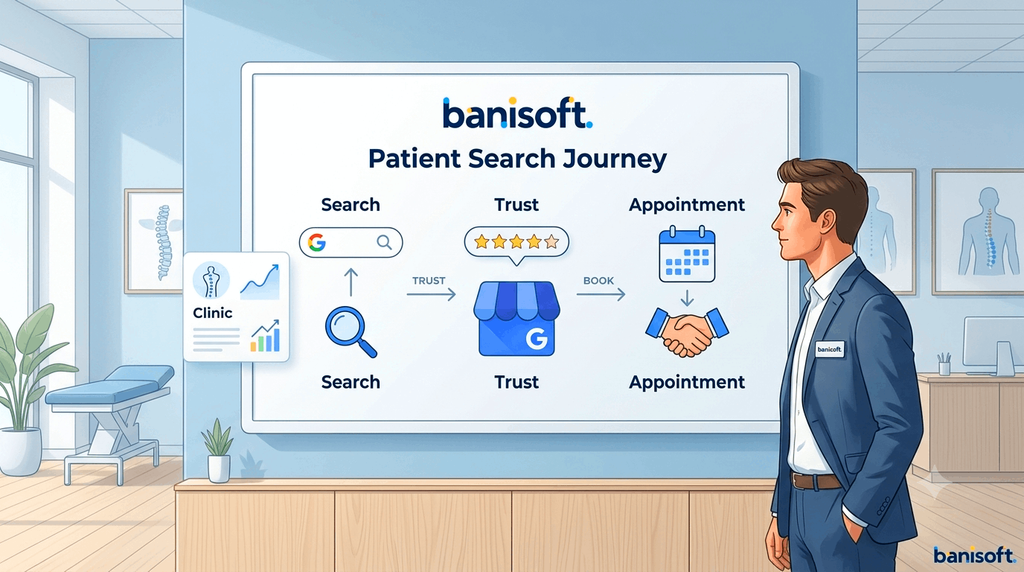
Each page needs a clear purpose.
That is the foundation of how to do SEO for chiropractors without creating a bloated website full of overlapping content.
1. Build Strong Pages for the Services Patients Are Actually Looking For
If your website has one page listing every service in a few sentences, search engines and prospective patients have very little information to work with.
Important services often deserve their own useful pages.
Depending on the practice, those might include pages about services such as chiropractic adjustments, sports-related care, prenatal chiropractic care or other treatments genuinely provided by the clinic.
A good service page should answer the questions someone considers before making contact:
What is this service? Who may consider it? What happens during an appointment? What can a patient expect? Who provides it? Where is the clinic? What should someone do next?
The exact page structure should depend on the service rather than following the same template every time.
This is also where healthcare content requires additional care. Avoid promising outcomes that cannot be guaranteed. Explain treatments accurately, have clinical information reviewed by someone appropriately qualified when possible, and keep medical claims grounded in credible evidence.
The objective is not to make the page sound impressive.
It is to make the decision easier for the prospective patient.
2. Make Your Google Business Profile Part of Your SEO Strategy
For a local chiropractic practice, website SEO and Google Maps visibility should not be treated as separate projects.
Google states that local results are mainly determined by relevance, distance and prominence. Complete business information can help Google understand how relevant a practice is to a particular search, while reviews, links and other signals can contribute to prominence.
Your Business Profile should therefore accurately reflect the real practice.
Check areas such as:
- correct practice name;
- primary and secondary categories;
- address;
- telephone number;
- opening hours;
- appointment or website links;
- services;
- photos;
- business description.
Do not rename a clinic from something like “Smith Chiropractic” to “Smith Chiropractic – Best Back Pain Chiropractor Toronto” simply because the longer version contains keywords.
Google requires the Business Profile name to reflect the name used by the business in the real world and says unnecessary information in the name is not permitted.
Local SEO shortcuts can create more problems than they solve.
3. Earn Reviews Without Turning Review Collection Into a Ranking Trick
Reviews serve two purposes.
They can contribute to local visibility, but more importantly, they help prospective patients decide whether they feel comfortable contacting a practice.
A clinic with a strong review profile also gives someone real-world context that your own marketing copy cannot provide.
Make requesting reviews part of the patient experience, but keep the process genuine.
Google allows businesses to remind customers to review them and provides review links and QR codes for that purpose. However, offering discounts, free services or other incentives in exchange for reviews is prohibited as fake engagement.
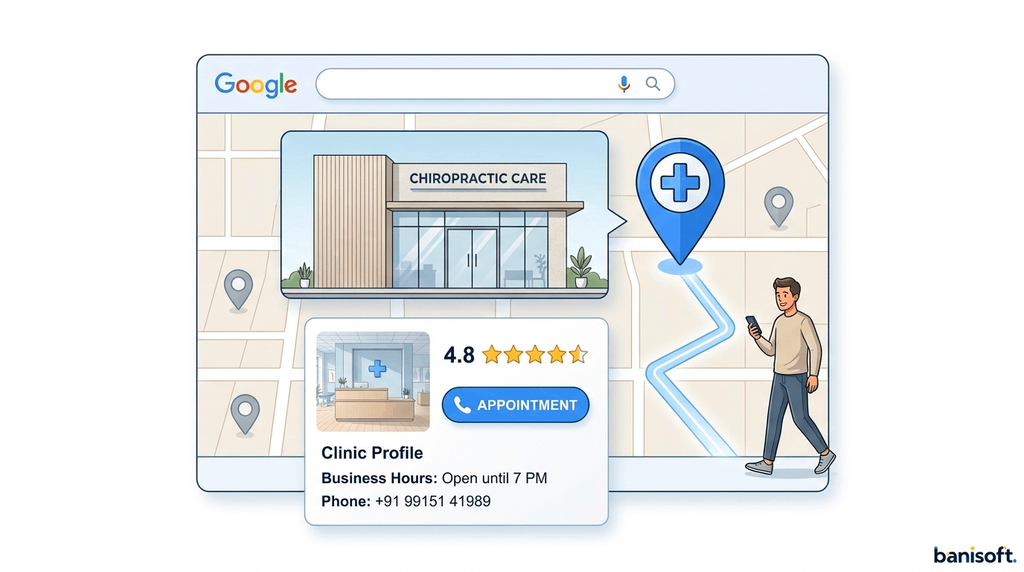
Also respond to reviews thoughtfully.
For healthcare businesses, responses should be written with privacy in mind. Avoid revealing information about a person’s care merely because they mentioned it publicly themselves.
The goal is not just to accumulate stars.
It is to build a credible digital reputation around the practice.
4. Create Content Around Questions That Can Lead Somewhere
Blogging can support chiropractic SEO, but publishing four random articles every month is not a strategy.
Start with the questions prospective patients ask before they choose care.
For example, a clinic may discover demand around subjects such as:
Why does my back hurt after sitting all day?
When should I consider seeing a chiropractor?
Can poor desk posture contribute to neck discomfort?
Chiropractor or physiotherapist: what is the difference?
What should I expect at my first chiropractic appointment?
These searches may not produce an immediate appointment every time. They introduce your practice while someone is researching a problem.
The important part is creating a logical next step.
An article about work-related neck discomfort might naturally reference a relevant service page. A first-appointment guide could lead to practitioner information or an appointment page.
This is how content becomes part of patient acquisition instead of an isolated traffic exercise.
5. Avoid Building Hundreds of Thin City Pages
Location SEO can be effective, especially for clinics serving densely populated metropolitan areas.
But that does not mean creating:
“Chiropractor in City A”
“Chiropractor in City B”
“Chiropractor in City C”
and changing little more than the city name.
Google specifically identifies substantially similar regional or city pages that funnel visitors toward the same destination as a potential form of doorway abuse. It also warns against producing large amounts of unoriginal content primarily to manipulate rankings.
If your practice genuinely operates multiple locations, each location can have a useful page containing real information specific to that clinic.
That could include:
- address and directions;
- local team members;
- services available at that location;
- opening hours;
- parking or transport details;
- photographs;
- location-specific FAQs;
- appointment information.
If there is nothing meaningfully different to say about a location, publishing another nearly identical page may not help the user.
6. Strengthen the Trust Signals Around Your Practice
Chiropractic websites operate in a health-related space, so prospective patients often need more reassurance than someone looking for a coffee shop or clothing store.
Your site should make it easy to understand who is behind the information.
Useful trust elements can include practitioner biographies, relevant qualifications, professional memberships where appropriate, clear clinic contact information, content authorship and dates showing when important health information was reviewed.
Do not turn a practitioner biography into another keyword page.
Tell people what they genuinely want to know about the person they may be trusting with their care.
Similarly, educational articles benefit from clearly identifying who wrote or reviewed the content.
The more significant the health claim, the more important accuracy and appropriate sourcing become.
7. Fix the Technical Problems That Quietly Hold Good Content Back
You can have an excellent clinic and useful content and still struggle if search engines cannot efficiently crawl or understand the website.
Technical SEO does not need to become a monthly obsession with hundreds of automated warnings.
Focus first on issues that affect important pages.
Check whether:
- priority pages can be indexed;
- old URLs redirect correctly;
- important content is internally linked;
- duplicate versions of pages exist;
- the website works properly on mobile devices;
- pages load reasonably quickly;
- title tags and headings describe the page accurately;
- sitemap and canonical signals are sensible;
- structured data is valid where appropriate.
The key word is priority.
A broken appointment page deserves more attention than a minor warning on an old blog nobody visits.
8. Turn SEO Traffic Into Appointments
This is where many chiropractic SEO campaigns lose sight of the business objective.
Suppose a service page moves from position 14 to position 4.
That looks good in an SEO report.
But what happens after someone lands on the page?
Can they quickly see where the clinic is located?
Can they find the phone number?
Is there an obvious appointment option?
Do they understand what the clinic provides?
Can they see who will treat them?
Does the page work well on a phone?
Is the booking form asking for far more information than necessary?
Ranking improvements create opportunity. The website still has to turn that opportunity into action.
If you want to know how to get more chiropractic patients, measure more than rankings.
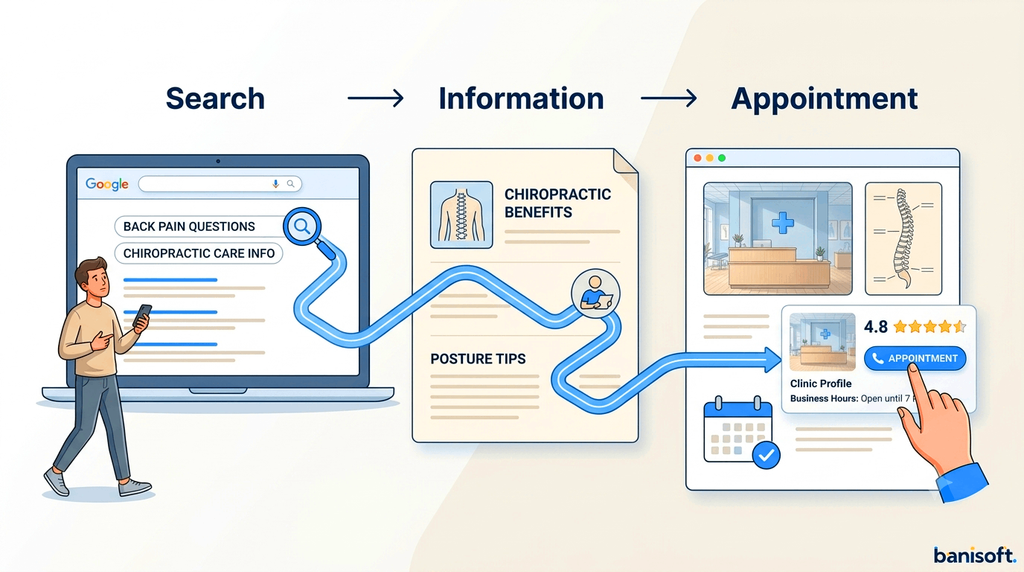
Track qualified organic traffic, phone calls, appointment forms, booking clicks, Google Business Profile activity and, where your systems allow it, which enquiries actually become patients.
9. Measure SEO by Patient-Acquisition Value, Not Traffic Alone
Not all organic traffic has equal business value.
A blog could attract thousands of visitors from around the world without generating a single appointment for a clinic in Calgary, Manchester, Brisbane or Dallas.
Meanwhile, a service page receiving only a few hundred highly relevant local visits could generate regular enquiries.
That is why the question should not be:
“Did our SEO traffic increase?”
It should be:
“Which search activity is helping the practice attract potential patients?”
Useful metrics may include:
| Metric | What It Tells You |
| Non-brand local visibility | Whether new people can discover the clinic |
| Service-page traffic | Demand reaching commercially important pages |
| Google Business Profile actions | Interaction with local listings |
| Calls and forms | Whether visibility produces enquiries |
| Booking conversion rate | How effectively pages turn interest into action |
| Leads by landing page | Which SEO assets contribute to acquisition |
| New-patient value | Whether organic acquisition makes commercial sense |
This approach makes SEO much easier to prioritize.
You can invest more in the pages and topics that contribute to the practice instead of chasing every keyword with search volume.
How to Grow a Chiropractic Business With SEO
If you are trying to understand how to grow your chiropractic practice, avoid treating SEO as a collection of disconnected tasks.
Build the system in order.
First, make sure your core website and local profile accurately explain who you are, what you provide and where you operate.
Next, create strong pages for services and locations that deserve their own search presence.
Then expand into educational content that answers the questions prospective patients ask before booking.
Strengthen those assets with genuine reviews, useful internal links, practitioner expertise and credible references.
Finally, track what produces calls and appointments.
That feedback should determine what you improve next.
A practice does not need to rank for every chiropractic-related search.
It needs enough visibility for the right searches in the right geographic market, supported by a website that gives prospective patients a reason to choose the clinic.
SEO Should Support the Practice, Not Become Another Marketing Checklist
Learning how to build a successful chiropractic practice involves much more than SEO. Patient care, retention, reputation, referrals, operations and the experience people have with your team all matter.
SEO has a specific role within that bigger picture.
It helps people who are already searching for information, solutions or local chiropractic care discover your practice.
The strongest strategy connects that visibility to what happens next.
If your clinic appears in search but patients do not trust the website, visibility is wasted.
If your website is excellent but nobody can find it, the opportunity is limited.
And if traffic keeps increasing while appointments stay flat, the strategy needs to be examined beyond rankings.
For practices that want help connecting technical SEO, local visibility, content and conversion opportunities, Banisoft’s SEO services focus on qualified visibility and measurable business outcomes rather than treating rankings as the end goal. Banisoft’s current SEO offering includes local SEO, Google Business Profile optimization, technical SEO, content strategy, internal linking and AI/GEO search visibility work.
4. FREQUENTLY ASKED QUESTIONS
What is chiropractor marketing?
Chiropractor marketing is the combination of strategies used to make a chiropractic practice more visible, trusted and accessible to prospective patients. It can include SEO, Google Business Profile optimization, reviews, paid advertising, social media, referrals, content marketing, email and conversion-focused website improvements.
How long does SEO take for a chiropractic practice?
There is no fixed SEO timeline. Results depend on the practice’s existing website, competition, market size, location, authority, technical condition and the searches being targeted. Technical or local improvements may show movement earlier, while competitive service and location searches usually require consistent work over a longer period.
Can SEO help a chiropractor get new patients?
SEO can help a practice become visible when people search for chiropractic services, local providers or information related to problems the clinic addresses. Whether that visibility becomes new patients depends on search intent, local competition, reputation, the quality of the website and how easy it is to contact or book the clinic.
Does a chiropractor need a blog for SEO?
Not every chiropractic practice needs to publish frequently, but useful educational content can help reach searches that service pages cannot naturally answer. The priority should be producing genuinely useful articles tied to patient questions and relevant services rather than publishing content simply to maintain a blogging schedule.
Is Google Business Profile important for chiropractors?
Yes, especially for practices relying on local patients. Google Business Profile can help a chiropractic clinic appear across Google Search and Maps. Google says local results are primarily influenced by relevance, distance and prominence, so accurate profile information and a strong overall local presence are important.
Should chiropractors create a separate page for every city nearby?
Only when the page serves a genuine user need and contains meaningful location-specific information. Publishing large numbers of substantially similar city pages purely to capture location keywords can create poor user experiences and may fall within Google’s guidance on doorway or scaled content abuse.