 Summarize in ChatGPT
Table of Contents
- Why Dental Website Traffic Isn’t Turning Into Patients
- Why Does Dental Website Traffic Not Always Turn Into Bookings?
- Is Your Dental Website Attracting the Right Type of Traffic?
- Are Your Dental Service Pages Built to Convert Patients?
- Is Your Website Creating Enough Trust Before Asking for the Booking?
- Is Your Google Business Profile Helping or Hurting Conversions?
- Are Your Calls-to-Action Too Weak or Too Hidden?
- Is Your Website Fast, Mobile-Friendly, and Easy to Use?
- Are Your Google Ads Sending Patients to the Right Page?
- Are You Tracking the Right Dental Marketing Metrics?
- Practical Framework: How to Turn Dental Website Traffic Into More Patient Bookings
- What Dental Clinics Often Get Wrong
- Dental Website Conversion Checklist
- Conclusion: Dental Website Traffic Only Matters When It Leads to Patient Action
- FAQ
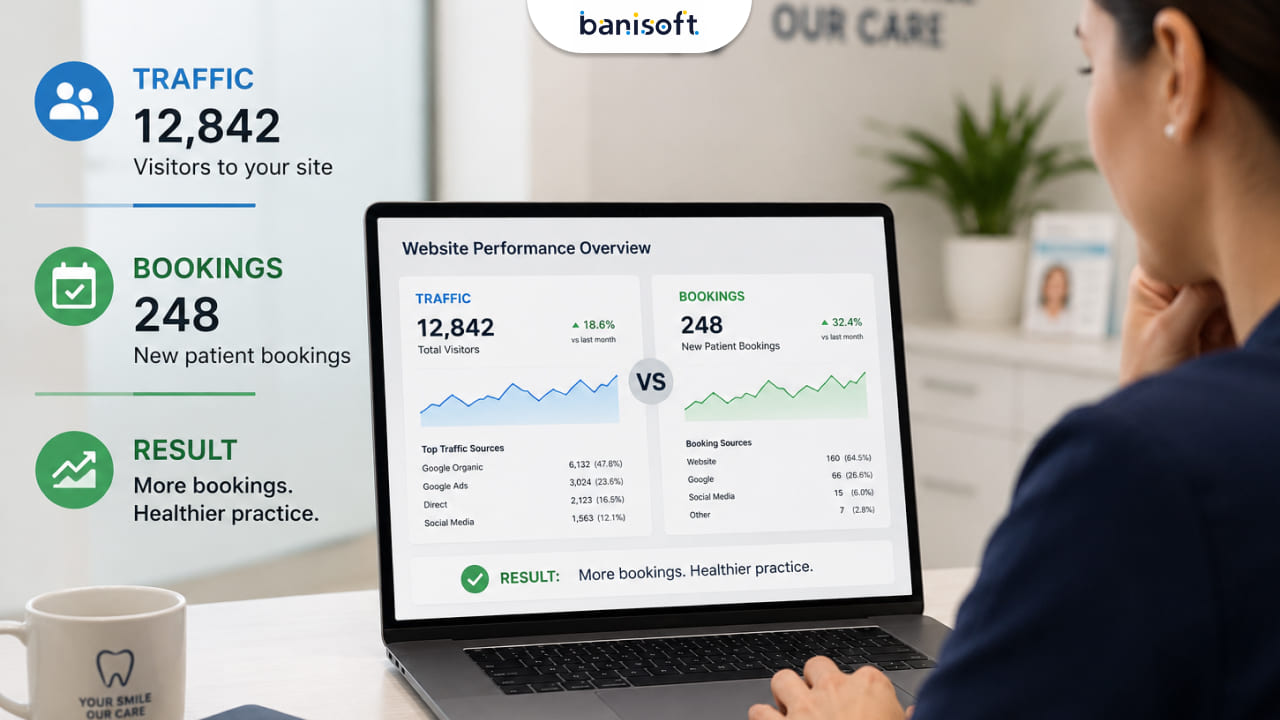
Many dental clinics look at their website reports and see a positive sign: traffic is increasing. But when they check the real business outcome — calls, appointment requests, treatment enquiries, and new patient bookings — the numbers do not match the traffic.
The reason is simple: dental website traffic does not automatically create patient bookings. A clinic can attract visitors from Google, Google Maps, blog content, or paid ads, but still lose them because of weak messaging, unclear treatment pages, poor local trust signals, slow enquiry paths, weak calls-to-action, or incorrect tracking.
This matters because dental marketing is not just about getting more visitors. It is about turning the right visitors into booked appointments.
Who this blog is for: Dental clinic owners, dentists, practice managers, and decision-makers who want more predictable patient growth.
How this advice was developed: Based on hands-on dental marketing experience across SEO, Google Business Profile, Google Ads, landing pages, tracking, and lead generation.
Why it matters: Because traffic without bookings creates the illusion of marketing progress while revenue stays flat.
Why Does Dental Website Traffic Not Always Turn Into Bookings?
Short answer: Dental traffic fails to convert when the website attracts the wrong search intent, does not build enough trust, makes booking difficult, or fails to connect the patient’s problem with the right dental service.
In dental marketing, not every visitor has the same value. Someone searching “what causes bleeding gums” may be in research mode. Someone searching “emergency dentist near me open now” has much stronger booking intent. If both visitors land on similar pages with generic content, the clinic may get traffic but not enough conversions.
A dental website needs to answer three questions quickly:
- Can this clinic solve my problem?
- Can I trust this clinic with my teeth, smile, pain, or family?
- How easy is it to book, call, or request help now?
If the answer is unclear, the patient may leave and choose another clinic.
Is Your Dental Website Attracting the Right Type of Traffic?
Short answer: More traffic is not always better. Dental clinics need high-intent local traffic from people who are actively looking for dental treatment, not just general information.
One of the most common mistakes in dental SEO is celebrating traffic growth without checking what type of traffic is growing.
For example, a blog titled “10 Foods That Are Good for Your Teeth” may bring visitors, but many of them may not be ready to book an appointment. On the other hand, a page targeting “root canal dentist in [city]” or “Invisalign dentist near me” may bring fewer visitors but produce better appointment enquiries.
| Traffic Type | Example Search | Patient Intent | Booking Potential |
| Informational | “why do gums bleed when brushing” | Researching symptoms | Medium |
| Local service | “dentist near me accepting new patients” | Looking for a clinic | High |
| Urgent care | “emergency dentist open today” | Needs immediate help | Very High |
| Treatment-specific | “Invisalign dentist in [city]” | Comparing providers | High |
| General education | “how to whiten teeth naturally” | Learning only | Low to Medium |
| Price comparison | “dental implant cost near me” | Evaluating options | Medium to High |
💡Expert Tip: Review your top landing pages in GA4 or Google Search Console. If most traffic comes from broad educational blogs but your service pages are weak, your website may look successful in reports while still underperforming in patient acquisition.
Are Your Dental Service Pages Built to Convert Patients?
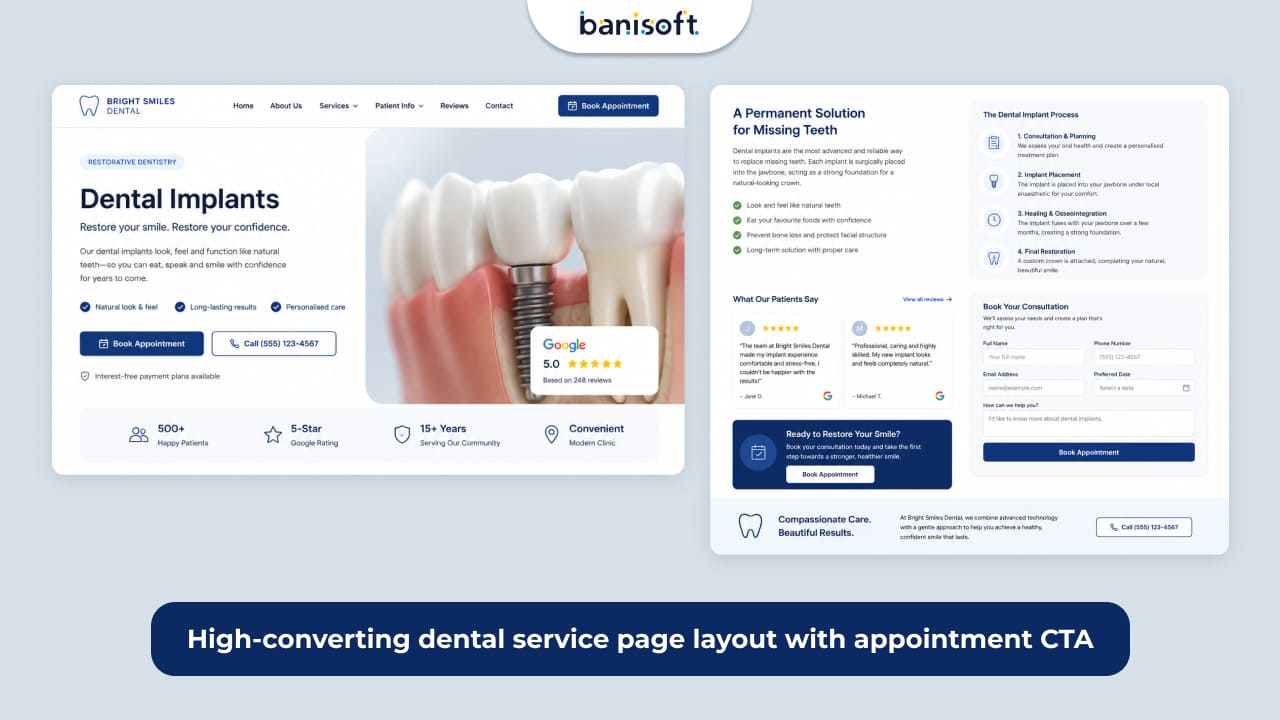
Short answer: Dental service pages should not only explain treatments. They should help patients understand symptoms, options, trust factors, pricing guidance, location convenience, and how to book.
Many dental websites have service pages that are too thin or too generic. A page may say “We offer dental implants, Invisalign, teeth whitening, root canal, and emergency dentistry,” but that does not give a patient enough confidence to take action.
A strong dental service page should include:
- What the treatment is
- Who it is for
- Common symptoms or situations
- Benefits and limitations
- What happens during the appointment
- Dentist or team expertise
- Patient safety and comfort information
- Location and parking details where relevant
- Reviews related to that treatment
- Clear booking options
- FAQs
- Internal links to related services
Example
A weak emergency dental page says:
“We provide emergency dental care. Call us today.”
A stronger page says:
“If you have severe tooth pain, swelling, a broken tooth, knocked-out tooth, bleeding, or pain after dental work, our dental team can assess the issue and recommend the next step. Call the clinic to check same-day appointment availability.”
The second version is more useful because it matches the patient’s real situation.
Is Your Website Creating Enough Trust Before Asking for the Booking?
Short answer: Dental patients often need reassurance before booking. Trust signals such as dentist profiles, real clinic photos, treatment explanations, reviews, credentials, and clear policies can improve conversion quality.
Dental decisions are personal. Patients are not just buying a service; they are choosing who will work on their teeth, manage their pain, improve their smile, or treat their family.
A dental website should reduce uncertainty.
Important trust signals include:
- Dentist and hygienist profiles
- Real clinic photos instead of only stock images
- Google reviews and service-specific testimonials
- Before-and-after galleries, where legally and ethically allowed
- Clear treatment explanations
- Payment or insurance guidance
- Emergency care availability
- Sterilization and safety information
- Transparent contact details
- Location, parking, and accessibility information
💡 Expert Tip: Do not place all reviews only on the homepage. If a patient is reading an Invisalign page, show Invisalign-related reviews where possible. If they are reading an emergency dental page, show reviews about urgent care, pain relief, or same-day support.
Is Your Google Business Profile Helping or Hurting Conversions?
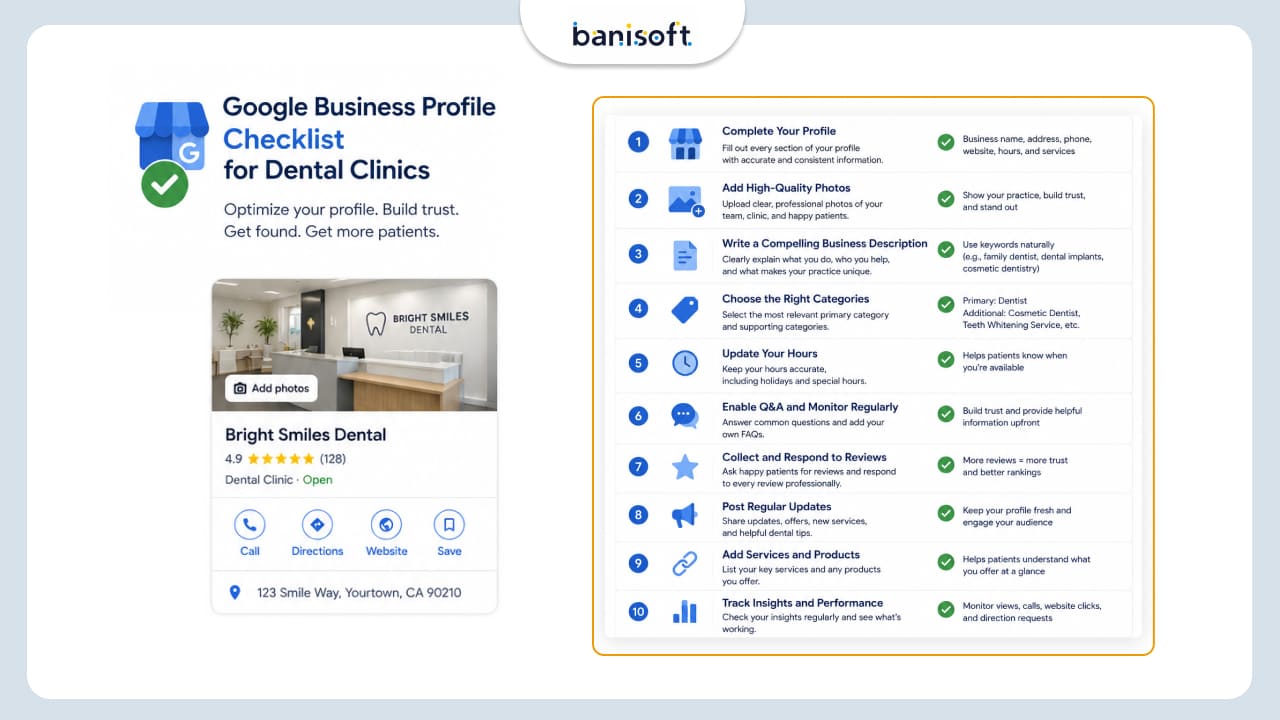
Short answer: Your Google Business Profile can influence calls, direction requests, reviews, local trust, and patient decisions before visitors even reach your website.
For local dental searches, Google Business Profile is often part of the patient’s decision journey. Google’s local ranking guidance explains that local results are influenced by relevance, distance, and prominence, and that complete, accurate business information helps people understand what a business offers.
For dental clinics, this means your website and GBP should work together.
Your Google Business Profile should have:
- Correct clinic name, address, phone number, and hours
- Accurate dental categories
- Services listed properly
- Appointment URL
- High-quality clinic photos
- Regular posts or updates
- Review responses
- Q&A section where relevant
- UTM tracking on website links
- Consistent information across the website and directories
Common GBP Conversion Problem
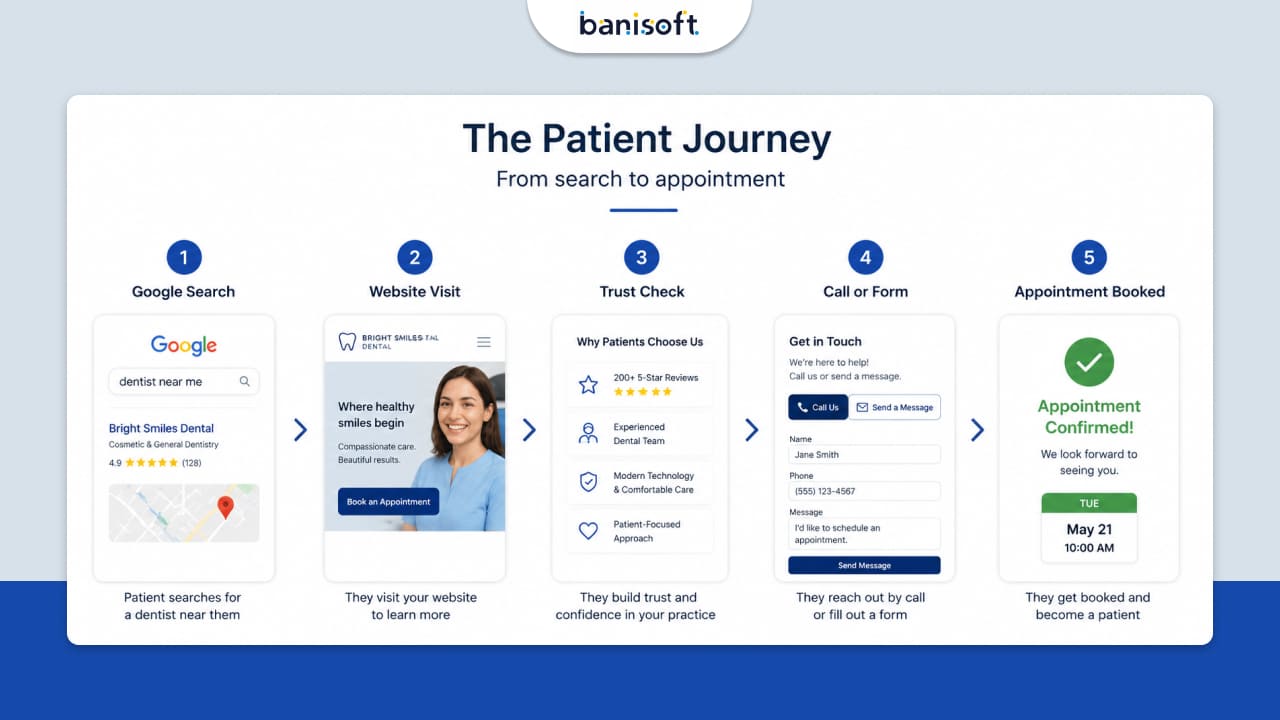
A patient finds your clinic on Google Maps, clicks to your website, lands on a generic homepage, cannot immediately find the treatment they searched for, and leaves.
A better journey would send the patient from the GBP listing or local search result to a relevant service or location page with a clear booking path.
Are Your Calls-to-Action Too Weak or Too Hidden?
Short answer: Patients should not have to search for how to book. Every important page should make the next step clear: call, book online, request an appointment, or ask a question.
Many dental websites lose bookings because the CTA is either hidden, vague, or not aligned with patient urgency.
Weak CTAs include:
- “Learn More”
- “Submit”
- “Contact Us”
- “Read More”
Stronger dental CTAs include:
- “Request an Appointment”
- “Call the Clinic”
- “Book a Dental Consultation”
- “Check Emergency Appointment Availability”
- “Ask About Invisalign Options”
- “Schedule a New Patient Visit”
CTA Placement Matters
Place CTAs:
- Above the fold
- After the first service explanation
- Beside treatment benefits
- Near reviews
- After FAQs
- In sticky mobile headers
- At the end of the page
💡Expert Tip: On mobile, the phone number should be clickable. Many dental patients search while in pain, at work, or between tasks. A slow or confusing mobile booking path can cost real appointments.
Is Your Website Fast, Mobile-Friendly, and Easy to Use?
Short answer: A slow or confusing dental website can reduce bookings even if SEO traffic is strong.
Dental patients often visit from mobile devices. If the page loads slowly, has intrusive pop-ups, confusing menus, broken forms, or unreadable text, visitors may leave before they understand your services.
Important website experience factors include:
- Fast page speed
- Mobile-friendly design
- Clear navigation
- Clickable phone numbers
- Simple appointment forms
- Visible clinic address
- Easy service page access
- No broken buttons
- No confusing pop-ups
- Clear privacy and patient information handling
Google’s Search Central guidance encourages helpful, reliable, people-first content and explains that SEO should support useful content rather than replace it. For dental clinics, that means the website should be designed for real patient decisions, not just rankings.
Are Your Google Ads Sending Patients to the Right Page?
Short answer: Dental Google Ads often underperform when clicks are sent to generic pages instead of treatment-specific, conversion-focused landing pages.
If someone clicks an ad for “dental implants consultation,” they should not land on a generic homepage. They should land on a page that speaks directly to dental implants, explains the process, builds trust, and provides a clear appointment path.
Good dental ad landing pages include:
- Clear headline matching the search intent
- Location and clinic trust signals
- Treatment overview
- Benefits and candidate information
- Dentist or clinic credibility
- Reviews or patient experience signals
- Strong CTA
- Simple form
- Click-to-call button
- Tracking for calls and forms
Google Ads for healthcare-related services can involve policy considerations depending on the country, treatment, claims, and service category, so dental clinics should verify ad copy, landing page claims, and tracking practices before publishing campaigns. Google maintains healthcare and medicines advertising policy guidance for advertisers.
Are You Tracking the Right Dental Marketing Metrics?
Short answer: Traffic is only one metric. Dental clinics should track calls, forms, booking requests, treatment enquiries, source quality, and actual patient outcomes where possible.
A clinic may think the website is not working, but the real issue may be incomplete tracking. Another clinic may think marketing is working because traffic is increasing, but no one is measuring booked appointments.
Track these key metrics:
- Organic traffic by landing page
- Google Business Profile clicks and calls
- Phone calls from website
- Form submissions
- Online booking clicks
- Treatment-specific enquiries
- New patient enquiries
- Missed calls
- Call answer rate
- Lead-to-booking rate
- Booking-to-show-up rate
- Revenue by service line, where available
Simple Definition: Conversion Rate
A conversion rate is the percentage of website visitors who take a desired action, such as calling the clinic, submitting a form, clicking to book, or requesting an appointment.
For dental clinics, conversion rate should not be measured only by form submissions. Phone calls, booking clicks, and GBP interactions matter too.
Practical Framework: How to Turn Dental Website Traffic Into More Patient Bookings
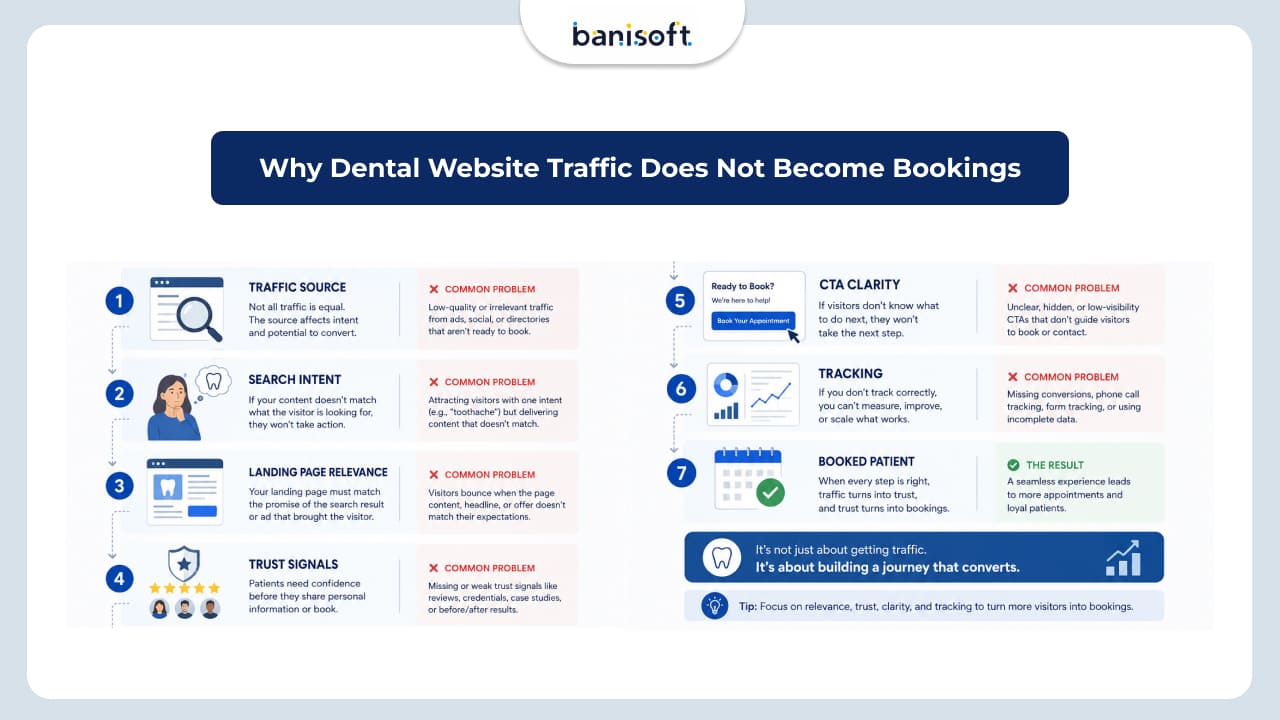
Short answer: Dental clinics need a connected system: attract the right searches, send visitors to the right pages, build trust, make booking easy, track every lead source, and improve based on data.
Step 1: Separate Traffic by Intent
Look at your top pages and keywords. Group them into:
- Informational searches
- Local service searches
- Emergency searches
- Treatment-specific searches
- Brand searches
- Price or comparison searches
This helps you understand whether your traffic is likely to convert.
Step 2: Audit Your Highest-Value Service Pages
Review pages such as:
- Emergency dentist
- Dental implants
- Invisalign
- Teeth whitening
- Root canal
- New patient dental exam
- Family dentistry
- Pediatric dentistry
- Cosmetic dentistry
Check whether each page answers patient questions and has a clear booking path.
Step 3: Align Google Business Profile With Your Website
Make sure your GBP categories, services, photos, posts, reviews, and appointment links support your website’s service pages.
Step 4: Improve Trust Signals
Add real clinic photos, provider bios, treatment-specific reviews, patient comfort details, and transparent appointment information.
Step 5: Fix Booking Friction
Make it easy to call, book, or request an appointment from every key page. Test mobile forms and click-to-call buttons.
Step 6: Set Up Proper Tracking
Use GA4, Google Search Console, GBP insights, call tracking, form tracking, Google Ads conversion tracking, and CRM notes where available.
Step 7: Review Lead Quality, Not Just Lead Volume
A clinic does not need more random enquiries. It needs more relevant appointment requests from patients who match the clinic’s services, location, and capacity.
What Dental Clinics Often Get Wrong
Short answer: Most dental clinics do not fail because they have no traffic. They fail because traffic, trust, messaging, booking, and tracking are not connected.
Mistake 1: Sending Every Visitor to the Homepage
The homepage is useful, but it should not do the job of every service page. High-intent searches need relevant landing pages.
Mistake 2: Writing Generic Dental Content
Patients do not want vague claims like “quality dental care.” They want clear answers about their pain, treatment options, cost factors, appointment availability, and trust.
Mistake 3: Ignoring Google Business Profile
A weak GBP can reduce calls before the patient even reaches your website.
Mistake 4: Not Tracking Phone Calls
Many dental leads happen by phone. If calls are not tracked, marketing performance will look incomplete.
Mistake 5: Using One CTA for Every Service
Emergency dentistry, Invisalign, dental implants, and routine cleaning require different levels of urgency and messaging.
Mistake 6: Measuring Rankings Instead of Revenue Signals
Rankings are useful, but they are not the final goal. The goal is patient acquisition, booked appointments, and profitable treatment growth.
Dental Website Conversion Checklist
Use this checklist to review your clinic website.
Traffic Quality
- Do we know which pages bring the most traffic?
- Do we know which keywords bring appointment-ready visitors?
- Are our service pages ranking, or only blog posts?
- Are we attracting local patients near the clinic?
Service Page Quality
- Does each treatment page answer patient questions?
- Does each page explain who the treatment is for?
- Do we show dentist or clinic expertise?
- Do we include FAQs?
- Do we use clear, patient-friendly language?
Trust Signals
- Do we show real clinic photos?
- Do we include dentist profiles?
- Do we display relevant reviews?
- Do we mention safety, comfort, and patient care?
- Do we avoid exaggerated claims?
Booking Journey
- Is the phone number visible and clickable?
- Is there a clear appointment CTA?
- Is the form short and easy to complete?
- Does the mobile experience work smoothly?
- Are urgent-care pages designed for fast action?
Tracking
- Are form submissions tracked?
- Are phone calls tracked?
- Are Google Ads conversions tracked?
- Are GBP clicks tracked with UTM links?
- Do we review lead quality, not just traffic?
Conclusion: Dental Website Traffic Only Matters When It Leads to Patient Action
Dental website traffic is valuable only when it helps the right patients find the right service, trust the clinic, and take the next step toward booking.
If your clinic is getting traffic but not enough patient bookings, the problem may not be SEO alone. It may be a conversion issue, a trust issue, a Google Business Profile issue, a landing page issue, a tracking issue, or a mismatch between search intent and page content.
The best dental marketing systems connect visibility with patient action. They do not stop at rankings, clicks, or reports. They help clinics understand where patients come from, what they need, what stops them from booking, and how to improve the journey.
Frequently asked questions
Why is my dental website getting traffic but no bookings?
Your dental website may be attracting visitors who are still researching, not ready to book, or looking for services you do not clearly promote. Another common issue is weak conversion design: unclear CTAs, poor mobile experience, lack of trust signals, slow forms, or no click-to-call option. Traffic needs to be matched with intent, trust, and a simple booking path.
What is a good conversion rate for a dental website?
There is no universal conversion rate because it depends on your location, services, traffic source, offer, website quality, and tracking setup. A clinic running emergency dental ads may convert differently from a clinic ranking for educational blogs. Instead of chasing one benchmark, track calls, form submissions, booking clicks, and actual appointment outcomes by source.
Should dental clinics focus on SEO or Google Ads for bookings?
Both can work, but they serve different roles. SEO helps build long-term visibility for local and treatment-related searches. Google Ads can generate faster visibility for high-intent services like emergency dentistry, implants, Invisalign, or new patient exams. The best approach depends on your market, budget, competition, and how quickly you need appointment volume.
How can Google Business Profile improve dental bookings?
Google Business Profile can influence calls, direction requests, reviews, and local trust before a patient visits your website. A complete profile with accurate services, photos, reviews, appointment links, and correct hours can make your clinic easier to choose. It should work together with your website service pages and local SEO strategy.
Why are patients visiting my dental website but not calling?
Patients may not call if they cannot quickly understand your services, location, availability, dentist expertise, pricing guidance, or next step. They may also hesitate if the website lacks reviews, real photos, or clear treatment information. On mobile, hidden phone numbers, slow pages, and long forms can also reduce calls.
Do dental blogs help generate patient bookings?
Dental blogs can help, but only when they support a broader patient acquisition strategy. Educational blogs often attract early-stage visitors. To turn that traffic into bookings, blogs should link to relevant service pages, answer treatment questions, include local context, and guide readers toward a consultation or appointment request when appropriate.
What should a dental clinic track besides website traffic?
Dental clinics should track phone calls, form submissions, booking clicks, Google Business Profile actions, treatment-specific enquiries, missed calls, lead source, booked appointments, and lead quality. Traffic alone does not show whether marketing is producing patients. Better tracking helps identify which channels and pages actually support patient growth.
How often should a dental website be reviewed for conversions?
A dental website should be reviewed at least quarterly, especially if the clinic depends on SEO, Google Ads, or Google Business Profile for new patients. High-value pages such as emergency dentistry, implants, Invisalign, and new patient exams should be checked more often because small improvements can affect calls and appointment requests.