 Summarize in ChatGPT
Table of Contents
- What Is SEO for a Cleaning Business?
- Why Cleaning Companies Rank Differently From Other Businesses
- Step 1: Set Up Your Google Business Profile as a Service Area Business
- Step 2: Build One Page Per Service, Not One “Services” Page
- Step 3: Add Service-Area Pages That Actually Earn Their Place
- Step 4: Target the Keywords That Book Jobs
- Step 5: Run a Review Engine, Not a Review Request
- Step 6: Answer the Questions People Ask Before They Book
- Step 7: Earn Local Links You Can Realistically Get
- Step 8: Make Your Site Fast, Mobile and Bookable in Three Taps
- How to Show Up When Customers Ask AI Instead of Google
- How Long Does SEO Take for a Cleaning Business?
- What to Measure (and What to Ignore)
- Five Mistakes That Keep Cleaning Companies Invisible
- Frequently Asked Questions
- Where to Start This Week
Key Takeaways
- Your Google Business Profile does more for a cleaning company than your website does. Google Business Profile signals carry roughly 32% of local pack ranking weight – the single largest controllable factor.
- One page per service beats one “Services” page. Deep cleaning, move-out, office and post-construction each need their own page targeting their own keyword.
- Reviews are now a ranking factor and a conversion factor at the same time. In 2026, 31% of consumers will only use a business rated 4.5 stars or above – up from 17% a year earlier.
- AI search is no longer optional. 45% of consumers now use AI tools to find local businesses, up from 6% in 2025.
- Expect movement in 8–12 weeks and meaningful lead volume in 5–7 months. Anyone promising faster is selling you something.
Most cleaning companies do not lose jobs because they are bad at cleaning. They lose them because a homeowner searched “house cleaning near me” at 9 pm on a Sunday and three other companies appeared first.
That search is not idle browsing. Someone typing “move out cleaning near me” has a lease deadline. Someone searching “post construction cleaning” has a handover date. These are people ready to book within days, sometimes hours – and the businesses that show up capture them.
This guide is the practical version: eight steps, in the order you should actually do them, written specifically for residential and commercial cleaning companies. No generic SEO theory.
What Is SEO for a Cleaning Business?
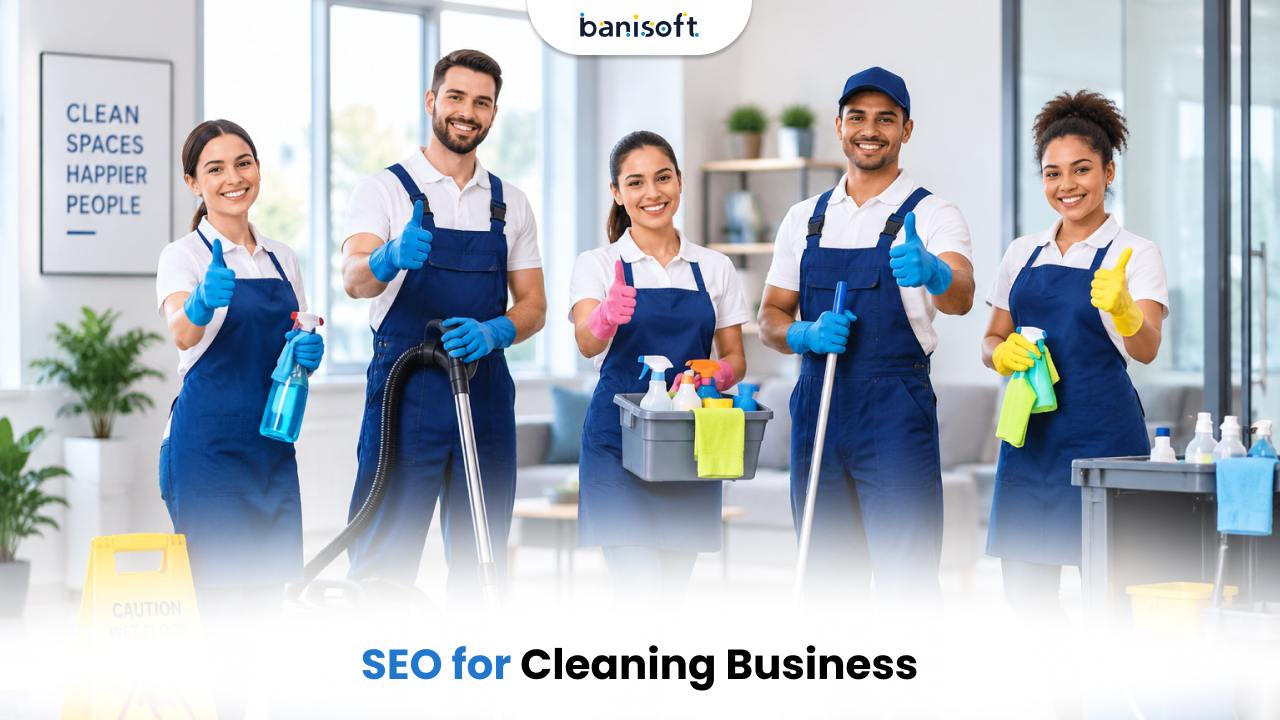
SEO for a cleaning business is the process of making your company the result Google shows when someone nearby searches for cleaning services. It combines Google Business Profile optimisation, service-specific landing pages, local reviews and technical site health to turn “near me” searches into booked jobs.
The distinction that matters: for a cleaning company, SEO is roughly 70% local search and 30% website search. A national brand fights for blue links. You are fighting for the three map results Google shows above them – and increasingly, for a mention when someone asks an AI assistant who to hire.
Why Cleaning Companies Rank Differently From Other Businesses
Four things make cleaning SEO its own discipline, and getting them wrong costs you months.
- You go to the customer, so you are a Service Area Business. Google’s own documentation uses cleaning services as its example of a service-area business – one that visits customers directly but doesn’t serve them at its business address (Google Business Profile Help). Configure this wrong and you either publish your home address or risk a suspension.
- Trust is the entire sale. You are asking a stranger to let you into their home while they are at work. Insurance, bonding, background checks and reviews are not marketing fluff here – they are the deciding factors.
- One customer is worth years, not one job. A fortnightly recurring client is a multi-year revenue stream. That changes what you can afford to spend acquiring one, and which keywords are worth chasing.
- Demand is seasonal and event-driven. Spring cleaning, end-of-tenancy in moving season, pre-holiday deep cleans, post-renovation handovers. Your content should lead each cycle by six to eight weeks.
Step 1: Set Up Your Google Business Profile as a Service Area Business
Your Google Business Profile is the highest-return asset in cleaning SEO. For most cleaning companies it generates more enquiries than the website – and it is free.
This is not opinion. Whitespark’s 2026 Local Search Ranking Factors report, a survey of 47 leading local SEO experts assessing 187 individual factors, puts Google Business Profile signals at roughly 32% of local pack ranking weight – more than reviews, on-page SEO or links.
Start here, before you touch anything else.
Get the service-area setup right
- Hide your address. If customers do not visit you, clear the street address field and define service areas instead. Google is explicit that service-area businesses should remove their address from the profile (Google guidelines).
- Define a realistic radius. List the suburbs, towns or postcodes you genuinely serve. Listing an entire state does not increase reach – it dilutes relevance for the areas that matter. Proximity is still calculated from your real base, not from the areas you list.
- Match your details exactly. Business name, phone number, hours and website must be identical on your profile and your site.
- Never keyword-stuff the name. “Sparkle Cleaning Services Chicago Best House Cleaning” is a suspension risk. Use your real trading name.
Choose the right categories
Category selection is one of the strongest local ranking levers available, and most cleaning companies pick one and stop.
|
Your business type |
Primary category |
Add as secondary |
|
Residential cleaning |
House Cleaning Service |
Carpet Cleaning Service, Window Cleaning Service |
|
Office / contract cleaning |
Commercial Cleaning Service |
Janitorial Service, Office Cleaning Service |
|
Move-out / end of tenancy |
House Cleaning Service |
Commercial Cleaning Service, Carpet Cleaning Service |
|
Post-construction |
Commercial Cleaning Service |
Construction Cleanup, Janitorial Service |
|
Specialist (carpet, window, pressure) |
The specific service category |
House Cleaning Service |
Set your primary category to the service that earns you the most revenue, then add secondary categories for every other service line you genuinely offer.
Then keep it active
- List every service individually in the Services section – deep cleaning, move-out cleaning, office cleaning, carpet cleaning, disinfection – each with a short description. Whitespark’s 2026 data shows adding Google’s predefined services jumped from #81 to #22 in importance in a single edition. This is a fifteen-minute job with outsized return.
- Set your hours accurately. Being open at the moment of search is now the fifth most important local pack ranking factor. If you take after-hours enquiries, say so.
- Upload real photos of your team and your work every month. Stock images of a woman in yellow gloves do nothing.
- Post weekly: seasonal offers, before-and-afters, service reminders.
- Turn on messaging and reply within the hour during business hours.
Step 2: Build One Page Per Service, Not One “Services” Page
This is where most cleaning websites lose. A single page listing eight services ranks for none of them, because Google cannot tell what it is about.
Whitespark’s 2026 report puts on-page signals at around 19% of local pack weight and identifies strong website content, proper structure and internal linking as the one factor that matters consistently across Maps results, organic results and AI platforms. Build one page per service, each targeting one keyword.
|
Service page |
Target keyword |
Who is searching |
|
/house-cleaning-services/ |
house cleaning services [city] |
Homeowners wanting recurring cleaning |
|
/deep-cleaning-services/ |
deep cleaning service [city] |
One-off, high-value, often first-time buyers |
|
/move-out-cleaning/ |
move out cleaning near me |
Tenants on a deadline – fastest to convert |
|
/office-cleaning-services/ |
office cleaning services [city] |
Facility and office managers, contract value |
|
/post-construction-cleaning/ |
post construction cleaning [city] |
Builders and project managers – highest ticket |
|
/airbnb-cleaning-service/ |
airbnb cleaning service [city] |
Short-let hosts wanting recurring turnovers |
|
/carpet-cleaning-services/ |
carpet cleaning [city] |
Add-on revenue and standalone demand |
What each service page needs
- An H1 containing the service and the city.
- The specific problem that service solves, in the first 100 words.
- Exactly what is included – a checklist, not a paragraph. This is also your best AI-extraction asset.
- Pricing guidance. A range beats silence; “from $180 for a 3-bed deep clean” outperforms “contact us for pricing”.
- Three to five reviews specific to that service.
- Before-and-after photos from real jobs.
- Three service-specific FAQs.
- A visible booking or quote CTA above the fold and again at the end.
Step 3: Add Service-Area Pages That Actually Earn Their Place
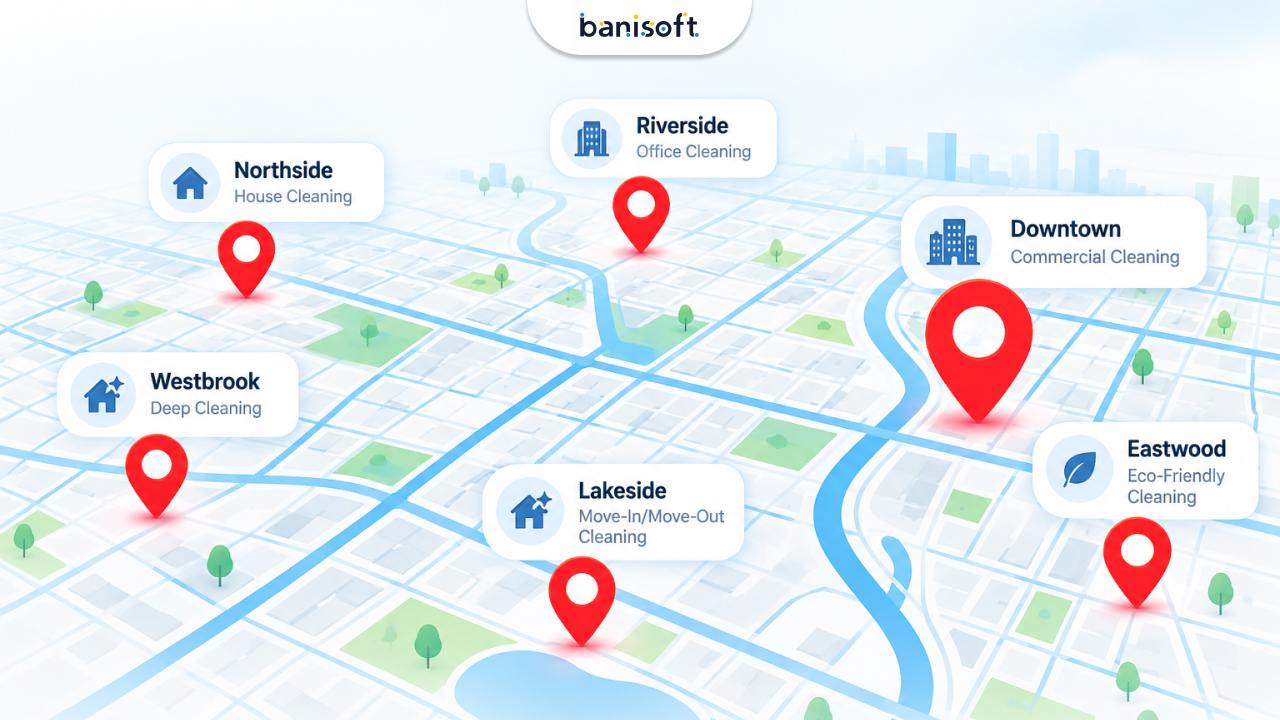
If you serve six suburbs, you can rank in six suburbs – but only if each page says something a human would find useful.
The failure mode is obvious to Google: take one page, swap the town name, publish forty copies. These are doorway pages and they will not rank.
A location page that works includes:
- Neighbourhoods and postcodes you cover within that area.
- Something true about local housing stock – Victorian terraces with sash windows, new-build apartments, large family homes.
- Reviews from customers in that specific area.
- Photos from jobs completed there.
- Your response time and typical availability for that area.
- A link back to the relevant service pages.
Rule of thumb: build a location page only for areas where you have completed at least three jobs and hold at least one review. Below that threshold you have nothing genuine to write.
Step 4: Target the Keywords That Book Jobs
Search volume is a vanity metric in this industry. A keyword with 200 searches a month and booking intent is worth more than one with 5,000 searches and no intent.
Sort every keyword you find into these four buckets and work from the top down.
|
Bucket |
Examples |
Intent |
Priority |
|
Ready to book |
“house cleaning near me”, “move out cleaning [city]”, “emergency cleaning service” |
Transactional |
1 – Highest |
|
Comparing options |
“best cleaning service in [city]”, “house cleaning prices”, “maid service vs cleaning company” |
Commercial |
2 – High |
|
Problem-aware |
“how much does deep cleaning cost”, “how often should you deep clean”, “what does end of tenancy cleaning include” |
Informational |
3 – Medium |
|
Trust-checking |
“are cleaning services insured”, “do cleaners do background checks”, “is it safe to leave cleaners alone in your home” |
Informational |
4 – Medium |
Bucket one goes on your service pages and your Google Business Profile. Buckets three and four become blog posts – and those posts are what get cited in AI answers, because they are the questions people actually ask.
Where to find them free
- Google autocomplete: type “cleaning service” plus your city and read every suggestion.
- People Also Ask boxes on the results page – each one is a blog post or an FAQ.
- Your own inbox. Every question a customer asks before booking is a keyword.
- Google Search Console, once you have data: filter for queries where you rank between position 5 and 20 and improve those pages first.
Step 5: Run a Review Engine, Not a Review Request
Reviews have quietly become the highest-leverage work in local SEO, and the 2026 data makes that hard to argue with.
Whitespark’s 2026 report shows review signals growing from 16% to roughly 20% of local pack ranking weight since the previous edition – one of the two biggest movers in the study.
The consumer side moved even faster. BrightLocal’s Local Consumer Review Survey 2026, a representative survey of 1,002 US adults published in February 2026, found:
- 97% of consumers read reviews before choosing a local business.
- 41% now always read reviews when browsing – up from 29% the previous year.
- 31% will only use a business rated 4.5 stars or higher – up from 17%.
- 85% are more likely to use a business after reading positive reviews; 77% are put off by negative ones.
- The average consumer checks six different review platforms before deciding.
Two things follow. First, a 4.3-star average is now actively costing you work. Second, one burst of twenty reviews is worth less than a steady two or three a week, because recency is what consumers scan first.
Build it into the job, not into a reminder
- Ask at handover, in person, while the customer is looking at a clean house. This is the highest-conversion moment you will get.
- Send a follow-up text within two hours with a direct review link. Not an email. Not tomorrow.
- Give the cleaner who completed the job a small bonus for every named review. It changes behaviour immediately.
- Reply to every review within 24 hours, including the bad ones. Owner responses are visible to both customers and Google.
- Spread them: Google first, then Yelp, Facebook, Angi or Thumbtack, and any local directory that ranks in your area.

Step 6: Answer the Questions People Ask Before They Book
Blogging for a cleaning company is not about publishing weekly for the sake of it. It is about answering, in public, every objection that currently happens on the phone.
Each of these is a page that earns search traffic and shortens your sales conversation:
- How much does house cleaning cost in [city]? The single most-searched question in this industry, and the one most companies refuse to answer.
- What is included in a deep clean vs a standard clean? A comparison table here is a strong featured snippet candidate.
- How long does end-of-tenancy cleaning take? High-intent, deadline-driven readers.
- Are your cleaners insured, bonded and background-checked? Pure trust content, and it converts.
- What cleaning products do you use around pets and children? A genuine differentiator if you use eco-friendly products.
- How do I prepare my home for a cleaning service? Ranks well and quietly reduces job time.
- How often should an office be professionally cleaned? Commercial buyers, high contract value.
Format matters as much as topic. Answer the question in the first two sentences under the heading, then explain. Search engines and AI assistants both extract opening lines – burying the answer in paragraph four costs you the citation.
Step 7: Earn Local Links You Can Realistically Get
Forget guest posting on marketing blogs. Cleaning companies win links locally, and there are only a handful of routes worth your time.
- Claim and complete listings on Yelp, Angi, Thumbtack, Bing Places, Apple Business Connect and Nextdoor. Keep the name, address and phone identical on every one.
- Join your local chamber of commerce. It is a paid link, but it is a relevant, local, trusted one.
- Partner with adjacent trades: estate agents, removal companies, property managers, builders. Offer a referral arrangement and ask to be listed as a recommended supplier.
- Sponsor something small and local – a school event, a junior sports team, a community clean-up. These produce local news mentions competitors cannot copy.
- Offer a free quarterly clean to a local charity or community centre and let them write about it.
Ten relevant local links will move your rankings further than a hundred irrelevant ones. Never buy links in bulk.
Step 8: Make Your Site Fast, Mobile and Bookable in Three Taps
Most cleaning searches happen on a phone, often standing in the room that needs cleaning. If your site takes six seconds to load or hides the phone number, the ranking work is wasted.
The checklist that matters:
- Click-to-call phone number in the header on every page.
- A quote form with five fields maximum: name, phone, postcode, service, preferred date.
- Service area stated on the homepage, above the fold.
- Compressed images in WebP format – photo-heavy cleaning sites are almost always slow for this one reason.
- HTTPS across the whole site.
- LocalBusiness schema on the homepage; Service schema on each service page.
- Online booking if your job volume justifies it. Removing the phone call from the process lifts conversion noticeably.
A note on tools: if a guide still tells you to run Google’s Mobile-Friendly Test, it is out of date. Google retired the Mobile-Friendly Test tool, the Mobile-Friendly Test API and the Search Console Mobile Usability report in December 2023, pointing users to Lighthouse instead. Bing’s equivalent has also gone. Use PageSpeed Insights for speed and mobile usability, Lighthouse in Chrome DevTools for a full audit, and the Core Web Vitals report in Google Search Console for real-user data across your whole site.
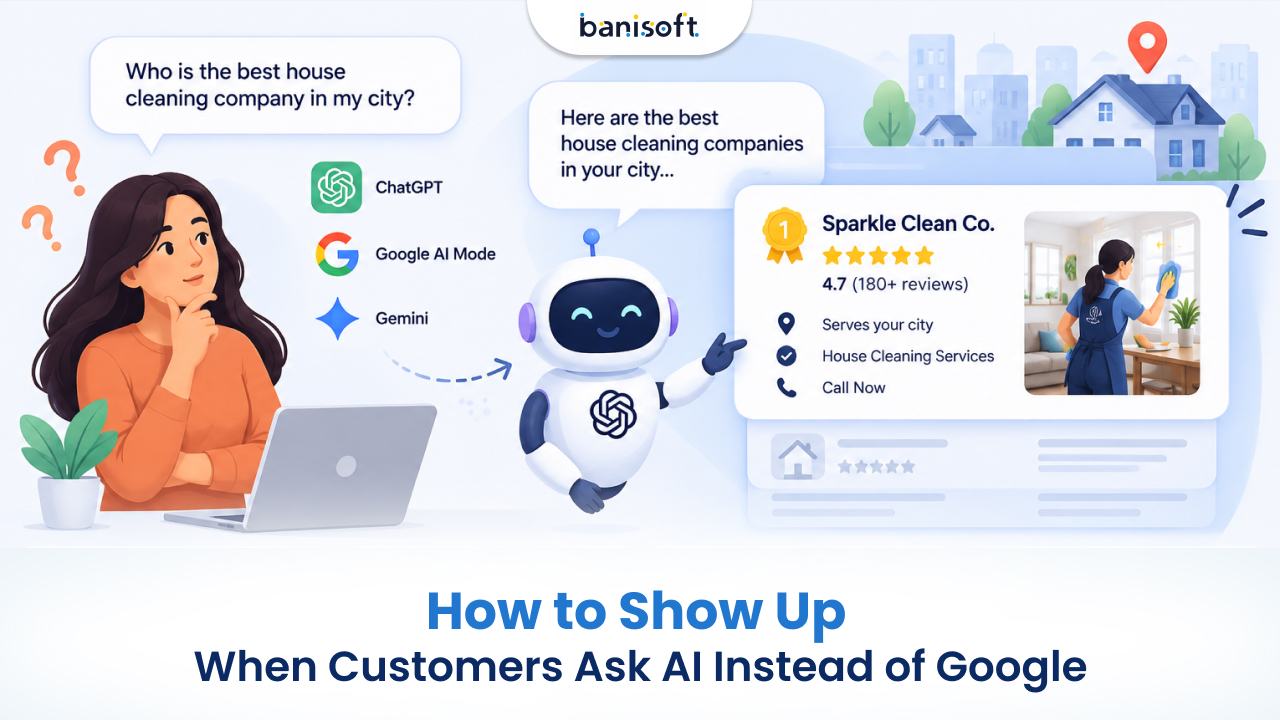
How to Show Up When Customers Ask AI Instead of Google
This is the section that did not exist two years ago, and it is now the fastest-moving part of local search.
BrightLocal’s 2026 survey found the share of consumers using AI tools such as ChatGPT, Google AI Mode and Gemini to find local businesses rose from 6% to 45% in a single year, while Google’s share of local business discovery fell from 83% to 71%. AI is now the third-largest local discovery channel, ahead of Yelp.
Whitespark added an “AI Search visibility” category to its ranking factors survey for the first time in 2026 for the same reason.
Somebody in your service area is currently typing “who is the best house cleaning company in [your city]” into an AI assistant. Whether your name comes back depends on four things.
- Consistency across the web. AI systems assemble local recommendations from Google Business Profile data, directory listings and review platforms. If your name, address, phone number and services differ across those sources, you get skipped in favour of a business the model is confident about.
- Review volume and recency. AI recommendations lean heavily on review signals. A business with 180 recent reviews at 4.7 stars gets recommended over one with 30 reviews from 2023.
- Content structured for extraction. Clear headings, direct answers in the first two sentences, comparison tables and FAQ sections. AI systems pull clean, self-contained passages – not paragraphs that take four sentences to reach the point.
- Structured data. LocalBusiness, Service and FAQPage schema tell machines exactly what you do, where you do it and what you charge. Without it, they are guessing.
How Long Does SEO Take for a Cleaning Business?
Honest answer: you will see movement in 8 to 12 weeks and meaningful lead volume in 5 to 7 months. Anyone promising page one in 30 days is either lying or planning to do something that gets you penalised.
|
Timeframe |
What you should see |
|
Weeks 1–4 |
Google Business Profile fully optimised, service pages live, technical fixes done. Little visible ranking change yet. |
|
Weeks 5–12 |
Map pack movement on lower-competition suburbs. First calls attributable to search. Review count climbing. |
|
Months 4–6 |
Service pages ranking for long-tail terms. Steady enquiry flow. Blog posts earning impressions. |
|
Months 7–12 |
Competitive “[service] + [city]” terms in play. SEO becomes a predictable lead source rather than an experiment. |
|
Year 2 onward |
Compounding. Cost per booked job falls as organic volume grows and paid dependency drops. |
What to Measure (and What to Ignore)
Rankings are a diagnostic, not a result. Track what connects to revenue.
|
Metric |
Where to find it |
Why it matters |
|
Calls and messages from your profile |
Google Business Profile Insights |
Closest measure of local visibility to actual bookings |
|
Direction and website clicks |
Google Business Profile Insights |
Shows whether your profile is converting, not just appearing |
|
Quote form submissions |
GA4 conversion events |
Your primary website conversion |
|
Queries in positions 5–20 |
Google Search Console |
Your highest-return optimisation list, every month |
|
Review count and average rating |
Google Business Profile |
Ranking factor, conversion factor and AI recommendation factor at once |
|
Cost per booked job |
Your own numbers |
The only metric that decides whether SEO is working |
|
Total organic sessions |
GA4 |
Deprioritise – traffic without bookings is noise |
Five Mistakes That Keep Cleaning Companies Invisible
- Publishing your home address on your Google profile. A privacy problem and a suspension risk. Configure as a Service Area Business instead.
- One page for every service. It ranks for nothing. Split it.
- Refusing to publish any pricing. Buyers filter you out and go to the company that gave them a number. A range is enough.
- Chasing reviews once a quarter. Recency is now a scanned signal. Two a week beats twenty in a burst.
- Copy-pasting location pages. Forty near-identical suburb pages are doorway pages. Six genuine ones outperform them.
Frequently Asked Questions
Is SEO worth it for a small cleaning business?
Yes, and usually more than for large companies. Local search is decided by relevance, distance and prominence rather than budget, so a two-van operation with a well-optimised Google Business Profile and strong recent reviews can outrank a national franchise in a specific suburb. The advantage compounds: recurring cleaning clients often stay for years, so a single booked customer can return the cost of months of SEO work.
How much does SEO cost for a cleaning company?
Doing it yourself costs time – realistically five to eight hours a week for the first three months. Agency retainers for local service businesses typically start around $500 to $1,500 a month, scaling with the number of service areas you want to rank in. Compare that against your current cost per lead from paid ads: home services is among the more expensive categories in Google Ads, and organic leads cost less once established.
How do I rank my cleaning business on Google Maps?
Optimise your Google Business Profile as a Service Area Business, choose the right primary and secondary categories, list every service individually, set accurate hours, add real photos monthly, post weekly, and build a steady flow of recent reviews. Then support it with a website that has a dedicated page for each service and consistent name, address and phone details across every directory you appear in. Google Business Profile signals carry roughly 32% of local pack ranking weight, so this is where the majority of your effort belongs.
What are the best keywords for a cleaning business?
The highest-converting keywords combine a service with a location or a “near me” modifier: “house cleaning near me”, “move out cleaning [city]”, “office cleaning services [city]”, “deep cleaning service [city]”, “post construction cleaning [city]”. Support those with question-based keywords such as “how much does deep cleaning cost” and “what is included in end of tenancy cleaning”, which attract buyers earlier in the process.
Do I need a blog for my cleaning business?
You need answers, not a blog for its own sake. Every question a customer asks before booking – pricing, what is included, insurance, product safety, how to prepare – should exist as a page on your site. Those pages rank for long-tail searches, get cited in AI answers, and shorten your sales calls. Publishing generic cleaning tips nobody searches for does nothing.
How many reviews does a cleaning business need?
There is no fixed number, but aim to beat the average review count of the three companies currently in the map pack for your main service and area, and hold a rating of 4.5 or higher. Recency matters as much as volume – BrightLocal’s 2026 research shows 31% of consumers will only use businesses rated 4.5 stars or above, and that consumers scan the most recent reviews first. A steady two to three new reviews per week is more valuable than a large but ageing total.
Should I use SEO or Google Ads for my cleaning business?
Both, in sequence. Google Ads and Local Services Ads produce leads immediately and are useful while SEO builds, but the leads stop the day the budget stops. SEO takes five to seven months to become a reliable channel and then keeps producing. The practical approach is to run ads for immediate cashflow while building organic visibility, then reduce ad spend as organic leads grow.
How do I get my cleaning business recommended by AI tools like ChatGPT?
Make your business easy for machines to verify. Keep your name, address, phone and services identical across your Google Business Profile, website and every directory listing. Maintain a high volume of recent reviews. Structure your website content with clear headings, direct answers in the opening sentences, comparison tables and FAQ sections. Add LocalBusiness, Service and FAQPage schema so AI systems can read your details without guessing. With 45% of consumers now using AI tools for local recommendations, this is no longer a side project.
Where to Start This Week
If you do nothing else from this guide, do these three things in this order:
- Fix your Google Business Profile. Service Area Business setup, correct primary and secondary categories, accurate hours, every service listed, ten real photos uploaded. Two hours of work, the largest single return available to you.
- Build your highest-value service page. Pick the service with the best margin and give it its own page, its own keyword and its own reviews.
- Start the review habit. Ask at handover, follow up by text within two hours, reply to everything within a day.
Do those consistently for ninety days and you will be ahead of most cleaning companies in your area – because most of them are still relying on word of mouth and hoping.
Want it done properly? Banisoft has been running local SEO for service businesses since 2001. If you would rather have the profile setup, service pages, review system and schema handled for you, we will audit your current visibility and show you exactly where the bookings are leaking. Get a free cleaning business SEO audit.