 Summarize in ChatGPT
Most dental clinics do not lose patients to better dentists. They lose them to clinics that are easier to find at the exact moment someone decides they need an appointment.
That moment is now split across two screens: the Google map pack, and an AI assistant answering “who’s a good dentist near me” in a paragraph. This guide covers what actually drives visibility in both, based on 2026 ranking data rather than the recycled statistics still circulating in most dental marketing articles.
Key Takeaways
Citations matter again. After a decade of declining importance, three of the top five AI search visibility factors are citation signals.
Your Google Business Profile is the lever. Eight of the ten highest-scoring local pack factors in Whitespark’s 2026 survey come directly from the Business Profile – starting with your primary category.
Review recency now outranks review volume. 74% of consumers only care about reviews written in the last three months, and 31% will only use a business rated 4.5 stars or higher – up from 17% a year earlier.
A dedicated page per treatment is the single strongest local organic factor. One “Services” page listing twelve treatments is the most common structural mistake in dental SEO.
Discovery is fragmenting. Google’s share of local business discovery fell from 83% to 71% in twelve months, while generative AI tools rose from 6% to 45%.
What is local SEO for dental clinics?
Local SEO for dental clinics is the practice of optimising a clinic’s Google Business Profile, website, and off-site business listings so the practice appears in the map pack, Google Maps, and local organic results when nearby patients search for dental treatment. It differs from general SEO because rankings are filtered by physical proximity to the searcher, not just by content quality or domain authority.
That proximity filter is the whole game. A clinic with a weaker website can outrank a stronger one simply by being closer to the person searching – which is why the tactics that work for a national ecommerce site do very little for a two-chair practice in a suburb.
How Google actually ranks dental clinics locally?
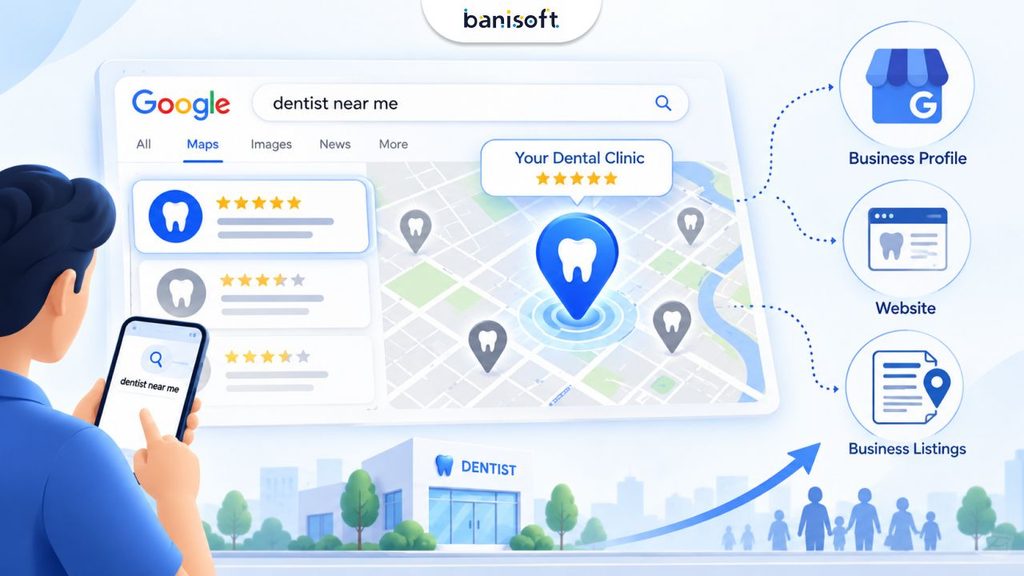
Google’s own documentation names three factors behind local results: relevance, distance, and prominence. Relevance is how closely your profile matches the query. Distance is how far you are from the searcher. Prominence is how well known your practice is – a signal Google explicitly ties to links and review volume.
Those three are the framing. The detail sits in Whitespark’s Local Search Ranking Factors report, published in November 2025, in which 47 local search practitioners scored 187 individual signals for their impact on local pack rankings, local organic rankings, and – new for the 2026 edition – visibility inside AI search responses.
Here are the ten highest-scoring local pack signals, translated into what they mean for a dental practice.
| # | Ranking signal | What it means for your clinic |
| 1 | Primary Business Profile category | “Dentist” vs “Dental Clinic” vs “Cosmetic Dentist” changes which searches you surface for |
| 2 | Proximity of address to the searcher | Largely fixed – but it defines your realistic catchment radius |
| 3 | Keywords in the profile business title | Your real-world name only; keyword stuffing here risks suspension |
| 4 | Physical address in the city being searched | A suburb address competing for a city-centre query starts behind |
| 5 | Business is open at time of search | Closed clinics get displaced in real time by open ones |
| 6 | High numerical Google rating (4–5 stars) | Rating is a ranking input, not just a trust signal |
| 7 | Address showing on the profile (not service-area only) | Hiding your address is high-risk for a fixed-premises clinic |
| 8 | Additional Business Profile categories | Secondary categories for implants, orthodontics, endodontics |
| 9 | Quantity of Google reviews with written text | Text reviews outweigh silent star ratings |
| 10 | Correct placement of the map pin | Frequently wrong after a relocation or fit-out |
Two things stand out. First, your primary category outweighs everything else you can control. Second, opening hours are now a live ranking factor – a signal that only entered the survey in this edition and went straight to fifth. If your profile says you close at 5pm, your visibility starts eroding before you actually lock the door.
A word of caution on #3. Keywords in the business title score highly, but Google’s guidelines require the name on your profile to be the name on your signage and stationery. “Smile Dental – Best Dentist in [City]” may lift rankings briefly and then trigger a suspension. Do not trade a profile for a short-term gain.
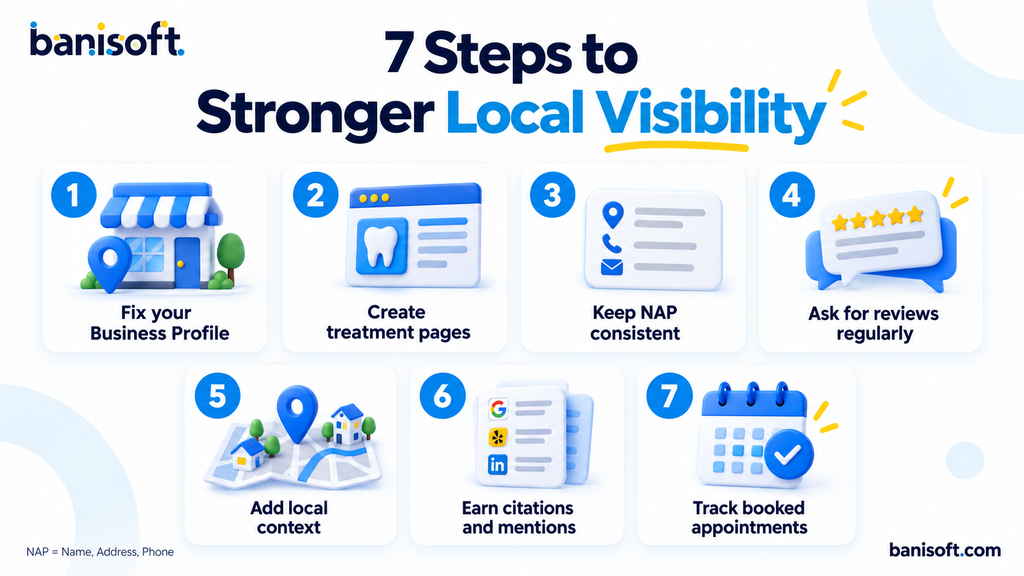
The 7-step local SEO framework for dental clinics
Step 1 – Fix the Business Profile foundation
Set the primary category to the one that matches your core revenue, not your broadest service list. Add secondary categories for each distinct discipline you actually deliver. Populate the predefined Services that Google suggests – these were confirmed as a real ranking input by Sterling Sky’s testing and now score as the 22nd most impactful local pack factor, having previously been dismissed as near-irrelevant.
Then verify the boring things: hours (including holiday hours), the pin location, the phone number, and whether the address is displaying.
Step 2 – Build a dedicated page for every treatment
“Dedicated Page for Each Service” is the number one local organic ranking factor in the 2026 survey. Most dental sites fail this outright, collapsing implants, whitening, root canal, orthodontics, and emergency care into a single Services page.
Each treatment page should carry its own title tag, its own H1, the treatment’s real cost range or a clear reason you don’t publish one, what the appointment involves, recovery expectations, and three to five questions patients actually ask about it. This is also where you win high-intent dental keywords like emergency dentist and Invisalign.
Step 3 – Make your NAP identical everywhere
Your name, address, and phone number as written in your website HTML must match your Business Profile exactly. This scores as the 15th most impactful local pack factor – higher than most link-building work.
“Suite 4” on the website and “Unit 4” on the profile is a mismatch. So is a tracking number in the header that doesn’t appear anywhere else. Audit the website footer, contact page, every location page, and your top twenty directory listings.
Step 4 – Engineer review recency, not just review count
The 2026 consumer data reframes reviews entirely. 47% of consumers won’t use a business with fewer than twenty reviews. 74% only care about reviews from the last three months. 31% now require 4.5 stars or higher – nearly double last year’s 17%. And 68% won’t consider anything under four stars.
Response behaviour matters as much as the reviews. 80% of consumers say they’re more likely to use a business that replies to every review, 81% expect a reply within a week, and – the part most practices get wrong – templated replies put off 50% of consumers.
The operational implication: a review request has to be part of the checkout or discharge routine, running every week, forever. A burst of thirty reviews after a campaign then eighteen months of silence performs worse than four reviews a month, indefinitely. That matches the ranking data too, where a sustained influx of reviews scores higher than raw quantity.
(Note on this data: BrightLocal’s 2026 survey was conducted with 1,002 US adults. Directional for other markets, not a precise read on patient behaviour in India, the UK, or Australia.)
Step 5 – Add genuine geographic relevance to your content
Geographic keyword relevance of content is the second strongest local organic factor and the 18th strongest local pack factor. This does not mean writing “dentist in [City]” fourteen times.
It means referencing the things that actually place you: the neighbourhoods you draw patients from, nearby landmarks, parking and transport specifics, the areas your emergency slots cover. Location pages that reference real local entities outperform templated city pages built from a spreadsheet – and templated location pages are increasingly a liability rather than a shortcut.
Step 6 – Earn local citations and mentions
Citations spent a decade declining in perceived value. That reversed in the 2026 report, and the reason is AI: three of the top five AI search visibility factors are citation signals. In AI-mediated search, consistent mentions across the web function the way links functioned in traditional SEO.
For a dental practice, that means dental association directories, health and practitioner directories, local chamber and business listings, insurance provider directories, and any curated “best dentists in [City]” list you can legitimately petition to join. Fill every field on each listing rather than submitting the minimum.
Step 7 – Measure what actually indicates growth
Track grid-based rankings rather than a single ranking position, because your visibility varies street by street. Track Business Profile actions – calls, direction requests, website clicks – as the layer between visibility and revenue. And track booked appointments, because everything above it is a proxy. If you don’t have that chain instrumented, start with how to track marketing ROI for a dental clinic.
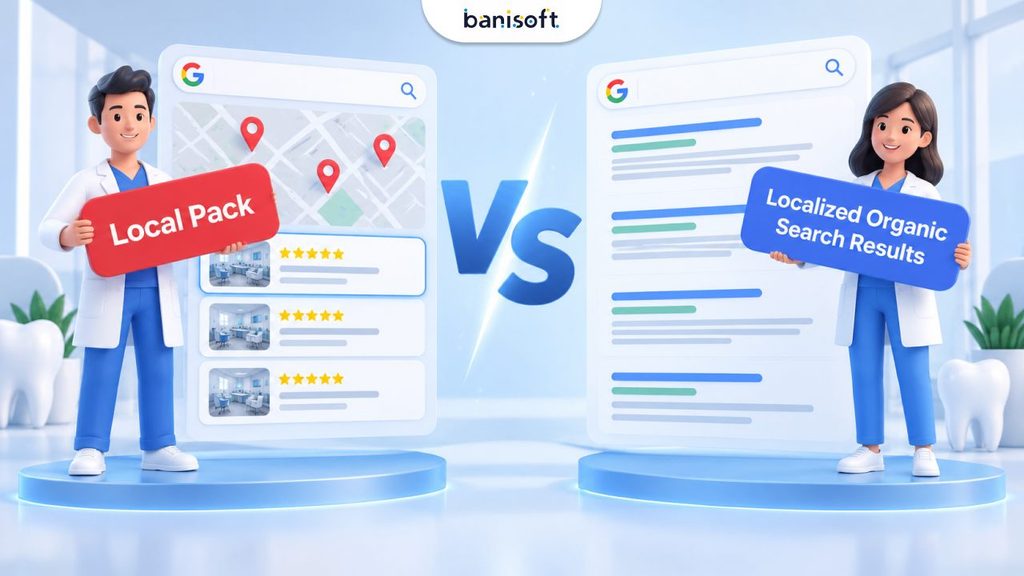
Local pack and local organic are two different games
Practices routinely optimise for one and wonder why the other doesn’t move. The signal sets barely overlap.
| Local pack / Maps | Local organic | |
| Strongest single signal | Primary Business Profile category | Dedicated page for each service |
| Role of proximity | Decisive (2nd overall) | Secondary (41st overall) |
| Role of backlinks | Moderate | Very high (3rd, 5th, 10th) |
| Role of reviews | High (multiple top-15 signals) | Low |
| Role of internal linking | Modest (47th) | Very high (6th) |
| Where the work happens | Google Business Profile | Your website |
| Realistic ceiling | Limited by your address | Limited by content depth and links |
If you rank in organic results but never appear in the map pack, your Business Profile is the problem. If you own the map pack but get no organic traffic, your site structure is. The diagnosis differs completely – a distinction covered in more depth in why your dental clinic isn’t ranking on Google Maps.
What moves the needle – and what doesn’t
The 2026 survey is as useful for what it demotes as for what it elevates.
| Tactic | 2026 verdict |
| Choosing the right primary category | Highest-impact single action available |
| Steady weekly review flow | Top-15 signal, rising |
| Dedicated page per treatment | #1 for local organic |
| Publishing 2,500-word service pages | Dropped 40 places; concision now wins |
| Keyword-stuffed image filenames | Ranked 175th of 187 |
| Keywords in meta descriptions | Ranked 179th of 187 |
| Obsessing over 60-character title tags | Ranked 184th – treated as a myth in this edition |
| Geo-tagged photos | Ranked last, 187th |
| Social follower count | Ranked 186th |
If your current agency’s monthly report leads with image alt text and geo-tagged photos, you are being billed for work that scores in the bottom five percent of known signals.

How dental clinics get surfaced by AI assistants
This is the genuinely new variable. In the space of one year, generative AI tools went from 6% to 45% as a source consumers use to find local businesses, becoming the third most common channel. Over the same period, Google’s share of local business discovery fell from 83% to 71%. Separately, 82% of consumers now read AI-generated review summaries, and 23% are willing to decide on that summary alone.
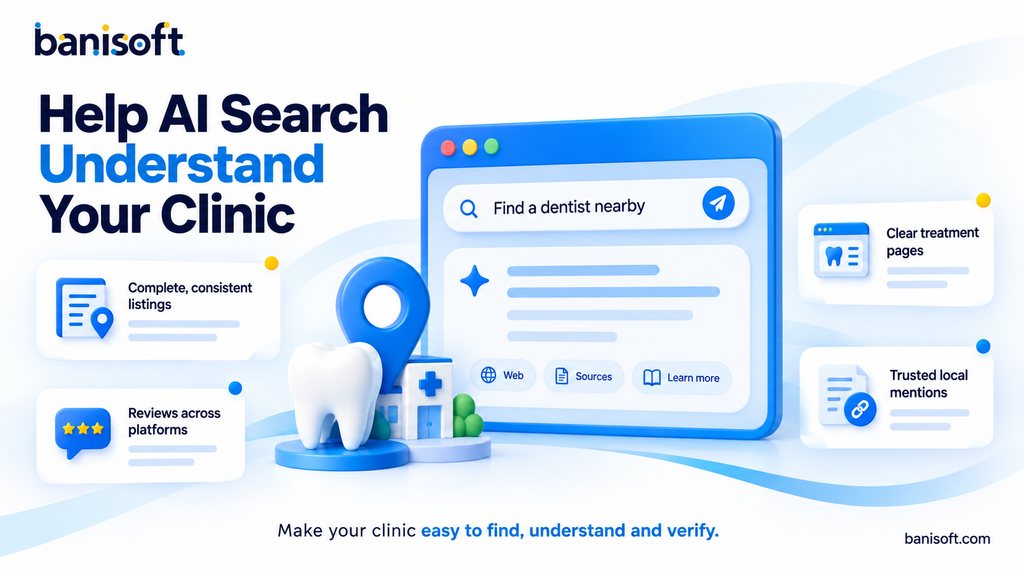
There is no special markup that gets you into AI answers. What the evidence points to is unglamorous:
- Consistent, complete listings across many sources – AI systems assemble answers from multiple references, so contradictory addresses or hours actively work against you.
- Reviews on more than one platform – consumers now consult an average of six review sites, and Google alone is no longer sufficient coverage.
- Clear, well-structured page content – headings, short paragraphs, direct answers. Scannable content structure across a website scores tenth for AI search visibility, versus 128th for the local pack.
- Presence on curated “best of” lists and industry directories – these are disproportionately represented in AI-generated recommendations.
Notably, the same 2026 survey flags AI-generated text and AI-generated images on a Business Profile as negative signals carrying suspension risk. Using AI to write your profile content is a different thing from being found by AI, and the first actively undermines the second.
What a realistic timeline looks like
Local SEO is not a fixed-duration project, and any agency promising map pack position one by a specific date is selling certainty it cannot supply. Broadly, here is what a competently run programme looks like for an established practice.
| Period | Focus | What you should see |
| Months 1–2 | Profile fix, NAP audit, category correction, review system built | Profile impressions and calls begin moving; rankings largely flat |
| Months 3–4 | Treatment pages built, location relevance added, citations cleaned | Movement on longer-tail treatment queries; grid coverage widens |
| Months 5–8 | Content depth, local links, sustained review flow | Map pack movement on core terms; organic traffic compounds |
| Months 9–12 | Consolidation, competitive gaps, conversion work | Booked appointments become the reporting metric |
These are directional. A clinic in a low-competition town moves faster. A clinic three kilometres outside a dense city centre may never win the centre-of-city query regardless of budget – and the honest strategy there is to dominate its own catchment rather than burn budget on an unwinnable radius.
Frequently asked questions
How long does local SEO take to work for a dental clinic?
Business Profile improvements can shift map pack visibility within two to six weeks because Google reprocesses profile data quickly. Website-driven gains – treatment pages, local content, links – typically take four to eight months to compound. Competition density and your address relative to the search area are the two biggest variables.
Why is my dental clinic not showing in the map pack?
The most common causes, in order: wrong primary category, address outside the searched city, an incomplete or unverified profile, a misplaced map pin, insufficient recent reviews, or the clinic being closed at the time of the search. Rule out profile issues before assuming it’s a website problem.
What is the best Google Business Profile category for a dentist?
Choose the category matching your core revenue rather than your widest service list. A general practice picks “Dentist.” A practice where implants drive most revenue may perform better under a more specific category, with “Dentist” retained as a secondary. This is worth testing rather than guessing – it’s the highest-impact single field on your profile.
How many Google reviews does a dental clinic need?
47% of consumers won’t use a business with fewer than twenty reviews, so twenty is a floor rather than a target. More important is flow: 74% only weigh reviews from the last three months, meaning a clinic with 200 reviews all older than a year is weaker in practice than one with 60 that arrive steadily.
Is local SEO different from regular SEO for dentists?
Yes, materially. Local SEO adds a proximity filter and a second ranking surface – the map pack – governed largely by your Google Business Profile. Traditional SEO signals like content depth and backlinks still matter, but they drive local organic results rather than map pack position.
Should a dental clinic hide its address if it doesn’t take walk-ins?
Almost never. Address showing on the profile ranks as the seventh strongest local pack signal, and clinics that remove their address frequently see visibility collapse. A practice with fixed premises should display them.
Do Google Posts help a dental clinic rank?
Only marginally as a direct ranking signal – post frequency ranks 148th. Their value is engagement: profile engagement signals score 33rd and rising, and posts give visitors something to interact with. Post because it converts, not because it ranks.
Can local SEO help a new dental clinic with no reviews?
Yes, but sequence matters. A new clinic should get the profile complete and correctly categorised first, then build reviews from its earliest patients before investing heavily in content or links. Consumers avoid businesses with almost no social proof, so review generation is the unlock, not an afterthought.
Where to start
If you take one action from this article, audit your primary Business Profile category against your actual revenue mix. It is the single highest-impact field available to you and it takes four minutes to check.
After that, work in this order: fix the profile, standardise your NAP, build a page per treatment, and start a weekly review request routine that never stops. Content and links come after – they compound on a foundation, not instead of one.
If you’d rather have someone map the gaps against your specific market, Banisoft’s SEO team runs local visibility audits for dental practices. Get in touch and we’ll show you where you’re actually losing patients – and whether the fix is worth what it costs.