
 Summarize in ChatGPT
Key Takeaways
- The global dog training services market is valued at approximately $40 billion in 2025, growing at a CAGR of 9.35% through 2034 — making this one of the most opportunity-rich niches for independent trainers who invest in SEO early. (Market Reports World)
- “Dog trainer near me” receives over 100,000 monthly searches in the US — and 74% of pet owners research online before choosing a trainer. (Blawgy, 2025)
- Businesses listed in Google’s Local 3-Pack receive 126% more traffic and 93% more actions (calls and clicks) than those ranking 4th to 10th. (SeoProfy, 2026)
- 45% of consumers now use ChatGPT or other generative AI tools to get local business recommendations — a new and rapidly growing discovery channel that requires a different optimization approach. (BrightLocal, 2026)
- Businesses with 50+ Google reviews earn 266% more leads than those with fewer than 10. (On The Map, 2026)
- The Animals & Pets category has a 13.07% conversion rate on local ads — one of the highest across all service industries. (Synup, 2026)
Introduction: Why SEO Is the Most Valuable Long-Term Investment for Dog Trainers
If you run a dog training business, you already know that referrals alone will not fill your calendar consistently — especially as competition grows. The good news is that the market is expanding rapidly: the global dog training services industry generated approximately $40 billion in revenue in 2025 and is projected to reach $88.9 billion by 2034 at a 9.35% CAGR. (Market Reports World)
The problem is that most of that demand starts with a Google search — and if your business does not appear on the first page, you are functionally invisible to the majority of potential clients.
Monthly searches for “dog trainer near me” exceed 100,000 in the US alone, and 74% of pet owners research online before choosing a service provider. (Blawgy, 2025) That means the single most reliable way to grow a local dog training business in 2026 is to show up where those searches land — on Page 1 of Google, in the Local Pack, and increasingly in AI-generated search answers from tools like Google AI Overviews, ChatGPT, and Perplexity.
This guide breaks down every SEO strategy that matters for dog trainers in 2026 — from keyword research to local citation building, from Google Business Profile optimization to AI search readiness — with specific implementation steps you can act on immediately.
What Is SEO for Dog Training Businesses?
SEO (Search Engine Optimization) is the process of optimizing your website and online presence so that your business appears prominently in search engine results when potential clients search for dog training services in your area.
For a local dog trainer, SEO operates on two distinct but connected levels:
Local SEO targets searches with geographic intent — “dog trainer in Austin,” “puppy classes near me,” “board and train [city].” These searches come from homeowners in your service area who are ready to book. Local SEO-optimized searches convert at 15–25%, compared to just 2–5% for generic informational queries. (WagBar)
Organic SEO targets broader informational and commercial searches — “how to stop puppy biting,” “positive reinforcement dog training,” “is board and train worth it?” These searches build brand awareness, establish your authority, and funnel readers into your local service pages over time.
Both work together. The trainers who dominate their local markets in 2026 do both well.
The Dog Training Market in 2026: Why Now Is the Time to Invest in SEO
Understanding the market context helps you understand why SEO compounds in value over time.
- The US dog training market reached $294 million in 2025, according to IBISWorld, with the broader US pet training services market on track to exceed $820 million. (IBISWorld, Arizton)
- Online dog training is the fastest-growing segment, expected to expand at a 9.2% CAGR through 2030 as digital adoption accelerates. Virtual dog training programs now account for approximately 12% of all training enrollments in 2025, up from just 3% in 2020. (Gitnux, 2026, Market Reports World)
- Small businesses dominate: 82% of the industry consists of trainers with fewer than 5 employees. (Gitnux, 2026) This means you are not competing with massive corporate marketing budgets — you are competing with other local operators who largely ignore SEO. That is your opportunity.
- Millennial dog owners — now the largest pet-owning demographic — spend an average of $1,200 per year on training, 30% more than Gen X, and they almost exclusively find services online. (Gitnux, 2026)
The market is growing. The majority of competitors are under-investing in digital visibility. The pet-owning audience is highly active online. SEO is your highest-leverage growth channel.
7 Key SEO Strategies for Dog Training Businesses in 2026
Strategy 1: Keyword Research Built for Local Intent
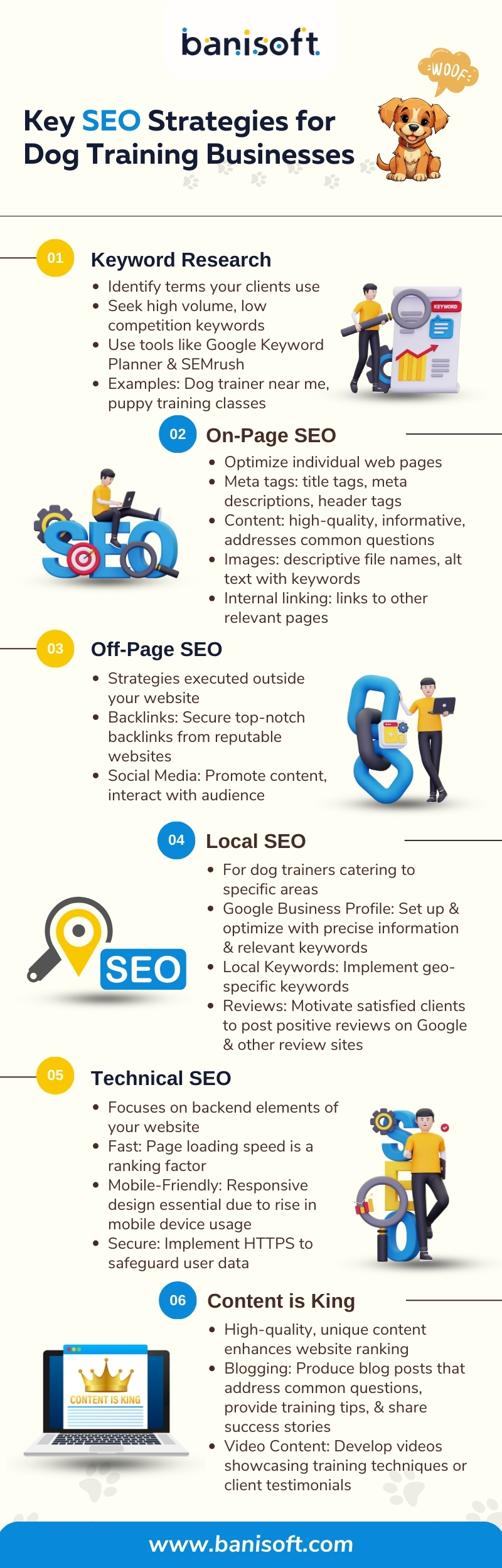
Identifying the right keywords is the foundation of every SEO strategy. For dog trainers, effective keyword research is less about broad terms and more about local intent plus service specificity — the combination that signals to Google exactly who you serve and where.
How to Approach Keyword Research
Start with tools like Google Keyword Planner, Semrush, or Ahrefs. Your goal is to identify three categories of keywords:
High-volume local keywords (broad, high competition):
- “dog trainer near me” — 100,000+ monthly US searches
- “dog training classes [city]”
- “puppy training [city]”
- “dog obedience training [city]”
Mid-volume service-specific keywords (moderate competition, high conversion):
- “board and train dog [city]”
- “dog behaviorist [city]”
- “aggressive dog training [city]”
- “leash reactivity training [city]”
- “certified dog trainer [city]”
Long-tail, low-competition keywords (lower volume, easiest to rank, buyer intent):
- “how to stop puppy biting [city]”
- “best puppy training classes for first-time dog owners [city]”
- “in-home dog trainer [city]”
- “private dog training lessons [city]”
- “positive reinforcement dog trainer [city]”
Best Practice: Review your keywords every 3–6 months. The dog training industry evolves seasonally — puppy searches spike in spring following holiday adoptions, and behavioral training searches rise in summer when outdoor activity peaks. Google Trends is a free tool to track these patterns. (Blawgy, 2025)
Strategy 2: On-Page SEO — Optimizing Every Page to Rank
On-page SEO means making sure each page on your website is structured so Google can understand what it is about and who it is relevant to. For a dog training business, this applies to your homepage, service pages, and every blog post you publish.
Title Tags: Your title tag is the blue clickable text in Google search results. It should include your primary keyword and your location. For example:
- “Dog Trainer in Austin, TX | Certified | [Your Business Name].”
- “Puppy Training Classes in San Diego | Positive Reinforcement | [Your Business Name].”
Keep title tags under 60 characters to prevent truncation in search results.
Meta Descriptions: Meta descriptions do not directly affect rankings, but they significantly impact click-through rate (CTR). Write descriptions that include your location, mention a specific service, and include a call to action:
- “Professional dog training in [City] since [year]. Certified trainers specializing in puppy socialization, leash reactivity, and aggression. Book a free consultation today.”
Keep meta descriptions under 155 characters. (WagBar)
Header Tags (H1, H2, H3): Use a single H1 per page that includes your primary keyword and location: “Dog Training Services in [City] and Surrounding Areas.” Use H2 and H3 subheadings to organize content and naturally include secondary keywords such as “Puppy Training in [Neighborhood]” or “Behavioral Training in [Area].” (WagBar)
Image Optimization: Name image files descriptively before uploading: “german-shepherd-puppy-training-austin.jpg” performs better than “IMG_0042.jpg.” Add alt text to every image that describes what is shown and includes your keyword where natural: “certified dog trainer working with Labrador puppy in Austin training facility.”
Internal Linking: Link between your pages to help Google understand your site structure and help visitors navigate. Your homepage should link to each service page. Each service page should link to relevant blog posts. Each blog post should link back to the relevant service page.
Strategy 3: Local SEO — Dominating Search in Your Service Area
For a dog training business, local SEO is not just important — it is the single most impactful category of SEO work you can do. Here is why: 46% of all Google searches have local intent, and 78% of local mobile searches result in an offline purchase within 24 hours. (Hook Agency)
Getting into Google’s Local 3-Pack — the three business listings that appear alongside Google Maps at the top of local search results — should be your primary SEO goal. Businesses in the Local 3-Pack receive 126% more traffic and 93% more actions (calls, direction requests, website visits) than those ranked 4th to 10th. (SeoProfy, 2026)
Google Business Profile (GBP) Optimisation
Your Google Business Profile is the most important single asset in your local SEO strategy. It is what drives your Local Pack appearance and your Google Maps ranking.
Steps to optimize it fully:
- Complete every field: business name, address, phone, website, hours, service area, business category (“Dog Trainer” as primary), service descriptions
- Upload a minimum of 10 high-quality photos: training sessions, your facility, before-and-after behavioral improvements, and your team
- Add your services individually in the Services section with descriptions and prices where applicable
- Post weekly updates — training tips, client success stories, seasonal offers — to keep your profile active and signal relevance to Google
- Enable messaging so clients can contact you directly through your profile
Customers are 2.7 times more likely to consider a business reputable if they find a complete Business Profile on Google Search and Maps. Complete profiles are also 70% more likely to attract visits and 50% more likely to drive purchase consideration. (BrightLocal, 2026)
Local Keywords Throughout Your Website
Use geo-specific keywords throughout your site — not just on one page. Include your city and neighborhood names in:
- Your homepage headline and body copy
- Service page titles and descriptions
- Blog post titles and content
- Your “About Us” page (mention the areas you serve)
- Image alt text
If you serve multiple areas, create a dedicated landing page for each: “Dog Training in [Neighborhood 1],” “Puppy Classes in [Suburb],” and so on. These pages can rank independently for hyper-local searches and dramatically expand your geographic visibility. (WagBar)
Local Citations and Directory Listings
Ensure your business Name, Address, and Phone number (NAP) is identical across every online directory — Google Business Profile, Yelp, Facebook, Nextdoor, the American Kennel Club trainer directory, PetSmart/Petco trainer listings, and any local business directories. Even small inconsistencies (abbreviating “Street” to “St.” on one platform but not another) can undermine your local rankings. (Salesgenie, 2026)
Strategy 4: Reviews — Your Highest-Impact Trust and Ranking Signal
In 2026, reviews are not optional — they are infrastructure.
Consider these statistics:
- Businesses with 50+ Google reviews earn 266% more leads than those with fewer than 10. (On The Map, 2026)
- 97% of consumers read reviews for local businesses before making a contact decision. (Salesgenie / BrightLocal, 2026)
- 77% of users read reviews for local services before choosing a provider. (Synup, 2026)
- 62% of consumers would avoid a business entirely if they found incorrect or poor review data online. (BrightLocal, 2026)
For dog trainers specifically, reviews carry even more weight because the service involves a beloved family member — trust is everything.
How to Build Reviews Systematically
- Send a personalized text message with your Google review link within 24 hours of completing a training session — this is the highest-response window when client satisfaction is at its peak
- Add a QR code to your invoice, training summary sheet, or follow-up email that links directly to your review page
- Ask for reviews in person at the end of your final session: “If you’re happy with how [dog’s name] has progressed, a quick Google review would mean a lot to us and helps other dog owners find us”
- Respond to every review – positive and negative – within 48 hours. Responses signal active engagement to Google and demonstrate professionalism to prospective clients reading the thread
Never incentivize reviews with discounts or gifts as this violates Google’s review policies and can result in review removal or profile suspension.
Strategy 5: Content Marketing — Becoming the Go-To Expert in Your Market
Content is how you build topical authority — the signal that tells Google your website is a comprehensive, trustworthy resource on dog training, not just a service brochure. It is also how you capture the 74% of pet owners who are researching before they are ready to book. (Blawgy, 2025)
Blog Content That Ranks
Focus on answering the questions your ideal clients are actively searching for. High-performing blog topics for dog trainers include:
- “How to stop puppy biting: a step-by-step guide for new dog owners”
- “Board and train vs. private lessons: which is right for your dog?”
- “How long does dog training take? A realistic timeline”
- “The 5 most common mistakes new dog owners make in the first year”
- “Positive reinforcement vs. dominance training: what the research says”
- “How to choose a certified dog trainer: 7 questions to ask before you book”
Each blog post should be a minimum of 1,500 words for competitive informational keywords, include your city name where naturally relevant, link to your service pages, and end with a clear call to action — “Ready to get started? Book a free consultation with our Austin dog training team.”
Video Content
Training technique videos perform exceptionally well for dog trainers. Short-form video (60–90 seconds) showing a before-and-after behavior transformation on Instagram Reels and TikTok can reach thousands of local pet owners organically. Trick training content garners massive engagement — trick training videos accumulated 500 million YouTube views in 2023 alone. (Gitnux, 2026) Embed relevant YouTube videos in your blog posts: Google rewards pages with embedded video as an engagement signal.
Online and Hybrid Training Content
The online dog training segment is growing at a 9.2% CAGR and now represents 5–10% of all industry revenue. (BusinessDojo, 2025) If you offer virtual consultations, online puppy courses, or app-based training supplements, create dedicated content around these services. This reaches a broader audience and opens a second revenue stream alongside in-person training.
Strategy 6: Technical SEO — The Foundation That Makes Everything Else Work
Technical SEO refers to the behind-the-scenes elements of your website that affect how easily Google can crawl, index, and rank your pages. No amount of great content overcomes serious technical problems.
Page Speed
Google uses page loading speed as a ranking factor for both desktop and mobile results. A slow website loses rankings and loses clients — 88% of smartphone users will call or visit a local business within 24 hours of a mobile search, meaning your page needs to load fast or they move to the next result. (SEO Tribunal via JS Interactive)
Use Google PageSpeed Insights (free tool) to test your site and identify issues. Common fixes include compressing images to WebP format, removing unused plugins, and enabling browser caching.
Mobile Responsiveness
More than 62% of global internet traffic comes from mobile devices. (Statista, 2025) Your dog training website must be fully responsive — meaning it adapts cleanly to any screen size. Google uses mobile-first indexing, meaning it primarily evaluates the mobile version of your site for ranking purposes. Test your site with Google’s Mobile-Friendly Test tool.
HTTPS Security
If your website URL begins with “http://” rather than “https://”, upgrade immediately. HTTPS is a confirmed ranking signal. More importantly, modern browsers flag non-HTTPS sites as “not secure,” which will cause potential clients to leave immediately.
Schema Markup (Structured Data)
Schema markup is code you add to your website that helps search engines understand your content and display it in richer formats. For a dog training business, the highest-priority schema types are:
- LocalBusiness schema: includes your business name, address, phone, hours, and service area — makes your business eligible for Knowledge Panel display
- FAQPage schema: marks up your FAQ section so Google can display your answers directly in search results as expandable boxes
- Service schema: details each service you offer with descriptions
- Review/AggregateRating schema: displays your star rating in search results, increasing CTR by 15–30%
If you use WordPress, plugins like Yoast SEO or Rank Math handle most schema implementation without requiring coding knowledge.
Strategy 7: AI Search Optimization — The New Frontier for Local Visibility in 2026
This is the strategy most dog trainers are not yet thinking about — and that makes it your biggest competitive advantage if you move now.
The AI Search Reality in 2026
- 45% of consumers now use ChatGPT or other generative AI tools to find local business recommendations. (BrightLocal, 2026)
- Google AI Overviews (the AI-generated answer summaries at the top of search results) now appear for approximately 15–25% of all search queries. (Salesgenie, 2026)
- Only 68% of business contact information on ChatGPT and Perplexity matches details on Google Business Profiles — meaning inaccurate data actively prevents AI systems from recommending your business. (SOCi / BrightLocal, 2026)
Getting cited in AI-generated answers requires a different optimization approach than traditional SEO. AI systems prioritize content that is structured, factual, directly answer-focused, and well-cited.
How to Optimize for AI Search as a Dog Trainer
Add a FAQ section to every key page. FAQ sections are the single highest trigger for Google AI Overview citations and People Also Ask inclusions. Write questions exactly as your clients ask them — “How long does it take to train a dog?”, “What is the difference between board and train and private lessons?”, “Do you use positive reinforcement methods?” — and answer each one in 40–80 concise words.
Write direct answer paragraphs. For every major claim or topic on your website, include a clear, confident sentence that directly answers the likely query. AI systems extract these passages for citation. For example: “Board and train is best for dogs with severe behavioral issues or owners with limited time for daily training sessions. Private lessons are better suited to puppies and dogs learning foundational obedience.”
Keep your Google Business Profile and all directory listings consistent and current. AI search engines like ChatGPT and Perplexity pull local business information from GBP, Yelp, and your website. Any inconsistency — a different phone number, a closed location listed as open — causes AI systems to deprioritize or exclude your business from recommendations.
Earn mentions on authoritative local platforms. The top factors for AI local recommendation visibility are: presence on expert-curated “Best Of” lists, dedicated pages on directories, and mentions in local media. Getting featured in “Best Dog Trainers in [City]” articles or local business association directories significantly improves your AI search visibility. (BrightLocal / SOCi, 2026)
Off-Page SEO: Building Authority Beyond Your Website
Off-page SEO refers to actions taken outside your own website that improve your rankings. The two primary drivers are backlinks and social signals.
Backlinks
A backlink is when another website links to yours. Google treats backlinks as votes of confidence — the more authoritative the site linking to you, the more ranking power it passes.
For dog trainers, the most effective backlink strategies are:
- Guest posting: write a dog training tip article for a local lifestyle blog, pet publication, or community news site in exchange for a link back to your website
- Local partnerships: partner with veterinarians, pet stores, dog daycares, groomers, and dog-friendly businesses to exchange website links — these are genuinely relevant local businesses with audiences that overlap precisely with yours
- Industry directories: ensure you are listed in the American Kennel Club trainer finder, the International Association of Animal Behavior Consultants (IAABC) directory, the Certification Council for Professional Dog Trainers (CCPDT) directory, and any regional pet business associations
Social Media as an SEO Support Channel
While social media signals are not direct Google ranking factors, they amplify your content reach, drive traffic to your website, and build brand signals that indirectly support SEO. Consistently sharing your blog content, training videos, and client success stories on Facebook, Instagram, and TikTok increases the likelihood of earning backlinks, directory mentions, and AI platform citations.
Keyword Reference: Best Keywords for Dog Trainers in 2026
| Keyword | Monthly Volume | Intent | Priority |
| dog trainer near me | 100,000+ | Local/Transactional | Primary |
| dog training classes [city] | 1,000–5,000 | Local/Commercial | Primary |
| puppy training [city] | 500–2,000 | Local/Commercial | Primary |
| board and train [city] | 500–1,500 | Local/Transactional | High |
| dog behaviorist [city] | 300–1,000 | Local/Commercial | High |
| aggressive dog training [city] | 200–800 | Local/Commercial | High |
| certified dog trainer [city] | 200–600 | Local/Commercial | High |
| in-home dog trainer [city] | 150–500 | Local/Transactional | Long-tail |
| how to stop puppy biting | 10,000+ | Informational | Blog/TOFU |
| positive reinforcement dog training | 8,000+ | Informational | Blog/TOFU |
| board and train vs private lessons | 2,000+ | Informational/Commercial | Blog/MOFU |
| how to choose a dog trainer | 3,000+ | Informational | Blog/TOFU |
| puppy socialization classes | 5,000+ | Informational/Commercial | Blog/TOFU |
Case Study: 50% Traffic Increase for an Austin Dog Trainer in 90 Days
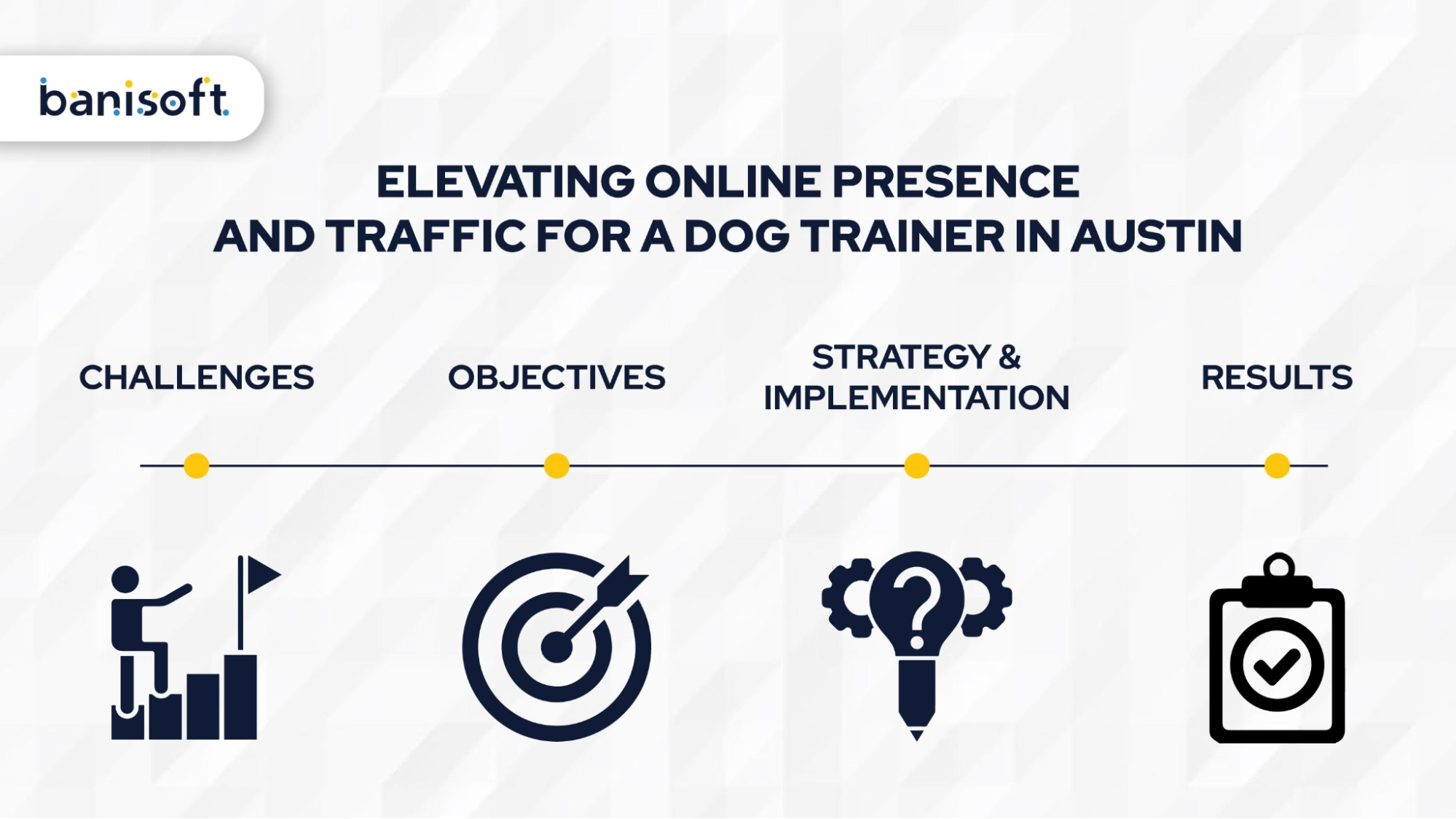
Client: Austin Dog Trainer | Agency: Banisoft Digital Marketing
The Challenge
Our client — an experienced, certified dog trainer in Austin — was generating strong word-of-mouth referrals but had virtually no online visibility. They ranked on page 3+ for “dog trainer Austin” and had minimal engagement on their Google Business Profile. Despite excellent client outcomes and competitive pricing, their digital presence was not reflecting the quality of their service.
The Strategy
1. Google Business Profile Overhaul: We conducted a complete audit and optimization of their GBP: corrected all business information, added 15 high-quality photos of training sessions and facilities, wrote keyword-optimized service descriptions for each training type offered, and implemented a weekly posting schedule for training tips and client spotlights.
2. Geo-Targeted Keyword Research: We identified the highest-value, lowest-competition local keywords for the Austin market: “dog trainer in Austin,” “Austin puppy training,” “in-home dog trainer Austin,” “aggressive dog training Austin,” and “board and train Austin.” Content was then optimized around these terms across the homepage, service pages, and a new blog.
3. Review Generation System: We implemented an automated post-session text message sequence asking satisfied clients for a Google review, paired with a QR code on all training materials. Within 90 days, Google reviews increased by 75%.
4. Local Citation Cleanup: We audited NAP consistency across 40+ directories, corrected inconsistencies, and added the business to 12 relevant local and industry-specific directories it was missing from.
5. On-Page Technical Fixes: We implemented LocalBusiness schema, FAQPage schema, and Service schema. We also resolved a page speed issue caused by uncompressed images, improving mobile load time by 40%.
The Results — 90 Days
| Metric | Before | After | Change |
| Monthly website traffic | Baseline | +50% | +50% |
| Google ranking for “dog trainer Austin” | Page 3 | Page 1 | +20+ positions |
| Google reviews | 12 | 21 | +75% |
| Monthly inquiries and bookings | Baseline | +40% | +40% |
| Local Pack appearances | Rare | Consistent | Significant |
The Takeaway
The results were not the product of one tactic — they were the compound effect of fixing the foundation (technical SEO, GBP, schema), targeting the right keywords, and building social proof systematically. None of these steps require a large budget. They require consistent execution.
Frequently Asked Questions: SEO for Dog Trainers
What is SEO and why does a dog trainer need it?
SEO (Search Engine Optimization) is the process of improving your website and online presence so your business appears prominently when potential clients search for dog training services in your area. Since 74% of pet owners research online before choosing a trainer (Blawgy, 2025), being visible in search results is now a prerequisite for consistent client acquisition — not an optional marketing extra.
How long does SEO take to show results for a dog training business?
Most dog training businesses in moderately competitive markets see measurable improvements in Local Pack visibility within 60–90 days after implementing Google Business Profile optimization and local citation cleanup. Organic ranking improvements for competitive keywords typically take 3–6 months. SEO is a compounding investment — the results grow over time and continue generating traffic without ongoing ad spend.
What is the most important SEO action for a local dog trainer?
Optimizing your Google Business Profile is the single highest-impact first step. It drives Local Pack rankings (the map results that capture 42% of local search clicks (Synup, 2026)), it is free, and it is the primary data source for AI search tools like ChatGPT and Google AI Overviews.
How many Google reviews does a dog trainer need to rank well locally?
There is no fixed number, but businesses with 50+ Google reviews earn 266% more leads than those with fewer than 10 (On The Map, 2026). More importantly, review velocity matters — consistently earning 2–4 new reviews per month signals active service quality to Google’s algorithm and outperforms competitors who earned many reviews once and then stopped.
Does social media help with dog trainer SEO?
Indirectly, yes. Social media signals are not direct ranking factors, but an active social presence drives traffic to your website, builds brand mentions that AI systems recognize, and increases the likelihood of earning backlinks — all of which support SEO. Short-form video content on Instagram and TikTok is particularly effective for dog trainers given the high engagement of dog training content on both platforms.
Should I target “dog trainer near me” as my main keyword?
“Dog trainer near me” is the highest-volume keyword in the category (100,000+ monthly searches), but it is also the most competitive. You cannot optimize your page specifically for “near me” because Google dynamically determines proximity. Focus instead on your city and neighborhood names — “dog trainer [city],” “puppy training [neighborhood]” — and Google will surface your site for “near me” searches when your business is in the relevant geographic range.
What are Google AI Overviews, and should dog trainers care about them?
Google AI Overviews are the AI-generated answer summaries that appear at the top of Google results for many queries. They now appear for 15–25% of searches. (Salesgenie, 2026) Getting cited in these answers can generate significant traffic without requiring the user to scroll past the AI answer. Optimize for AI Overviews by adding a structured FAQ section to your key pages, writing direct answer paragraphs, and ensuring your GBP data is accurate — AI systems pull from both your website and your GBP.
Next Steps: Where to Start Your Dog Training SEO Journey
If you are starting from zero or have an existing website with little organic traffic, here is the recommended sequence:
- Week 1: Complete and optimize your Google Business Profile. Add photos, fill in all fields, add services, and set up posts.
- Week 2: Audit your NAP consistency across all directories. Fix any inconsistencies.
- Week 3–4: Implement schema markup (LocalBusiness, FAQPage) and fix any technical SEO issues flagged by Google PageSpeed Insights.
- Month 2: Begin building reviews systematically with a post-session text message process.
- Month 2–3: Publish your first three keyword-targeted blog posts targeting local informational queries.
- Month 3+: Build backlinks through local partnerships, guest posting, and industry directory listings.
SEO is not a sprint — it is the most durable marketing investment a dog training business can make. The trainers who start now will own their local market in 12 months, while competitors are still depending entirely on referrals and paid ads.
Ready to Grow Your Dog Training Business Online?
Whether you are just starting your SEO journey or need a comprehensive strategy to dominate your local market, Banisoft specializes in SEO and digital marketing for local service businesses. We have helped dog trainers, contractors, dental practices, and professional service businesses build sustainable organic growth through data-driven SEO strategy.
Get a free SEO consultation for your dog training business →