 Summarize in ChatGPT
Table of Contents
- Introduction: Best Dental Services to Promote Online for Higher-Value Patient Leads
- Why Should Dental Clinics Promote Specific Services Instead of Everything?
- What Are the Best Dental Services to Promote Online?
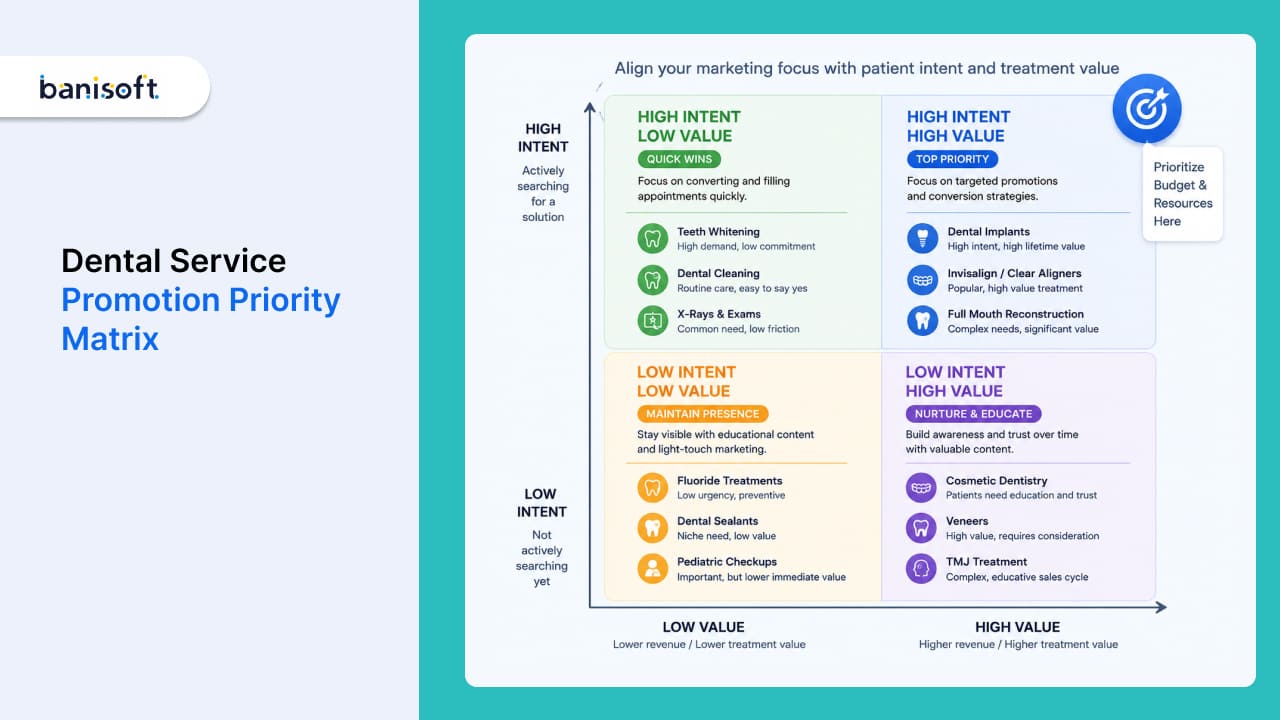
- Which Dental Services Should You Promote First?
- How to Choose the Best Dental Services to Promote Online: A Practical Framework
- How Should Dental Clinics Promote High-Value Services Online?
- Common Mistakes Dental Clinics Make When Promoting Services Online
- Dental Service Promotion Checklist for Clinic Owners
- How a Dental Marketing Partner Can Help
- Conclusion: Building a High-Value Dental Marketing Strategy
- Frequently Asked Questions (FAQs)
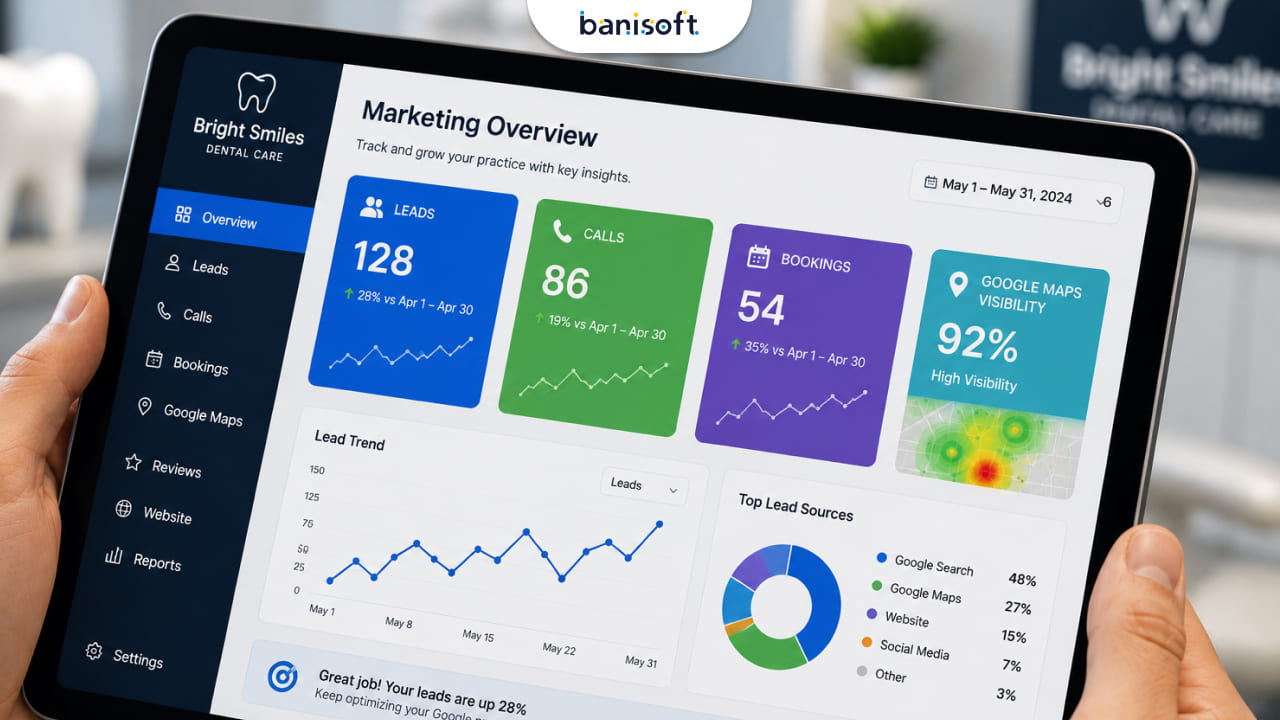
Many dental clinics invest in SEO, Google Ads, and Google Business Profile optimization but still promote every service the same way. That is one of the biggest reasons clinics get traffic without enough profitable appointment requests.
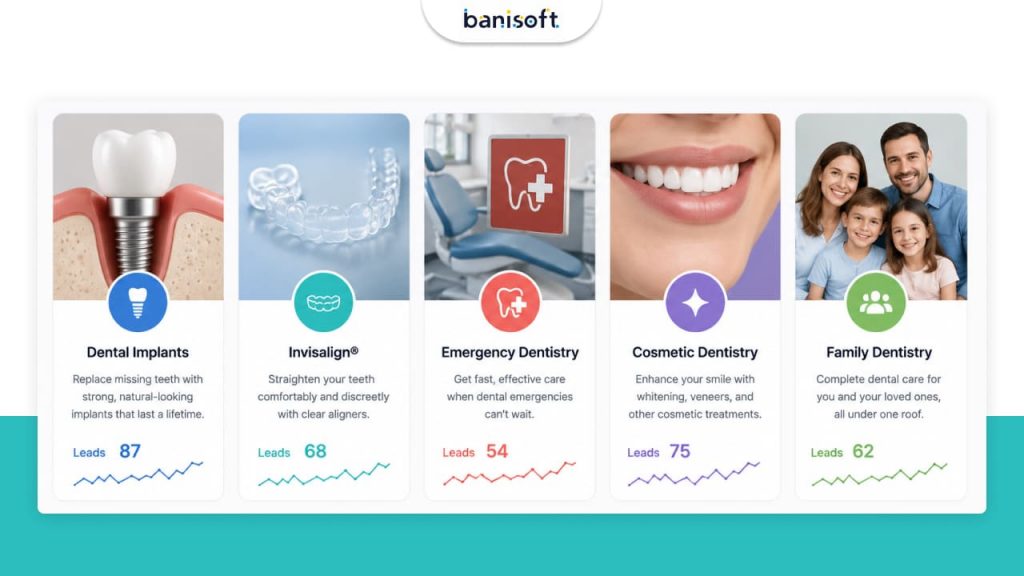
The best dental services to promote online are high-intent, high-value, and decision-driven treatments such as dental implants, Invisalign or clear aligners, cosmetic dentistry, emergency dentistry, root canal treatment, teeth whitening, dentures, crowns, and family dentistry. These services work well online because patients actively search for them when they have a problem, a goal, or a strong reason to book.
This matters because dental marketing is no longer just about “getting more clicks.” It is about attracting the right patients for the right services through the right channel, and tracking which campaigns actually lead to booked appointments.
This article is for dental clinic owners, dentists, practice managers, and decision-makers who want stronger patient acquisition from SEO, Google Business Profile, Google Ads, local SEO, reviews, and landing pages.
Google’s own guidance emphasizes helpful, reliable, people-first content, and dental clinics should follow the same principle in marketing: answer real patient concerns clearly rather than creating thin service pages solely for rankings.
Why Should Dental Clinics Promote Specific Services Instead of Everything?
Short answer: Dental clinics should promote specific services because different treatments have different patient intent, value, urgency, competition, and conversion paths.
A patient searching for “dentist near me” may simply need a check-up. A patient searching for “dental implants cost near me” is usually comparing treatment options, pricing, trust factors, and provider expertise. A patient searching “emergency dentist open now” may be ready to call immediately.
These are very different patient journeys.
From a dental marketing strategy perspective, each service should be evaluated based on:
- Search demand in your city or service area
- Treatment value and profitability
- Patient urgency
- Level of competition
- Website conversion potential
- Google Business Profile relevance
- Review support
- Ability to track calls, forms, and bookings
A clinic that promotes every service equally often spreads its budget too thin. A clinic that promotes the right services with dedicated SEO pages, GBP optimization, ads, and landing pages usually builds a more focused patient acquisition system.
What Are the Best Dental Services to Promote Online?
Short answer: The best dental services to promote online are usually those with strong patient intent, higher treatment value, clear search demand, and a compelling reason for patients to book a consultation.
Below are the dental services that often perform well in SEO, Google Ads, Google Maps, and conversion-focused campaigns.
1. Dental Implants
Dental implants are among the most important services to promote online because patients often research them thoroughly before choosing a clinic. They may compare costs, procedural steps, pain levels, recovery times, financing, technology, and dentists’ experience.
Why dental implants attract higher-value leads
Dental implant patients are not usually looking for a quick, low-cost appointment. They are often trying to solve a long-term functional, cosmetic, and confidence-related problem. This makes implant marketing valuable, but also more trust-dependent.
Best channels to promote dental implants
- Dedicated dental implant SEO service page
- Google Ads search campaigns
- Google Business Profile service optimization
- Educational blog content
- Before-and-after case explanations, if compliant and real
- Video FAQs from the dentist
- Review strategy focused on implant-related patient experience
What your implant page should include
A strong dental implant page should answer:
- Who is a good candidate for dental implants?
- What is the process?
- How long does treatment take?
- What affects cost?
- What alternatives exist?
- Why choose this clinic?
- How can patients book a consultation?
💡Expert Tip: Do not make dental implant marketing only about price. Patients want affordability, but they also want confidence, safety, experience, technology, and clear next steps.
2. Invisalign and Clear Aligners
Invisalign and clear aligners are excellent services to promote because patients often search with strong comparison intent. They want to know whether clear aligners are right for them, how long treatment takes, how they compare with braces, and whether the clinic provides flexible payment options.
Why Invisalign marketing works well online
Clear aligner patients are often motivated by appearance, comfort, confidence, and lifestyle convenience. This makes the service suitable for SEO, Google Ads, social proof, landing pages, and educational content.
Best keywords and content angles
Examples include:
- Invisalign dentist near me
- Clear aligners near me
- Invisalign cost
- Invisalign vs braces
- Best Invisalign dentist in [city]
- Can adults get Invisalign?
A clinic should not rely solely on a single Invisalign page. Supporting blog posts can cover benefits, cost factors, common myths, treatment timelines, adult orthodontics, and comparison content.
💡Expert Tip: Invisalign campaigns typically require robust conversion support. Add consultation CTAs, financing mentions where applicable, smile assessment prompts, FAQs, and trust-building content from the dentist.
3. Cosmetic Dentistry
Cosmetic dentistry can attract high-value patients because people seeking smile improvement often compare providers, portfolios, reviews, treatment options, and aesthetic outcomes.
Services under cosmetic dentistry to promote
- Veneers
- Teeth whitening
- Smile makeovers
- Cosmetic bonding
- Gum contouring
- Tooth reshaping
- Clear aligners
- Cosmetic crowns
Why cosmetic dentistry needs strong trust signals
Cosmetic patients are not only asking, “Can you fix my teeth?” They are asking, “Can I trust you with my smile?” That means the page needs visual proof, real explanations, dentist expertise, treatment options, and realistic expectations.
Do not use fake before-and-after images or generic stock results. If before-and-after photos are used, they should be real, compliant, approved, and clearly presented.
4. Emergency Dentistry
Emergency dentistry is one of the strongest services for immediate lead generation because search intent is urgent. A person with tooth pain, swelling, broken teeth, or dental trauma is often ready to call.
Why emergency dental leads convert quickly
Emergency patients usually need immediate help. They are less likely to read five blogs before contacting a clinic. They want to know:
- Are you open now?
- Can I get a same-day appointment?
- Do you treat severe tooth pain?
- Where are you located?
- Can I call immediately?
- What should I do before I arrive?
Best channels for emergency dentistry
- Google Business Profile
- Google Maps visibility
- Local SEO service page
- Google Ads call campaigns
- Mobile-friendly landing page
- Call tracking
- Clear opening hours
Google states that local ranking is influenced by relevance, distance, and prominence, which is why emergency dental marketing must effectively connect the website, Google Business Profile, reviews, and location signals.
Expert Tip: Emergency dentistry pages should be built for mobile users first. Patients in pain do not want long paragraphs before they find the phone number.
5. Root Canal Treatment
Root canal treatment is an important service to promote because patients usually seek it when they are experiencing pain, infection, sensitivity, or fear of losing a tooth.
Why root canal marketing works
Root canal searches often combine urgency with anxiety. Patients want pain relief, clarity, reassurance, and proof that the clinic can safely handle the treatment.
Content that helps convert root canal patients
- Symptoms that may require a root canal
- Whether root canal treatment is painful
- Treatment steps
- Recovery expectations
- Cost factors
- Emergency appointment availability
- Difference between extraction and saving the tooth
💡Expert Tip: Root canal content should reduce fear. Avoid overly clinical language. Explain the treatment in simple terms, focusing on pain relief, tooth preservation, and next steps.
6. Dental Crowns and Bridges
Crowns and bridges are valuable to promote because they connect with restorative, cosmetic, and functional dentistry. Patients may seek care for a broken tooth, a root canal, a missing tooth, or a recommendation from another dentist.
Why crowns and bridges deserve dedicated pages
Many clinics bury crowns and bridges under a general restorative dentistry page. That can limit visibility. A dedicated page can rank for specific searches and help patients understand when each treatment is needed.
Useful content angles
- Dental crown cost
- Same-day crowns, if offered
- Crown after root canal
- Dental bridge vs implant
- Broken tooth repair
- Front tooth crown
7. Teeth Whitening
Teeth whitening may not always be the highest-value dental service, but it is useful for attracting cosmetic patients and introducing new people to the clinic.
Why teeth whitening is strategically useful
Teeth whitening can act as an entry-point service. A patient may first visit for whitening and later consider veneers, clear aligners, cosmetic bonding, hygiene visits, or a full smile makeover.
Best way to promote teeth whitening
- Local SEO page
- Cosmetic dentistry cluster
- Google Business Profile service listing
- Social media content
- Offer-led landing page, if ethical and compliant
- Email marketing to existing patients
💡Expert Tip: Teeth whitening marketing should clearly explain professional whitening versus over-the-counter options without making exaggerated claims.
8. Dentures and Implant-Supported Dentures
Dentures are important for clinics serving older adults, patients with missing teeth, and people looking for affordable tooth replacement options.
Why denture leads can be valuable
Denture patients often need consultation, fitting, adjustments, repairs, replacements, or implant-supported options. This can create multiple appointment opportunities.
Content to include
- Full dentures vs partial dentures
- Denture repairs
- Implant-supported dentures
- Cost factors
- Eating and speaking with dentures
- Adjustment timeline
- When to replace old dentures
9. Family Dentistry and New Patient Exams
Family dentistry may not always be the highest-value service per appointment, but it is essential for building long-term patient volume.
Why family dentistry matters
A single new family patient can lead to multiple appointments across check-ups, hygiene, fillings, sealants, children’s dentistry, orthodontic referrals, whitening, and emergency care.
Best channels
- Local SEO
- Google Business Profile
- Review strategy
- Location pages
- School/community content
- New patient landing page
💡Expert Tip: Family dentistry marketing should focus on convenience, trust, location, appointment availability, children’s comfort, insurance/payment clarity, and long-term care.
10. Pediatric Dentistry
Pediatric dentistry can be a strong local SEO and Google Maps opportunity, especially for clinics that want to attract families.
What parents search for
Parents often search for:
- Kids dentist near me
- Pediatric dentist near me
- Child tooth pain
- First dental visit
- Dental cleaning for kids
- Cavity treatment for children
A pediatric dental page should speak to parents, not just describe the treatment. It should explain comfort, safety, child-friendly communication, appointment expectations, and preventive care.
Which Dental Services Should You Promote First?
Short answer: Start with services that combine strong local search demand, high patient value, good clinic capacity, strong reviews, and clear conversion potential.
Not every dental clinic should promote the same services first. A new clinic may need general dentistry and emergency dentistry to increase appointment volume. An established clinic may focus on implants, Invisalign, cosmetic dentistry, or full-mouth rehabilitation.
Here is a practical comparison.
| Dental Service | Patient Intent | Lead Value Potential | Best Marketing Channels | Conversion Requirement |
| Dental Implants | Research + consultation | High | SEO, Google Ads, GBP, landing pages | Strong trust, FAQs, financing info |
| Invisalign / Clear Aligners | Comparison + consultation | High | SEO, Google Ads, blogs, social proof | Assessment CTA, before/after proof |
| Cosmetic Dentistry | Research + aesthetic trust | High | SEO, content, GBP, social, landing pages | Visual proof, dentist authority |
| Emergency Dentistry | Immediate need | Medium to high | GBP, Local SEO, Google Ads, call tracking | Phone visibility, same-day messaging |
| Root Canal Treatment | Pain + urgency | Medium to high | SEO, GBP, Google Ads | Reassurance, pain-relief messaging |
| Crowns and Bridges | Problem-solving | Medium to high | SEO, service pages, GBP | Clear treatment explanation |
| Teeth Whitening | Cosmetic entry point | Medium | Local SEO, social, email, GBP | Offer clarity, realistic expectations |
| Family Dentistry | Ongoing care | Long-term value | Local SEO, GBP, reviews | Convenience, trust, family messaging |
| Pediatric Dentistry | Parent-driven | Long-term value | Local SEO, GBP, content | Comfort, safety, parent reassurance |
| Dentures | Functional need | Medium to high | SEO, GBP, Google Ads | Cost factors, options, consultation CTA |
How to Choose the Best Dental Services to Promote Online: A Practical Framework
Short answer: Use a service prioritization framework before spending more on SEO or ads.
Here is a step-by-step system dental clinics can follow.
Step 1: List Your Core Dental Services
Create a complete list of your services, including:
- General dentistry
- Emergency dentistry
- Cosmetic dentistry
- Dental implants
- Invisalign or clear aligners
- Teeth whitening
- Veneers
- Crowns and bridges
- Root canal treatment
- Dentures
- Pediatric dentistry
- Hygiene and preventive care
Do not start with keywords first. Start with business priorities.
Step 2: Score Each Service by Business Value
Ask:
- Which services generate stronger revenue?
- Which treatments have better profit margins?
- Which services does the clinic want more of?
- Which services does the dentist have strong expertise in?
- Which services can the clinic handle operationally?
For example, promoting implants makes sense only if the clinic has the right clinical capacity, consultation process, treatment planning, follow-up workflow, and patient education system.
Step 3: Check Local Search Demand
Now evaluate search behavior. Look at:
- Google Search Console data
- Google Ads Keyword Planner
- Google Business Profile search terms
- Competitor service pages
- Local SERP results
- Google Maps competitors
- Existing website rankings
You are looking for services that patients are already searching for, and your clinic has a realistic opportunity to compete.
Step 4: Review Current Visibility
For each service, check whether your clinic has:
- A dedicated service page
- A location-specific version, where relevant
- Google Business Profile service listing
- Internal links from related pages
- Reviews that mention the service
- Photos or videos supporting the treatment
- FAQs answering patient concerns
- Tracking for calls and forms
If a high-value service has no dedicated page and no GBP support, that is usually a major opportunity.
Step 5: Match the Service to the Right Channel
Not every service needs the same marketing channel.
Dental implants may need SEO, Google Ads, landing pages, and nurturing. Emergency dentistry may need Google Maps, phone calls, local SEO, and ads. Teeth whitening may work well with GBP posts, email marketing, and social content.
Google Ads can work well for dental clinics, but healthcare advertising must follow applicable laws, industry standards, and platform policies. Google’s healthcare and medicines policy states that some healthcare-related content is subject to location-based restrictions and approval requirements.
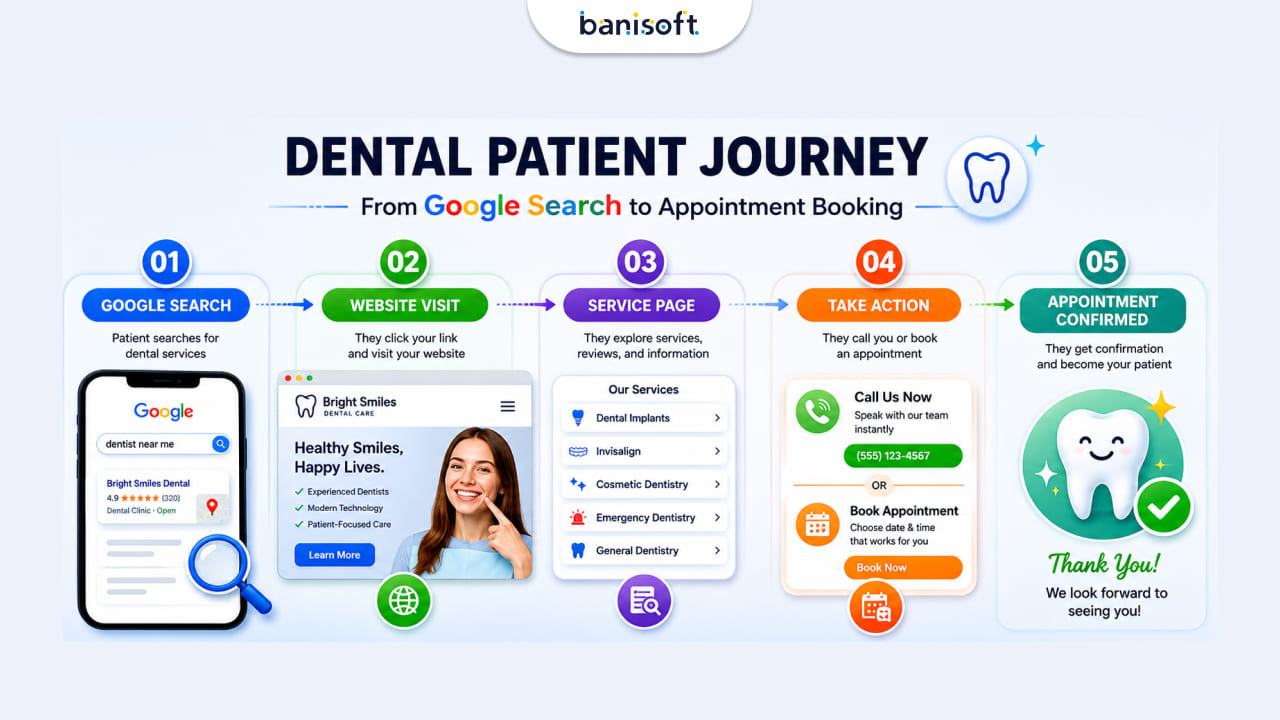
Step 6: Build a Conversion Journey
Traffic alone does not create patients. For each promoted service, build a clear conversion path:
- Patient searches
- Patient finds your clinic
- Patient lands on the right page
- Page answers their concern
- Trust signals reduce hesitation
- CTA prompts call or booking
- Clinic tracks the lead source
- Front desk follows up quickly
- Marketing data is reviewed monthly
Google Ads conversion tracking usually requires defining a conversion action and installing the Google tag or using Google Tag Manager, which is important if your clinic wants to know which campaigns are driving calls, form submissions, or bookings.
How Should Dental Clinics Promote High-Value Services Online?
Short answer: Use a connected system: service pages, Google Business Profile, Google Ads, local SEO, reviews, content, tracking, and conversion-focused landing pages.
1. Create Dedicated Service Pages
Each high-value service should have its own page. Avoid putting implants, Invisalign, veneers, crowns, and emergency dentistry into one generic “services” page.
A strong service page should include:
- Clear service explanation
- Symptoms or patient situations
- Treatment options
- Dentist/team expertise
- Location relevance
- FAQs
- Reviews, if real and service-specific
- Strong CTA
- Internal links
- Schema markup
- Tracking
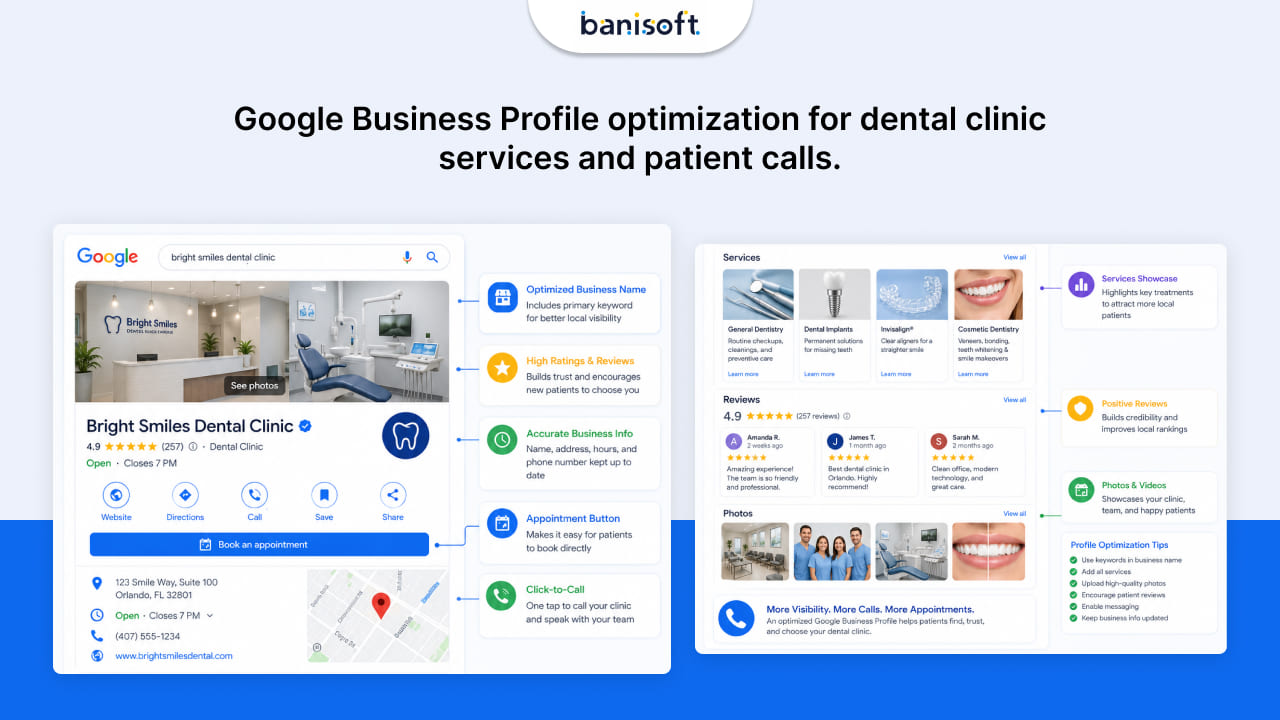
2. Optimize Google Business Profile for Service Relevance
Your Google Business Profile should support your website strategy. Add accurate categories, services, descriptions, appointment links, photos, updates, and review responses.
Google recommends keeping Business Profile information complete and accurate because it helps customers know what you do, where you are, and when they can visit.
For a dental clinic, GBP optimization should include:
- Primary category: Dentist or relevant clinic type
- Secondary categories, if applicable
- Service listings
- Appointment URL
- Accurate hours
- Photos of clinic, team, treatment rooms
- Review responses
- Posts for key services
- Local phone number
3. Use Google Ads for High-Intent Services
Google Ads can be useful for services where patients are ready to act or compare options.
Good candidates include:
- Emergency dentist
- Dental implants
- Invisalign
- Root canal
- Dentist near me
- Teeth whitening
- Dentures
- Cosmetic dentist
But the campaign must be structured carefully. Sending all ad traffic to the homepage usually wastes budget. Each ad group should connect to a relevant landing page.
4. Build Local SEO Around Service + Location
Local SEO is especially important for dental clinics because patients usually choose a nearby provider. For service pages, include natural location context, such as neighborhood, city, nearby landmarks, parking, accessibility, and service area.
Examples:
- Dental implants in [city]
- Emergency dentist in [neighborhood]
- Invisalign provider near [location]
- Family dentist near [community]
Avoid stuffing city names unnaturally. The page should read as if it were written for a local patient, not just for Google.
5. Use Reviews Strategically and Ethically
Reviews influence trust, conversion, and local discovery. For promoted services, clinics should encourage genuine patient feedback without incentives, pressure, or fake review practices.
Useful review prompts after treatment may include:
- How was your experience with the team?
- Did the clinic explain the treatment clearly?
- Was scheduling easy?
- Did you feel comfortable during your visit?
Do not ask patients to mention specific keywords in a forced way. Keep review generation ethical and patient-first.
6. Track Calls, Forms, and Bookings
Dental clinics often judge marketing by impressions and clicks, but the real question is:
Which service pages and campaigns are producing appointment requests?
Track:
- Phone calls
- Form submissions
- Online bookings
- Direction clicks
- GBP calls
- Google Ads conversions
- Service-page conversions
- Cost per qualified lead
- Consultation-to-treatment conversion
Without tracking, the clinic may continue funding campaigns that appear active but do not generate high-quality leads.
Common Mistakes Dental Clinics Make When Promoting Services Online
Short answer: Most clinics do not fail for lack of services. They fail because their marketing does not connect patient intent, service value, page content, local visibility, and tracking.
Mistake 1: Promoting the Homepage Instead of Service Pages
The homepage is too general for many high-intent searches. A patient searching for dental implants should land on an implant page, not a generic homepage.
Mistake 2: Running Ads Without Conversion Tracking
Clicks do not prove patient growth. Calls, consultation requests, and booked appointments matter more.
Mistake 3: Using the Same CTA for Every Service
An emergency dentistry page may need a “Call Now” CTA. An Invisalign page may need “Book a Smile Assessment.” A dental implant page may need “Request an Implant Consultation.”
Mistake 4: Ignoring Google Business Profile Services
Many clinics optimize the website but forget to align GBP services, categories, posts, reviews, and photos.
Mistake 5: Writing Thin Service Pages
A 300-word page and a booking button are rarely enough for competitive services like implants, Invisalign, veneers, or cosmetic dentistry.
Mistake 6: Not Using Real Trust Signals
Patients want to see real clinic photos, dentist experience, technology, reviews, treatment explanations, and clear expectations.
Mistake 7: Measuring All Leads Equally
A hygiene inquiry, an emergency call, an implant consultation, and an Invisalign lead should not be judged the same way. Segment leads by service type and quality.
Dental Service Promotion Checklist for Clinic Owners
Use this checklist before investing more into SEO, Google Ads, or GBP campaigns.
Service Selection Checklist
- Have we identified our top 5 priority services?
- Do these services match our business goals?
- Do we have capacity to handle more of these patients?
- Do these services have local search demand?
- Do we know which competitors rank for these services?
Website Checklist
- Does each priority service have a dedicated page?
- Is the page written for patients, not just search engines?
- Does it answer questions about cost, process, pain, timeline, and suitability?
- Does it include a strong CTA?
- Does it include internal links to related services?
- Does it load well on mobile?
Google Business Profile Checklist
- Are services added to GBP?
- Are the hours, phone number, address, and appointment links accurate?
- Are reviews being requested ethically?
- Are review responses active?
- Are posts and photos updated?
Google Ads Checklist
- Do services separate campaigns?
- Are ads going to relevant landing pages?
- Are calls and forms tracked?
- Are negative keywords reviewed?
- Are healthcare advertising policies checked?
Conversion Checklist
- Is the phone number visible on mobile?
- Is the booking form short and easy to use?
- Is there a clear consultation CTA?
- Is front-desk follow-up fast?
- Does treatment type categorize leads?
How a Dental Marketing Partner Can Help
A strong dental marketing strategy is not about pushing every service online. It is about choosing the right services, understanding patient intent, improving visibility, and building a conversion journey that turns searches into calls, bookings, and consultations.
For many clinics, the biggest opportunity is not “more marketing.” It is better alignment between SEO, Google Business Profile, Google Ads, service pages, reviews, and tracking.
Conclusion
The best dental services to promote online are those that combine patient demand, treatment value, local search opportunities, and strong conversion potential. For many clinics, this includes dental implants, Invisalign, cosmetic dentistry, emergency dentistry, root canal treatment, crowns, dentures, teeth whitening, pediatric dentistry, and family dentistry.
But the service itself is only one part of the strategy. To generate higher-value patient leads, clinics need dedicated service pages, accurate Google Business Profile optimization, ethical review generation, Google Ads tracking, local SEO, and a clear booking journey.
If your clinic wants more appointment requests from the right patients, start by identifying which dental services to promote online first, then build the marketing system around those services.
Frequently Asked Questions
1. What are the best dental services to promote online?
The dental services that perform best online are usually dental implants, Invisalign or clear aligners, cosmetic dentistry, emergency dentistry, root canal treatment, crowns, dentures, teeth whitening, pediatric dentistry, and family dentistry. These services often have strong patient intent, clear search demand, and good potential to generate appointment requests when supported by SEO, Google Ads, GBP, and conversion tracking.
2. Should a dental clinic promote implants with SEO or Google Ads?
Dental implants can work well with both SEO and Google Ads. SEO helps build long-term visibility through service pages, FAQs, blogs, and local authority. Google Ads can generate faster visibility for high-intent searches. The best approach is usually a combined strategy with a strong implant landing page, tracking, reviews, and clear consultation CTAs.
3. Is emergency dentistry a good service to advertise online?
Yes, emergency dentistry is one of the strongest services for immediate patient leads because the search intent is urgent. Patients seeking emergency dental care often want a same-day appointment, a phone number, a location, and opening hours. Google Business Profile, local SEO, mobile landing pages, and call tracking are especially important for this service.
4. How do I know which dental service to promote first?
Start by reviewing treatment value, local search demand, clinic capacity, competition, existing rankings, review support, and conversion potential. A service may be profitable, but if your clinic cannot handle more appointments or lacks a proper landing page, it may not be the best starting point. Score each service before spending more on ads or SEO.
5. Should every dental service have its own website page?
Priority services should usually have dedicated pages, especially if patients search for them directly. Dental implants, Invisalign, emergency dentistry, root canals, veneers, crowns, and dentures should not be hidden inside a generic services page. Dedicated pages help answer specific patient questions and support SEO, Google Ads, and conversion tracking.
6. How does Google Business Profile help promote dental services?
Google Business Profile helps dental clinics appear in local search results and on Google Maps when patients search for nearby services. Clinics should keep business details accurate, add services, upload photos, respond to reviews, and use appointment links. Google explains that local ranking is influenced by relevance, distance, and prominence.
7. Can Google Ads generate high-value dental leads?
Google Ads can generate high-value dental leads when campaigns are built around specific services, strong landing pages, accurate tracking, and compliant messaging. The mistake many clinics make is sending all traffic to the homepage or tracking clicks instead of calls, forms, and booked appointments. Healthcare advertising policies should be reviewed before publishing campaigns.
8. What should a dental service page include to convert better?
A strong dental service page should include a clear explanation of the treatment, symptoms or patient situations, benefits, process, cost factors, FAQs, dentist expertise, real trust signals, location relevance, reviews if available, and a clear CTA. The page should also be mobile-friendly and connected to tracking so the clinic can measure calls and bookings.