dental clinic

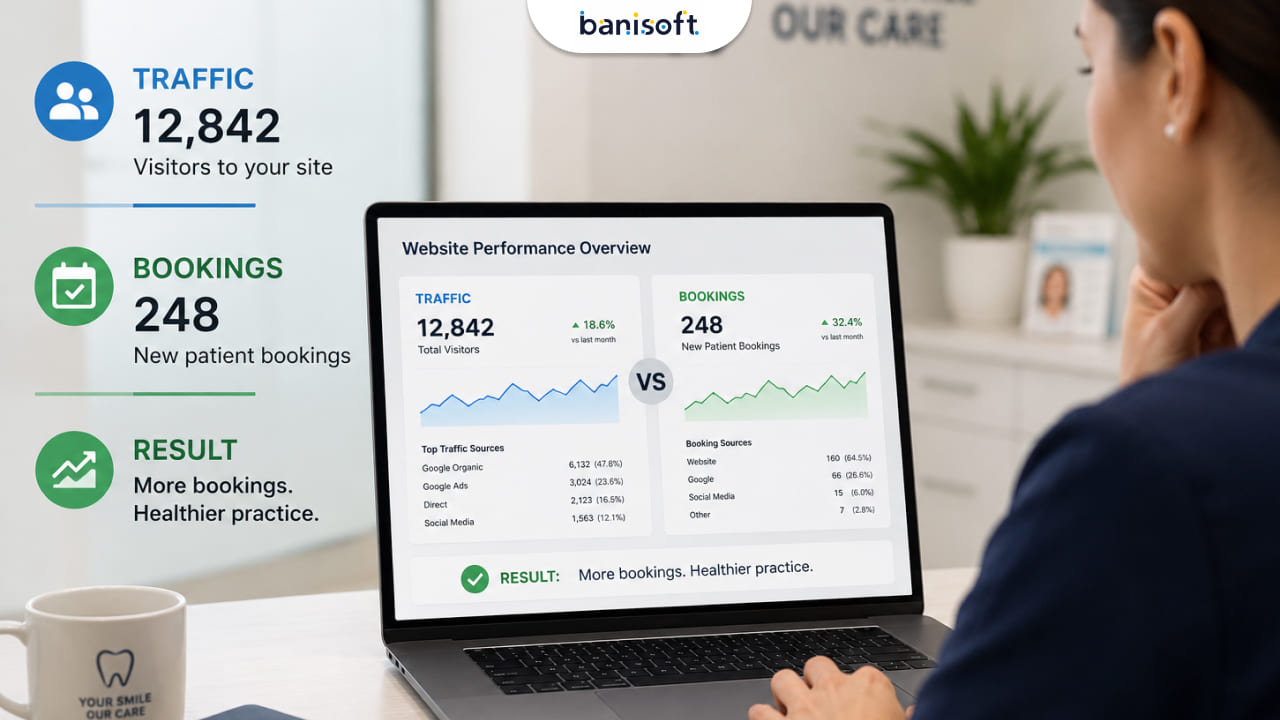
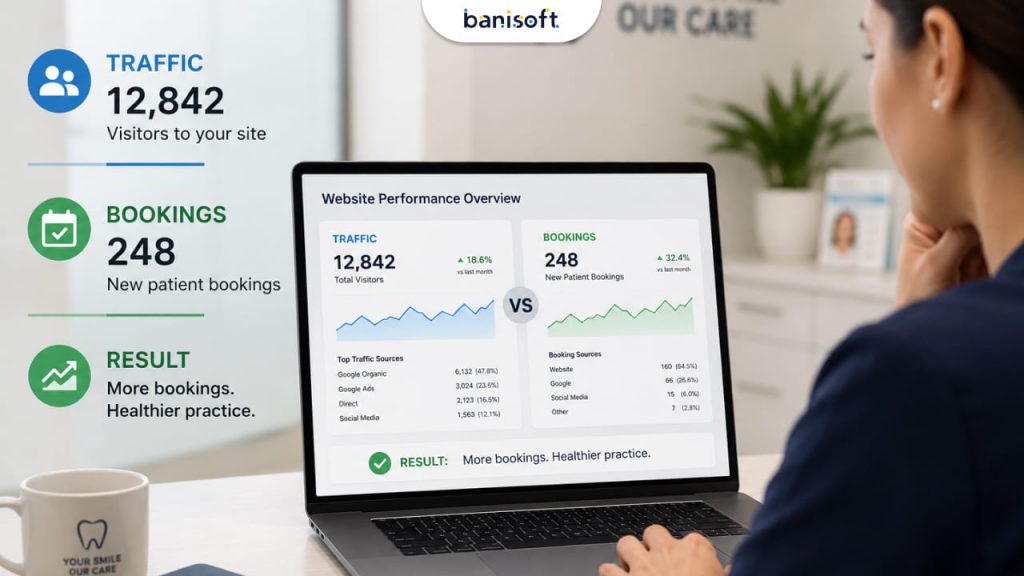
Dental clinic reviewing website traffic and patient booking performance

Why Dental Website Traffic Isn’t Turning Into Patients

Dental clinic reviewing website traffic and patient booking performance

Many dental clinics look at their website reports and see a positive sign: traffic is increasing. But when they check the real business outcome — calls, appointment requests, treatment enquiries, and new patient bookings — the numbers do not match the traffic.

The reason is simple: dental website traffic does not automatically create patient bookings. A clinic can attract visitors from Google, Google Maps, blog content, or paid ads, but still lose them because of weak messaging, unclear treatment pages, poor local trust signals, slow enquiry paths, weak calls-to-action, or incorrect tracking.

This matters because dental marketing is not just about getting more visitors. It is about turning the right visitors into booked appointments.

Who this blog is for: Dental clinic owners, dentists, practice managers, and decision-makers who want more predictable patient growth.
How this advice was developed: Based on hands-on dental marketing experience across SEO, Google Business Profile, Google Ads, landing pages, tracking, and lead generation.
Why it matters: Because traffic without bookings creates the illusion of marketing progress while revenue stays flat.

Short answer: Dental traffic fails to convert when the website attracts the wrong search intent, does not build enough trust, makes booking difficult, or fails to connect the patient’s problem with the right dental service.

In dental marketing, not every visitor has the same value. Someone searching “what causes bleeding gums” may be in research mode. Someone searching “emergency dentist near me open now” has much stronger booking intent. If both visitors land on similar pages with generic content, the clinic may get traffic but not enough conversions.

A dental website needs to answer three questions quickly:

  1. Can this clinic solve my problem?
  2. Can I trust this clinic with my teeth, smile, pain, or family?
  3. How easy is it to book, call, or request help now?

If the answer is unclear, the patient may leave and choose another clinic.
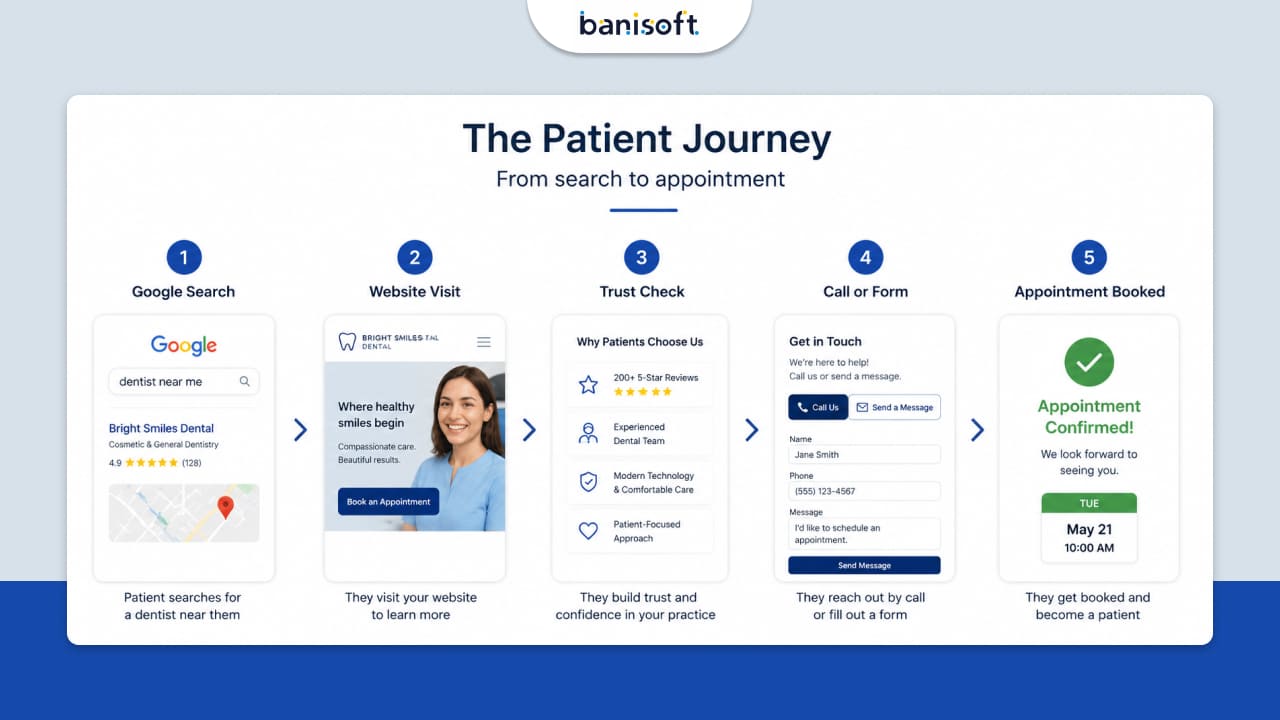
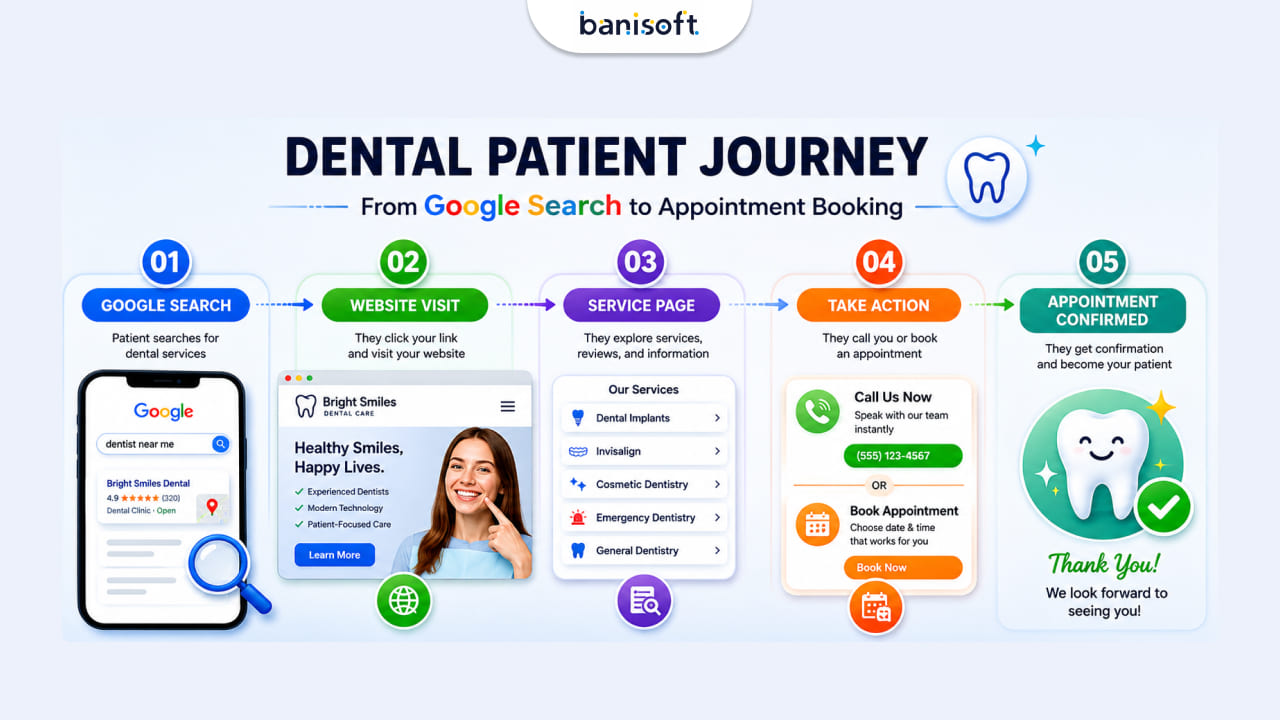
Dental patient journey from Google search to appointment booking

Short answer: More traffic is not always better. Dental clinics need high-intent local traffic from people who are actively looking for dental treatment, not just general information.

One of the most common mistakes in dental SEO is celebrating traffic growth without checking what type of traffic is growing.

For example, a blog titled “10 Foods That Are Good for Your Teeth” may bring visitors, but many of them may not be ready to book an appointment. On the other hand, a page targeting “root canal dentist in [city]” or “Invisalign dentist near me” may bring fewer visitors but produce better appointment enquiries.

Traffic TypeExample SearchPatient IntentBooking Potential
Informational“why do gums bleed when brushing”Researching symptomsMedium
Local service“dentist near me accepting new patients”Looking for a clinicHigh
Urgent care“emergency dentist open today”Needs immediate helpVery High
Treatment-specific“Invisalign dentist in [city]”Comparing providersHigh
General education“how to whiten teeth naturally”Learning onlyLow to Medium
Price comparison“dental implant cost near me”Evaluating optionsMedium to High

💡Expert Tip: Review your top landing pages in GA4 or Google Search Console. If most traffic comes from broad educational blogs but your service pages are weak, your website may look successful in reports while still underperforming in patient acquisition.


Short answer: Dental service pages should not only explain treatments. They should help patients understand symptoms, options, trust factors, pricing guidance, location convenience, and how to book.

Many dental websites have service pages that are too thin or too generic. A page may say “We offer dental implants, Invisalign, teeth whitening, root canal, and emergency dentistry,” but that does not give a patient enough confidence to take action.

A strong dental service page should include:

  • What the treatment is
  • Who it is for
  • Common symptoms or situations
  • Benefits and limitations
  • What happens during the appointment
  • Dentist or team expertise
  • Patient safety and comfort information
  • Location and parking details where relevant
  • Reviews related to that treatment
  • Clear booking options
  • FAQs
  • Internal links to related services

Example

A weak emergency dental page says:

“We provide emergency dental care. Call us today.”

A stronger page says:

“If you have severe tooth pain, swelling, a broken tooth, knocked-out tooth, bleeding, or pain after dental work, our dental team can assess the issue and recommend the next step. Call the clinic to check same-day appointment availability.”

The second version is more useful because it matches the patient’s real situation.
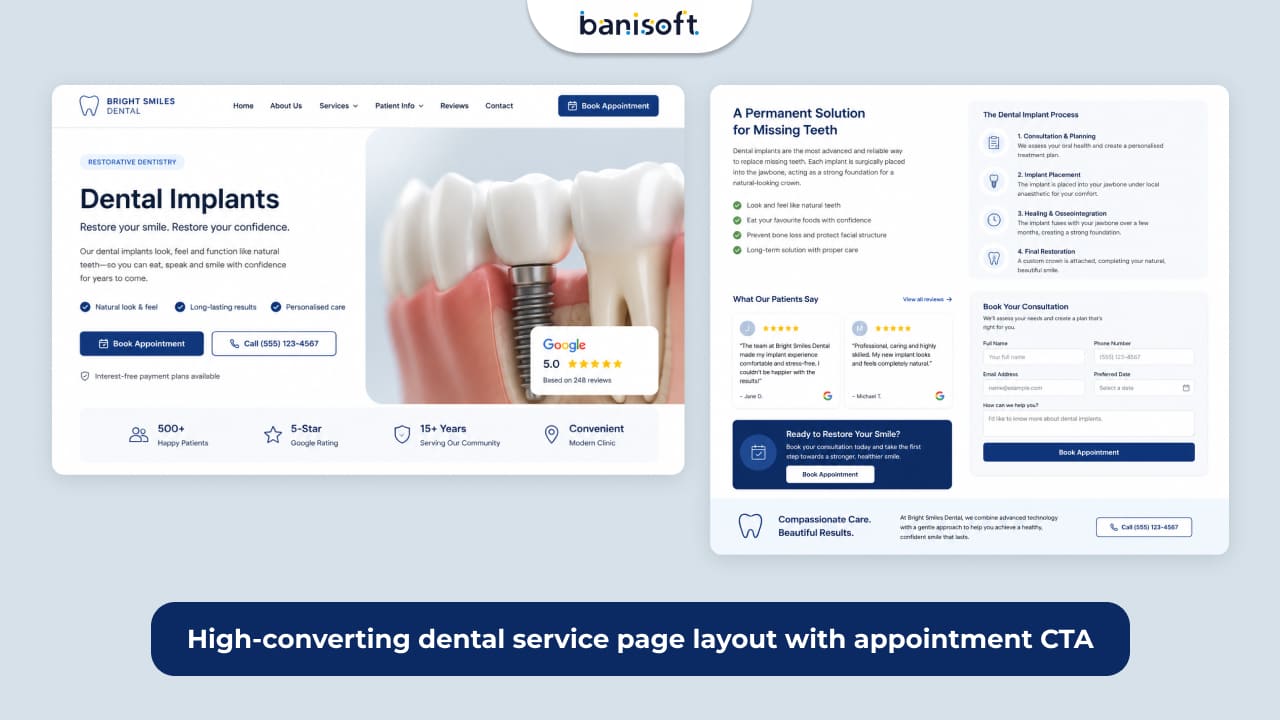
High-converting dental service page layout with appointment CTA

Short answer: Dental patients often need reassurance before booking. Trust signals such as dentist profiles, real clinic photos, treatment explanations, reviews, credentials, and clear policies can improve conversion quality.

Dental decisions are personal. Patients are not just buying a service; they are choosing who will work on their teeth, manage their pain, improve their smile, or treat their family.

A dental website should reduce uncertainty.

Important trust signals include:

  • Dentist and hygienist profiles
  • Real clinic photos instead of only stock images
  • Google reviews and service-specific testimonials
  • Before-and-after galleries, where legally and ethically allowed
  • Clear treatment explanations
  • Payment or insurance guidance
  • Emergency care availability
  • Sterilization and safety information
  • Transparent contact details
  • Location, parking, and accessibility information

💡 Expert Tip: Do not place all reviews only on the homepage. If a patient is reading an Invisalign page, show Invisalign-related reviews where possible. If they are reading an emergency dental page, show reviews about urgent care, pain relief, or same-day support.


Short answer: Your Google Business Profile can influence calls, direction requests, reviews, local trust, and patient decisions before visitors even reach your website.

For local dental searches, Google Business Profile is often part of the patient’s decision journey. Google’s local ranking guidance explains that local results are influenced by relevance, distance, and prominence, and that complete, accurate business information helps people understand what a business offers. 

For dental clinics, this means your website and GBP should work together.

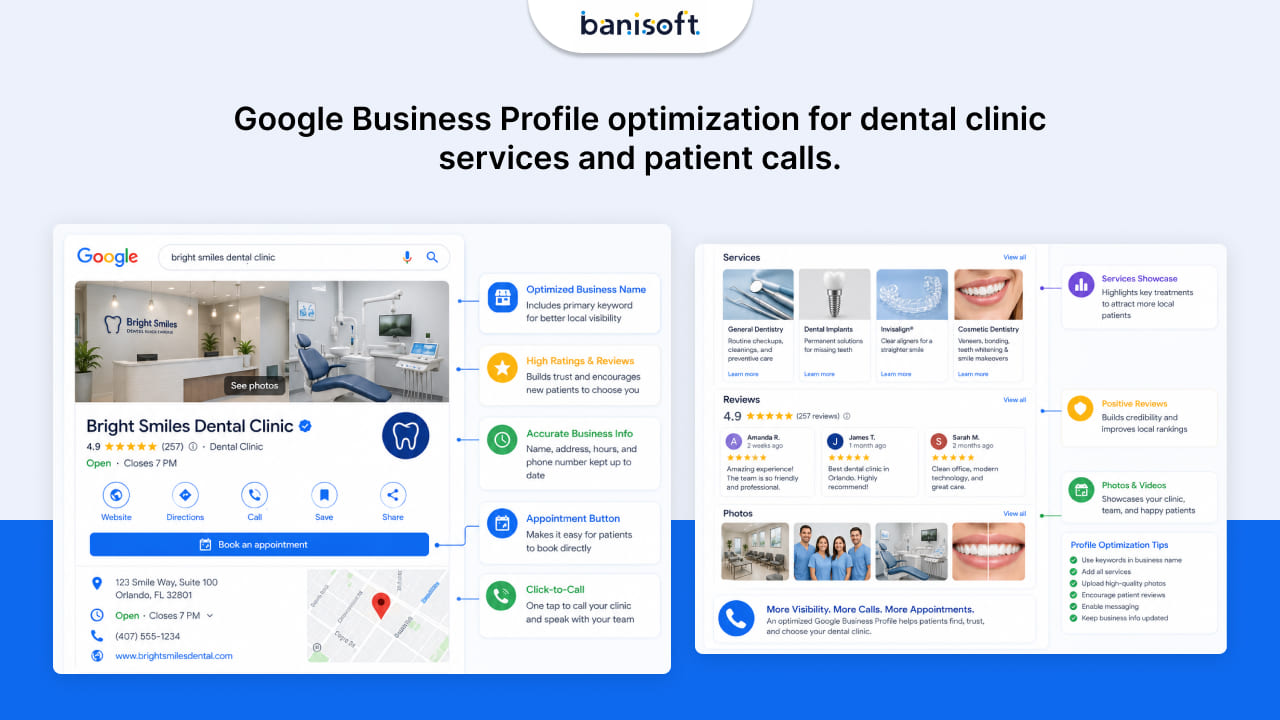
Your Google Business Profile should have:

  • Correct clinic name, address, phone number, and hours
  • Accurate dental categories
  • Services listed properly
  • Appointment URL
  • High-quality clinic photos
  • Regular posts or updates
  • Review responses
  • Q&A section where relevant
  • UTM tracking on website links
  • Consistent information across the website and directories

Common GBP Conversion Problem

A patient finds your clinic on Google Maps, clicks to your website, lands on a generic homepage, cannot immediately find the treatment they searched for, and leaves.

A better journey would send the patient from the GBP listing or local search result to a relevant service or location page with a clear booking path.
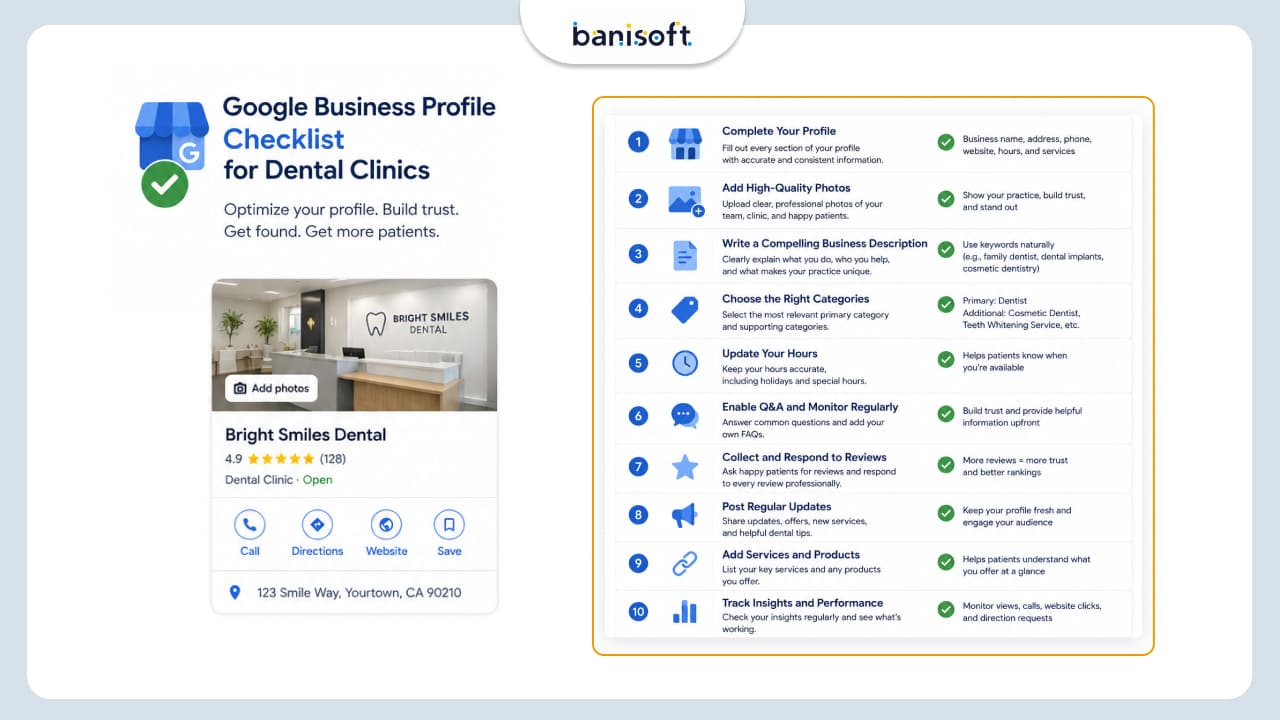
Google Business Profile optimization checklist for dental clinics

Short answer: Patients should not have to search for how to book. Every important page should make the next step clear: call, book online, request an appointment, or ask a question.

Many dental websites lose bookings because the CTA is either hidden, vague, or not aligned with patient urgency.

Weak CTAs include:

  • “Learn More”
  • “Submit”
  • “Contact Us”
  • “Read More”

Stronger dental CTAs include:

  • “Request an Appointment”
  • “Call the Clinic”
  • “Book a Dental Consultation”
  • “Check Emergency Appointment Availability”
  • “Ask About Invisalign Options”
  • “Schedule a New Patient Visit”

Place CTAs:

  • Above the fold
  • After the first service explanation
  • Beside treatment benefits
  • Near reviews
  • After FAQs
  • In sticky mobile headers
  • At the end of the page

💡Expert Tip: On mobile, the phone number should be clickable. Many dental patients search while in pain, at work, or between tasks. A slow or confusing mobile booking path can cost real appointments.


Short answer: A slow or confusing dental website can reduce bookings even if SEO traffic is strong.

Dental patients often visit from mobile devices. If the page loads slowly, has intrusive pop-ups, confusing menus, broken forms, or unreadable text, visitors may leave before they understand your services.

Important website experience factors include:

  • Fast page speed
  • Mobile-friendly design
  • Clear navigation
  • Clickable phone numbers
  • Simple appointment forms
  • Visible clinic address
  • Easy service page access
  • No broken buttons
  • No confusing pop-ups
  • Clear privacy and patient information handling

Google’s Search Central guidance encourages helpful, reliable, people-first content and explains that SEO should support useful content rather than replace it. For dental clinics, that means the website should be designed for real patient decisions, not just rankings.


Short answer: Dental Google Ads often underperform when clicks are sent to generic pages instead of treatment-specific, conversion-focused landing pages.

If someone clicks an ad for “dental implants consultation,” they should not land on a generic homepage. They should land on a page that speaks directly to dental implants, explains the process, builds trust, and provides a clear appointment path.

Good dental ad landing pages include:

  • Clear headline matching the search intent
  • Location and clinic trust signals
  • Treatment overview
  • Benefits and candidate information
  • Dentist or clinic credibility
  • Reviews or patient experience signals
  • Strong CTA
  • Simple form
  • Click-to-call button
  • Tracking for calls and forms

Google Ads for healthcare-related services can involve policy considerations depending on the country, treatment, claims, and service category, so dental clinics should verify ad copy, landing page claims, and tracking practices before publishing campaigns. Google maintains healthcare and medicines advertising policy guidance for advertisers.

Short answer: Traffic is only one metric. Dental clinics should track calls, forms, booking requests, treatment enquiries, source quality, and actual patient outcomes where possible.

A clinic may think the website is not working, but the real issue may be incomplete tracking. Another clinic may think marketing is working because traffic is increasing, but no one is measuring booked appointments.

Track these key metrics:

  • Organic traffic by landing page
  • Google Business Profile clicks and calls
  • Phone calls from website
  • Form submissions
  • Online booking clicks
  • Treatment-specific enquiries
  • New patient enquiries
  • Missed calls
  • Call answer rate
  • Lead-to-booking rate
  • Booking-to-show-up rate
  • Revenue by service line, where available

A conversion rate is the percentage of website visitors who take a desired action, such as calling the clinic, submitting a form, clicking to book, or requesting an appointment.

For dental clinics, conversion rate should not be measured only by form submissions. Phone calls, booking clicks, and GBP interactions matter too.
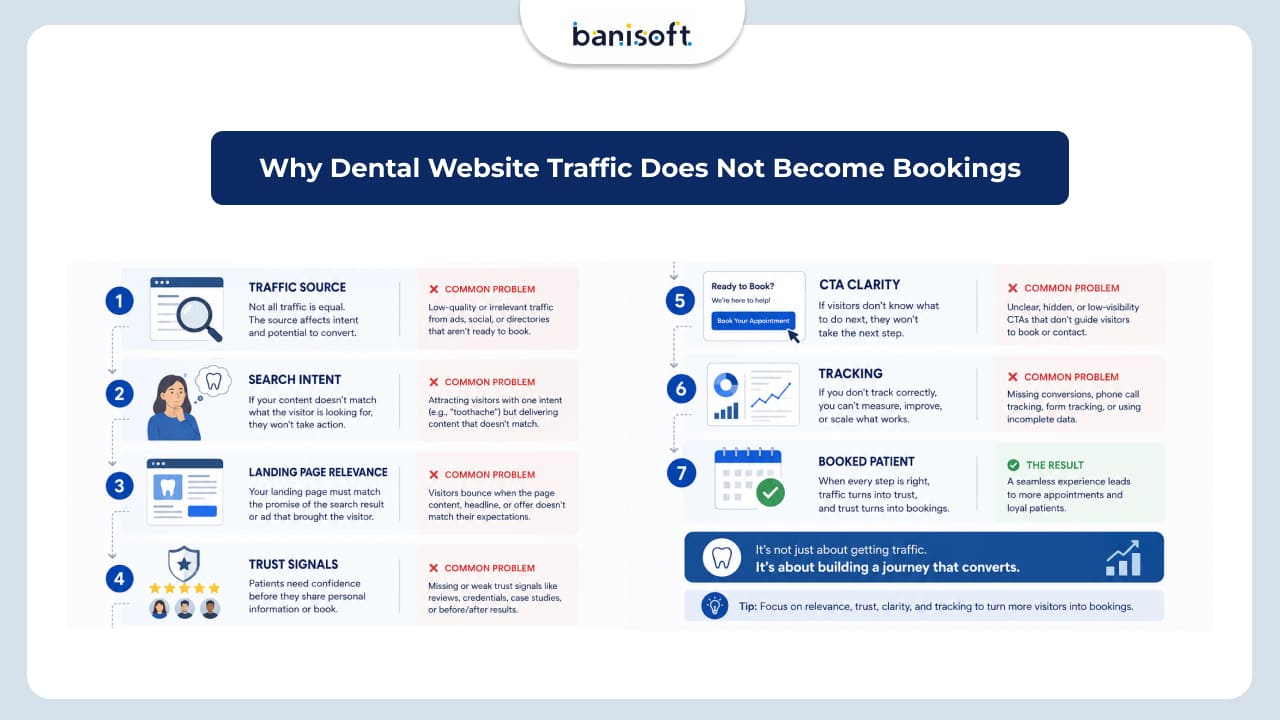

Infographic explaining why dental website traffic may not turn into patient bookings

Short answer: Dental clinics need a connected system: attract the right searches, send visitors to the right pages, build trust, make booking easy, track every lead source, and improve based on data.

Look at your top pages and keywords. Group them into:

  • Informational searches
  • Local service searches
  • Emergency searches
  • Treatment-specific searches
  • Brand searches
  • Price or comparison searches

This helps you understand whether your traffic is likely to convert.

Review pages such as:

  • Emergency dentist
  • Dental implants
  • Invisalign
  • Teeth whitening
  • Root canal
  • New patient dental exam
  • Family dentistry
  • Pediatric dentistry
  • Cosmetic dentistry

Check whether each page answers patient questions and has a clear booking path.

Make sure your GBP categories, services, photos, posts, reviews, and appointment links support your website’s service pages.

Add real clinic photos, provider bios, treatment-specific reviews, patient comfort details, and transparent appointment information.

Make it easy to call, book, or request an appointment from every key page. Test mobile forms and click-to-call buttons.

Use GA4, Google Search Console, GBP insights, call tracking, form tracking, Google Ads conversion tracking, and CRM notes where available.

A clinic does not need more random enquiries. It needs more relevant appointment requests from patients who match the clinic’s services, location, and capacity.


Short answer: Most dental clinics do not fail because they have no traffic. They fail because traffic, trust, messaging, booking, and tracking are not connected.

Mistake 1: Sending Every Visitor to the Homepage

The homepage is useful, but it should not do the job of every service page. High-intent searches need relevant landing pages.

Mistake 2: Writing Generic Dental Content

Patients do not want vague claims like “quality dental care.” They want clear answers about their pain, treatment options, cost factors, appointment availability, and trust.

Mistake 3: Ignoring Google Business Profile

A weak GBP can reduce calls before the patient even reaches your website.

Mistake 4: Not Tracking Phone Calls

Many dental leads happen by phone. If calls are not tracked, marketing performance will look incomplete.

Mistake 5: Using One CTA for Every Service

Emergency dentistry, Invisalign, dental implants, and routine cleaning require different levels of urgency and messaging.

Mistake 6: Measuring Rankings Instead of Revenue Signals

Rankings are useful, but they are not the final goal. The goal is patient acquisition, booked appointments, and profitable treatment growth.


Use this checklist to review your clinic website.

Traffic Quality

  •  Do we know which pages bring the most traffic?
  •  Do we know which keywords bring appointment-ready visitors?
  •  Are our service pages ranking, or only blog posts?
  •  Are we attracting local patients near the clinic?

Service Page Quality

  •  Does each treatment page answer patient questions?
  •  Does each page explain who the treatment is for?
  •  Do we show dentist or clinic expertise?
  •  Do we include FAQs?
  •  Do we use clear, patient-friendly language?

Trust Signals

  •  Do we show real clinic photos?
  •  Do we include dentist profiles?
  •  Do we display relevant reviews?
  •  Do we mention safety, comfort, and patient care?
  •  Do we avoid exaggerated claims?

Booking Journey

  •  Is the phone number visible and clickable?
  •  Is there a clear appointment CTA?
  •  Is the form short and easy to complete?
  •  Does the mobile experience work smoothly?
  •  Are urgent-care pages designed for fast action?

Tracking

  •  Are form submissions tracked?
  •  Are phone calls tracked?
  •  Are Google Ads conversions tracked?
  •  Are GBP clicks tracked with UTM links?
  •  Do we review lead quality, not just traffic?

Dental website traffic is valuable only when it helps the right patients find the right service, trust the clinic, and take the next step toward booking.

If your clinic is getting traffic but not enough patient bookings, the problem may not be SEO alone. It may be a conversion issue, a trust issue, a Google Business Profile issue, a landing page issue, a tracking issue, or a mismatch between search intent and page content.

The best dental marketing systems connect visibility with patient action. They do not stop at rankings, clicks, or reports. They help clinics understand where patients come from, what they need, what stops them from booking, and how to improve the journey.


Why is my dental website getting traffic but no bookings?

Your dental website may be attracting visitors who are still researching, not ready to book, or looking for services you do not clearly promote. Another common issue is weak conversion design: unclear CTAs, poor mobile experience, lack of trust signals, slow forms, or no click-to-call option. Traffic needs to be matched with intent, trust, and a simple booking path.

What is a good conversion rate for a dental website?

There is no universal conversion rate because it depends on your location, services, traffic source, offer, website quality, and tracking setup. A clinic running emergency dental ads may convert differently from a clinic ranking for educational blogs. Instead of chasing one benchmark, track calls, form submissions, booking clicks, and actual appointment outcomes by source.

Should dental clinics focus on SEO or Google Ads for bookings?

Both can work, but they serve different roles. SEO helps build long-term visibility for local and treatment-related searches. Google Ads can generate faster visibility for high-intent services like emergency dentistry, implants, Invisalign, or new patient exams. The best approach depends on your market, budget, competition, and how quickly you need appointment volume.

How can Google Business Profile improve dental bookings?

Google Business Profile can influence calls, direction requests, reviews, and local trust before a patient visits your website. A complete profile with accurate services, photos, reviews, appointment links, and correct hours can make your clinic easier to choose. It should work together with your website service pages and local SEO strategy.

Why are patients visiting my dental website but not calling?

Patients may not call if they cannot quickly understand your services, location, availability, dentist expertise, pricing guidance, or next step. They may also hesitate if the website lacks reviews, real photos, or clear treatment information. On mobile, hidden phone numbers, slow pages, and long forms can also reduce calls.

Do dental blogs help generate patient bookings?

Dental blogs can help, but only when they support a broader patient acquisition strategy. Educational blogs often attract early-stage visitors. To turn that traffic into bookings, blogs should link to relevant service pages, answer treatment questions, include local context, and guide readers toward a consultation or appointment request when appropriate.

What should a dental clinic track besides website traffic?

Dental clinics should track phone calls, form submissions, booking clicks, Google Business Profile actions, treatment-specific enquiries, missed calls, lead source, booked appointments, and lead quality. Traffic alone does not show whether marketing is producing patients. Better tracking helps identify which channels and pages actually support patient growth.

How often should a dental website be reviewed for conversions?

A dental website should be reviewed at least quarterly, especially if the clinic depends on SEO, Google Ads, or Google Business Profile for new patients. High-value pages such as emergency dentistry, implants, Invisalign, and new patient exams should be checked more often because small improvements can affect calls and appointment requests.

Why Dental Website Traffic Isn’t Turning Into Patients Read More »
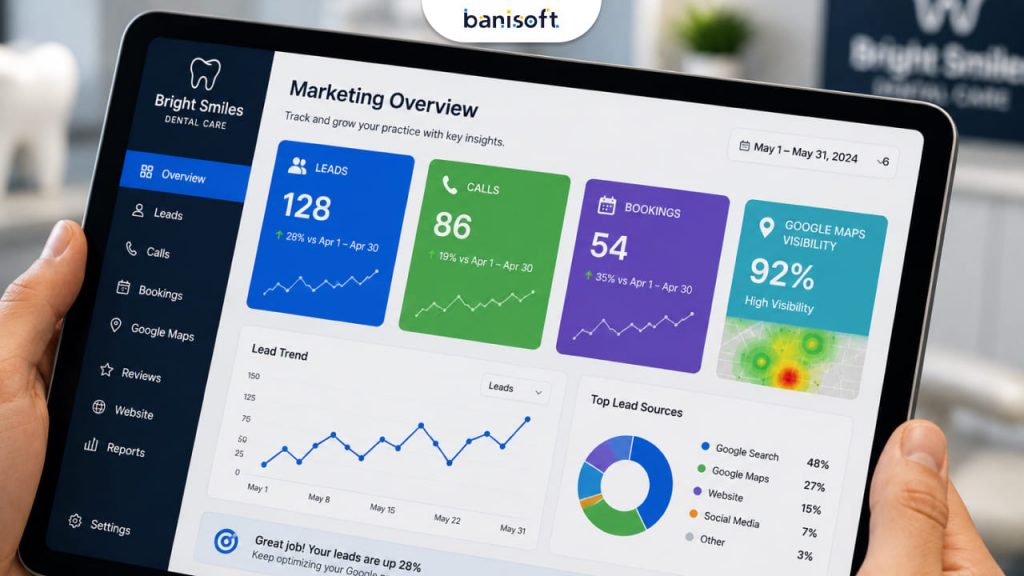
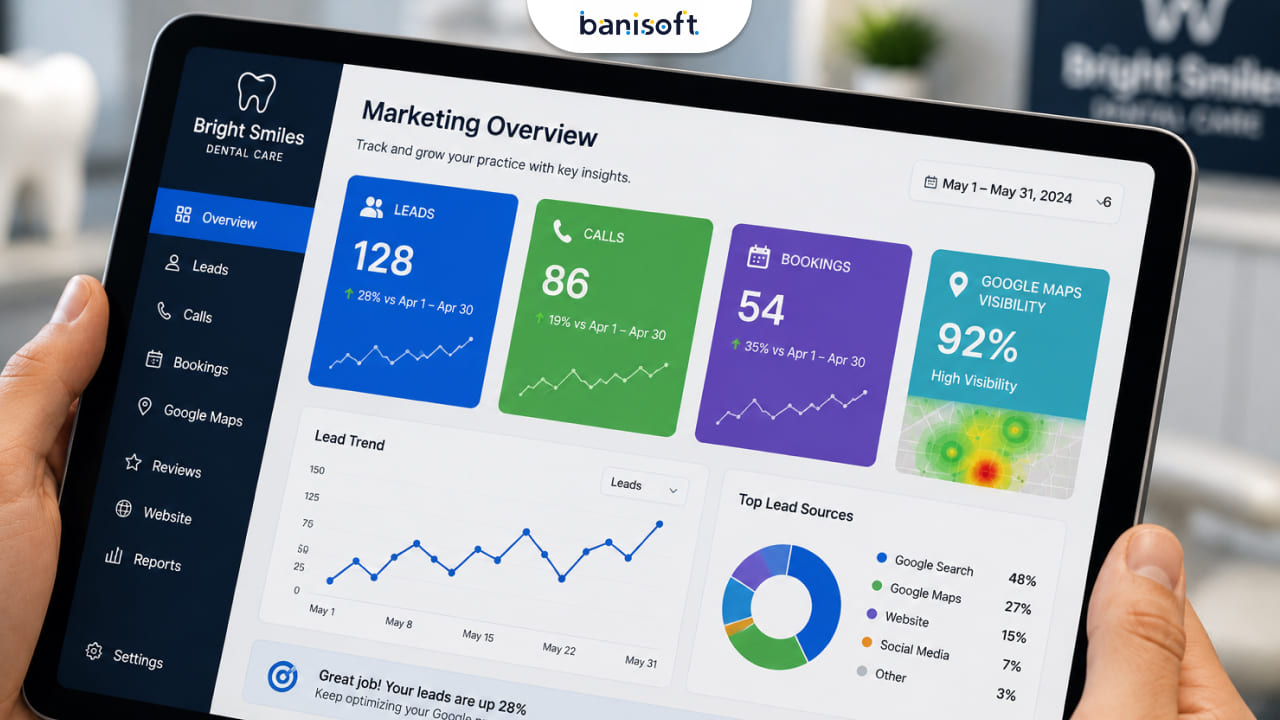
Dental clinic marketing dashboard showing high-value patient leads from SEO, Google Ads, and Google Business Profile.

Best Dental Services to Promote Online for Higher-Value Patient Leads

Table of Contents

Dental clinic marketing dashboard showing high-value patient leads from SEO, Google Ads, and Google Business Profile.

Many dental clinics invest in SEO, Google Ads, and Google Business Profile optimization but still promote every service the same way. That is one of the biggest reasons clinics get traffic without enough profitable appointment requests.

The best dental services to promote online are high-intent, high-value, and decision-driven treatments such as dental implants, Invisalign or clear aligners, cosmetic dentistry, emergency dentistry, root canal treatment, teeth whitening, dentures, crowns, and family dentistry. These services work well online because patients actively search for them when they have a problem, a goal, or a strong reason to book.

This matters because dental marketing is no longer just about “getting more clicks.” It is about attracting the right patients for the right services through the right channel, and tracking which campaigns actually lead to booked appointments.

This article is for dental clinic owners, dentists, practice managers, and decision-makers who want stronger patient acquisition from SEO, Google Business Profile, Google Ads, local SEO, reviews, and landing pages.

Google’s own guidance emphasizes helpful, reliable, people-first content, and dental clinics should follow the same principle in marketing: answer real patient concerns clearly rather than creating thin service pages solely for rankings. 


Short answer: Dental clinics should promote specific services because different treatments have different patient intent, value, urgency, competition, and conversion paths.

A patient searching for “dentist near me” may simply need a check-up. A patient searching for “dental implants cost near me” is usually comparing treatment options, pricing, trust factors, and provider expertise. A patient searching “emergency dentist open now” may be ready to call immediately.

These are very different patient journeys.

From a dental marketing strategy perspective, each service should be evaluated based on:

  • Search demand in your city or service area
  • Treatment value and profitability
  • Patient urgency
  • Level of competition
  • Website conversion potential
  • Google Business Profile relevance
  • Review support
  • Ability to track calls, forms, and bookings

A clinic that promotes every service equally often spreads its budget too thin. A clinic that promotes the right services with dedicated SEO pages, GBP optimization, ads, and landing pages usually builds a more focused patient acquisition system.


Short answer: The best dental services to promote online are usually those with strong patient intent, higher treatment value, clear search demand, and a compelling reason for patients to book a consultation.

Below are the dental services that often perform well in SEO, Google Ads, Google Maps, and conversion-focused campaigns.


Dental implants are among the most important services to promote online because patients often research them thoroughly before choosing a clinic. They may compare costs, procedural steps, pain levels, recovery times, financing, technology, and dentists’ experience.

Why dental implants attract higher-value leads

Dental implant patients are not usually looking for a quick, low-cost appointment. They are often trying to solve a long-term functional, cosmetic, and confidence-related problem. This makes implant marketing valuable, but also more trust-dependent.

Best channels to promote dental implants

  • Dedicated dental implant SEO service page
  • Google Ads search campaigns
  • Google Business Profile service optimization
  • Educational blog content
  • Before-and-after case explanations, if compliant and real
  • Video FAQs from the dentist
  • Review strategy focused on implant-related patient experience

What your implant page should include

A strong dental implant page should answer:

  • Who is a good candidate for dental implants?
  • What is the process?
  • How long does treatment take?
  • What affects cost?
  • What alternatives exist?
  • Why choose this clinic?
  • How can patients book a consultation?

💡Expert Tip: Do not make dental implant marketing only about price. Patients want affordability, but they also want confidence, safety, experience, technology, and clear next steps.


Invisalign and clear aligners are excellent services to promote because patients often search with strong comparison intent. They want to know whether clear aligners are right for them, how long treatment takes, how they compare with braces, and whether the clinic provides flexible payment options.

Why Invisalign marketing works well online

Clear aligner patients are often motivated by appearance, comfort, confidence, and lifestyle convenience. This makes the service suitable for SEO, Google Ads, social proof, landing pages, and educational content.

Best keywords and content angles

Examples include:

  • Invisalign dentist near me
  • Clear aligners near me
  • Invisalign cost
  • Invisalign vs braces
  • Best Invisalign dentist in [city]
  • Can adults get Invisalign?

A clinic should not rely solely on a single Invisalign page. Supporting blog posts can cover benefits, cost factors, common myths, treatment timelines, adult orthodontics, and comparison content.

💡Expert Tip: Invisalign campaigns typically require robust conversion support. Add consultation CTAs, financing mentions where applicable, smile assessment prompts, FAQs, and trust-building content from the dentist.


Cosmetic dentistry can attract high-value patients because people seeking smile improvement often compare providers, portfolios, reviews, treatment options, and aesthetic outcomes.

Services under cosmetic dentistry to promote

  • Veneers
  • Teeth whitening
  • Smile makeovers
  • Cosmetic bonding
  • Gum contouring
  • Tooth reshaping
  • Clear aligners
  • Cosmetic crowns

Why cosmetic dentistry needs strong trust signals

Cosmetic patients are not only asking, “Can you fix my teeth?” They are asking, “Can I trust you with my smile?” That means the page needs visual proof, real explanations, dentist expertise, treatment options, and realistic expectations.

Do not use fake before-and-after images or generic stock results. If before-and-after photos are used, they should be real, compliant, approved, and clearly presented.


Emergency dentistry is one of the strongest services for immediate lead generation because search intent is urgent. A person with tooth pain, swelling, broken teeth, or dental trauma is often ready to call.

Why emergency dental leads convert quickly

Emergency patients usually need immediate help. They are less likely to read five blogs before contacting a clinic. They want to know:

  • Are you open now?
  • Can I get a same-day appointment?
  • Do you treat severe tooth pain?
  • Where are you located?
  • Can I call immediately?
  • What should I do before I arrive?

Best channels for emergency dentistry

  • Google Business Profile
  • Google Maps visibility
  • Local SEO service page
  • Google Ads call campaigns
  • Mobile-friendly landing page
  • Call tracking
  • Clear opening hours

Google states that local ranking is influenced by relevance, distance, and prominence, which is why emergency dental marketing must effectively connect the website, Google Business Profile, reviews, and location signals. 

Expert Tip: Emergency dentistry pages should be built for mobile users first. Patients in pain do not want long paragraphs before they find the phone number.


Root canal treatment is an important service to promote because patients usually seek it when they are experiencing pain, infection, sensitivity, or fear of losing a tooth.

Why root canal marketing works

Root canal searches often combine urgency with anxiety. Patients want pain relief, clarity, reassurance, and proof that the clinic can safely handle the treatment.

Content that helps convert root canal patients

  • Symptoms that may require a root canal
  • Whether root canal treatment is painful
  • Treatment steps
  • Recovery expectations
  • Cost factors
  • Emergency appointment availability
  • Difference between extraction and saving the tooth

💡Expert Tip: Root canal content should reduce fear. Avoid overly clinical language. Explain the treatment in simple terms, focusing on pain relief, tooth preservation, and next steps.


Crowns and bridges are valuable to promote because they connect with restorative, cosmetic, and functional dentistry. Patients may seek care for a broken tooth, a root canal, a missing tooth, or a recommendation from another dentist.

Why crowns and bridges deserve dedicated pages

Many clinics bury crowns and bridges under a general restorative dentistry page. That can limit visibility. A dedicated page can rank for specific searches and help patients understand when each treatment is needed.

Useful content angles

  • Dental crown cost
  • Same-day crowns, if offered
  • Crown after root canal
  • Dental bridge vs implant
  • Broken tooth repair
  • Front tooth crown

Teeth whitening may not always be the highest-value dental service, but it is useful for attracting cosmetic patients and introducing new people to the clinic.

Why teeth whitening is strategically useful

Teeth whitening can act as an entry-point service. A patient may first visit for whitening and later consider veneers, clear aligners, cosmetic bonding, hygiene visits, or a full smile makeover.

Best way to promote teeth whitening

  • Local SEO page
  • Cosmetic dentistry cluster
  • Google Business Profile service listing
  • Social media content
  • Offer-led landing page, if ethical and compliant
  • Email marketing to existing patients

💡Expert Tip: Teeth whitening marketing should clearly explain professional whitening versus over-the-counter options without making exaggerated claims.


Dentures are important for clinics serving older adults, patients with missing teeth, and people looking for affordable tooth replacement options.

Why denture leads can be valuable

Denture patients often need consultation, fitting, adjustments, repairs, replacements, or implant-supported options. This can create multiple appointment opportunities.

Content to include

  • Full dentures vs partial dentures
  • Denture repairs
  • Implant-supported dentures
  • Cost factors
  • Eating and speaking with dentures
  • Adjustment timeline
  • When to replace old dentures

Family dentistry may not always be the highest-value service per appointment, but it is essential for building long-term patient volume.

Why family dentistry matters

A single new family patient can lead to multiple appointments across check-ups, hygiene, fillings, sealants, children’s dentistry, orthodontic referrals, whitening, and emergency care.

Best channels

  • Local SEO
  • Google Business Profile
  • Review strategy
  • Location pages
  • School/community content
  • New patient landing page

💡Expert Tip: Family dentistry marketing should focus on convenience, trust, location, appointment availability, children’s comfort, insurance/payment clarity, and long-term care.


Pediatric dentistry can be a strong local SEO and Google Maps opportunity, especially for clinics that want to attract families.

What parents search for

Parents often search for:

  • Kids dentist near me
  • Pediatric dentist near me
  • Child tooth pain
  • First dental visit
  • Dental cleaning for kids
  • Cavity treatment for children

A pediatric dental page should speak to parents, not just describe the treatment. It should explain comfort, safety, child-friendly communication, appointment expectations, and preventive care.

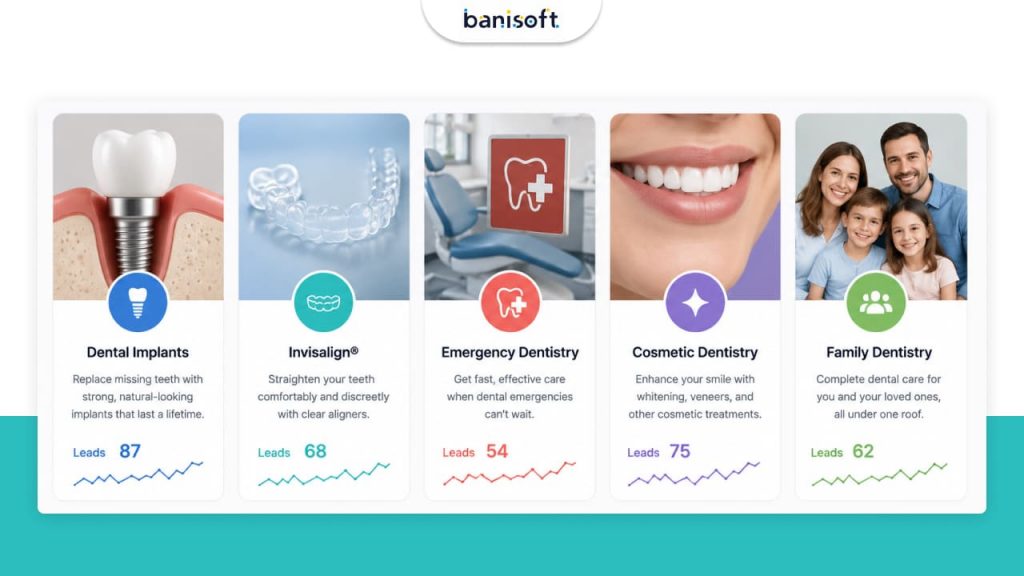
Best dental services to promote online for higher-value patient leads.

Short answer: Start with services that combine strong local search demand, high patient value, good clinic capacity, strong reviews, and clear conversion potential.

Not every dental clinic should promote the same services first. A new clinic may need general dentistry and emergency dentistry to increase appointment volume. An established clinic may focus on implants, Invisalign, cosmetic dentistry, or full-mouth rehabilitation.

Here is a practical comparison.

Dental ServicePatient IntentLead Value PotentialBest Marketing ChannelsConversion Requirement
Dental ImplantsResearch + consultationHighSEO, Google Ads, GBP, landing pagesStrong trust, FAQs, financing info
Invisalign / Clear AlignersComparison + consultationHighSEO, Google Ads, blogs, social proofAssessment CTA, before/after proof
Cosmetic DentistryResearch + aesthetic trustHighSEO, content, GBP, social, landing pagesVisual proof, dentist authority
Emergency DentistryImmediate needMedium to highGBP, Local SEO, Google Ads, call trackingPhone visibility, same-day messaging
Root Canal TreatmentPain + urgencyMedium to highSEO, GBP, Google AdsReassurance, pain-relief messaging
Crowns and BridgesProblem-solvingMedium to highSEO, service pages, GBPClear treatment explanation
Teeth WhiteningCosmetic entry pointMediumLocal SEO, social, email, GBPOffer clarity, realistic expectations
Family DentistryOngoing careLong-term valueLocal SEO, GBP, reviewsConvenience, trust, family messaging
Pediatric DentistryParent-drivenLong-term valueLocal SEO, GBP, contentComfort, safety, parent reassurance
DenturesFunctional needMedium to highSEO, GBP, Google AdsCost factors, options, consultation CTA
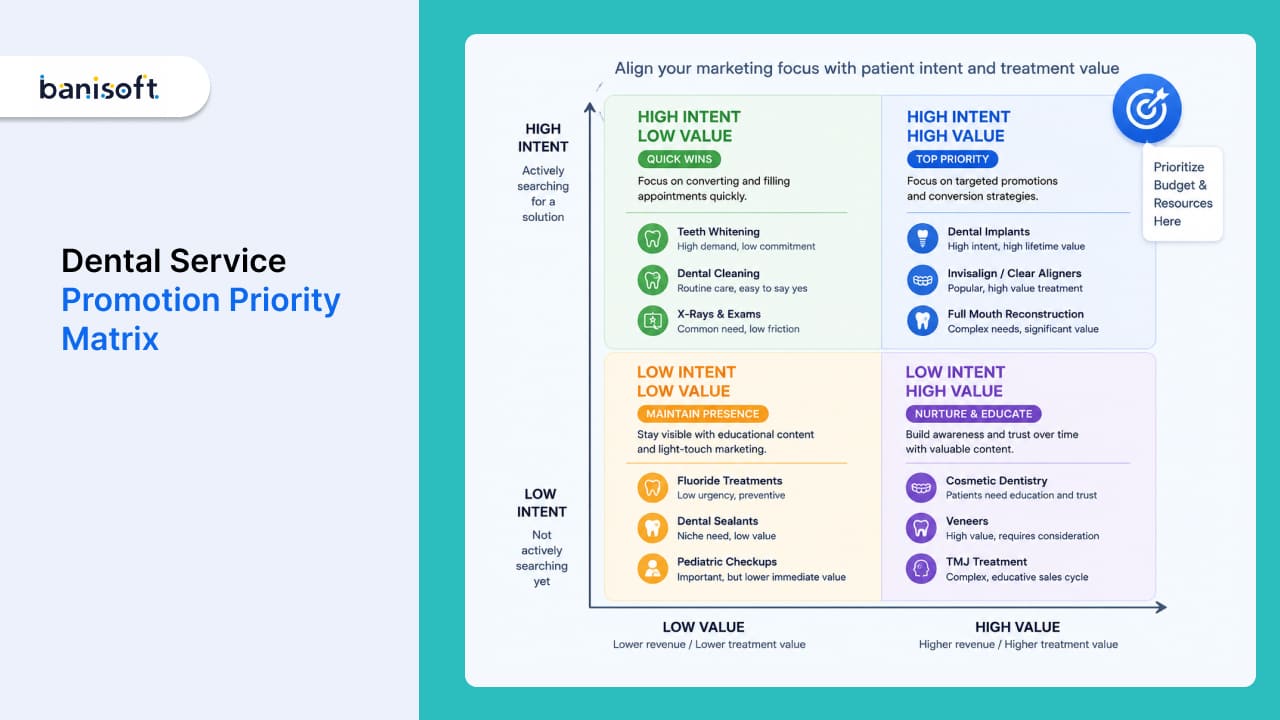
Dental service promotion matrix comparing patient intent and treatment value.

Short answer: Use a service prioritization framework before spending more on SEO or ads.

Here is a step-by-step system dental clinics can follow.

Create a complete list of your services, including:

  • General dentistry
  • Emergency dentistry
  • Cosmetic dentistry
  • Dental implants
  • Invisalign or clear aligners
  • Teeth whitening
  • Veneers
  • Crowns and bridges
  • Root canal treatment
  • Dentures
  • Pediatric dentistry
  • Hygiene and preventive care

Do not start with keywords first. Start with business priorities.


Ask:

  • Which services generate stronger revenue?
  • Which treatments have better profit margins?
  • Which services does the clinic want more of?
  • Which services does the dentist have strong expertise in?
  • Which services can the clinic handle operationally?

For example, promoting implants makes sense only if the clinic has the right clinical capacity, consultation process, treatment planning, follow-up workflow, and patient education system.


Now evaluate search behavior. Look at:

  • Google Search Console data
  • Google Ads Keyword Planner
  • Google Business Profile search terms
  • Competitor service pages
  • Local SERP results
  • Google Maps competitors
  • Existing website rankings

You are looking for services that patients are already searching for, and your clinic has a realistic opportunity to compete.


For each service, check whether your clinic has:

  • A dedicated service page
  • A location-specific version, where relevant
  • Google Business Profile service listing
  • Internal links from related pages
  • Reviews that mention the service
  • Photos or videos supporting the treatment
  • FAQs answering patient concerns
  • Tracking for calls and forms

If a high-value service has no dedicated page and no GBP support, that is usually a major opportunity.


Not every service needs the same marketing channel.

Dental implants may need SEO, Google Ads, landing pages, and nurturing. Emergency dentistry may need Google Maps, phone calls, local SEO, and ads. Teeth whitening may work well with GBP posts, email marketing, and social content.

Google Ads can work well for dental clinics, but healthcare advertising must follow applicable laws, industry standards, and platform policies. Google’s healthcare and medicines policy states that some healthcare-related content is subject to location-based restrictions and approval requirements. 


Traffic alone does not create patients. For each promoted service, build a clear conversion path:

  1. Patient searches
  2. Patient finds your clinic
  3. Patient lands on the right page
  4. Page answers their concern
  5. Trust signals reduce hesitation
  6. CTA prompts call or booking
  7. Clinic tracks the lead source
  8. Front desk follows up quickly
  9. Marketing data is reviewed monthly

Google Ads conversion tracking usually requires defining a conversion action and installing the Google tag or using Google Tag Manager, which is important if your clinic wants to know which campaigns are driving calls, form submissions, or bookings. 


How Should Dental Clinics Promote High-Value Services Online?

Short answer: Use a connected system: service pages, Google Business Profile, Google Ads, local SEO, reviews, content, tracking, and conversion-focused landing pages.

1. Create Dedicated Service Pages

Each high-value service should have its own page. Avoid putting implants, Invisalign, veneers, crowns, and emergency dentistry into one generic “services” page.

A strong service page should include:

  • Clear service explanation
  • Symptoms or patient situations
  • Treatment options
  • Dentist/team expertise
  • Location relevance
  • FAQs
  • Reviews, if real and service-specific
  • Strong CTA
  • Internal links
  • Schema markup
  • Tracking

2. Optimize Google Business Profile for Service Relevance

Your Google Business Profile should support your website strategy. Add accurate categories, services, descriptions, appointment links, photos, updates, and review responses.

Google recommends keeping Business Profile information complete and accurate because it helps customers know what you do, where you are, and when they can visit. 

For a dental clinic, GBP optimization should include:

  • Primary category: Dentist or relevant clinic type
  • Secondary categories, if applicable
  • Service listings
  • Appointment URL
  • Accurate hours
  • Photos of clinic, team, treatment rooms
  • Review responses
  • Posts for key services
  • Local phone number
Google Business Profile optimization for dental clinic services and patient calls.

Google Ads can be useful for services where patients are ready to act or compare options.

Good candidates include:

  • Emergency dentist
  • Dental implants
  • Invisalign
  • Root canal
  • Dentist near me
  • Teeth whitening
  • Dentures
  • Cosmetic dentist

But the campaign must be structured carefully. Sending all ad traffic to the homepage usually wastes budget. Each ad group should connect to a relevant landing page.


4. Build Local SEO Around Service + Location

Local SEO is especially important for dental clinics because patients usually choose a nearby provider. For service pages, include natural location context, such as neighborhood, city, nearby landmarks, parking, accessibility, and service area.

Examples:

  • Dental implants in [city]
  • Emergency dentist in [neighborhood]
  • Invisalign provider near [location]
  • Family dentist near [community]

Avoid stuffing city names unnaturally. The page should read as if it were written for a local patient, not just for Google.


5. Use Reviews Strategically and Ethically

Reviews influence trust, conversion, and local discovery. For promoted services, clinics should encourage genuine patient feedback without incentives, pressure, or fake review practices.

Useful review prompts after treatment may include:

  • How was your experience with the team?
  • Did the clinic explain the treatment clearly?
  • Was scheduling easy?
  • Did you feel comfortable during your visit?

Do not ask patients to mention specific keywords in a forced way. Keep review generation ethical and patient-first.


6. Track Calls, Forms, and Bookings

Dental clinics often judge marketing by impressions and clicks, but the real question is:

Which service pages and campaigns are producing appointment requests?

Track:

  • Phone calls
  • Form submissions
  • Online bookings
  • Direction clicks
  • GBP calls
  • Google Ads conversions
  • Service-page conversions
  • Cost per qualified lead
  • Consultation-to-treatment conversion

Without tracking, the clinic may continue funding campaigns that appear active but do not generate high-quality leads.

Dental patient journey from Google search to website visit and appointment booking.

Common Mistakes Dental Clinics Make When Promoting Services Online

Short answer: Most clinics do not fail for lack of services. They fail because their marketing does not connect patient intent, service value, page content, local visibility, and tracking.

Mistake 1: Promoting the Homepage Instead of Service Pages

The homepage is too general for many high-intent searches. A patient searching for dental implants should land on an implant page, not a generic homepage.

Mistake 2: Running Ads Without Conversion Tracking

Clicks do not prove patient growth. Calls, consultation requests, and booked appointments matter more.

Mistake 3: Using the Same CTA for Every Service

An emergency dentistry page may need a “Call Now” CTA. An Invisalign page may need “Book a Smile Assessment.” A dental implant page may need “Request an Implant Consultation.”

Mistake 4: Ignoring Google Business Profile Services

Many clinics optimize the website but forget to align GBP services, categories, posts, reviews, and photos.

Mistake 5: Writing Thin Service Pages

A 300-word page and a booking button are rarely enough for competitive services like implants, Invisalign, veneers, or cosmetic dentistry.

Mistake 6: Not Using Real Trust Signals

Patients want to see real clinic photos, dentist experience, technology, reviews, treatment explanations, and clear expectations.

Mistake 7: Measuring All Leads Equally

A hygiene inquiry, an emergency call, an implant consultation, and an Invisalign lead should not be judged the same way. Segment leads by service type and quality.


Dental Service Promotion Checklist for Clinic Owners

Use this checklist before investing more into SEO, Google Ads, or GBP campaigns.

Service Selection Checklist

  • Have we identified our top 5 priority services?
  • Do these services match our business goals?
  • Do we have capacity to handle more of these patients?
  • Do these services have local search demand?
  • Do we know which competitors rank for these services?

Website Checklist

  • Does each priority service have a dedicated page?
  • Is the page written for patients, not just search engines?
  • Does it answer questions about cost, process, pain, timeline, and suitability?
  • Does it include a strong CTA?
  • Does it include internal links to related services?
  • Does it load well on mobile?

Google Business Profile Checklist

  • Are services added to GBP?
  • Are the hours, phone number, address, and appointment links accurate?
  • Are reviews being requested ethically?
  • Are review responses active?
  • Are posts and photos updated?

Google Ads Checklist

  • Do services separate campaigns?
  • Are ads going to relevant landing pages?
  • Are calls and forms tracked?
  • Are negative keywords reviewed?
  • Are healthcare advertising policies checked?

Conversion Checklist

  • Is the phone number visible on mobile?
  • Is the booking form short and easy to use?
  • Is there a clear consultation CTA?
  • Is front-desk follow-up fast?
  • Does treatment type categorize leads?

How a Dental Marketing Partner Can Help

A strong dental marketing strategy is not about pushing every service online. It is about choosing the right services, understanding patient intent, improving visibility, and building a conversion journey that turns searches into calls, bookings, and consultations.

For many clinics, the biggest opportunity is not “more marketing.” It is better alignment between SEO, Google Business Profile, Google Ads, service pages, reviews, and tracking.


Conclusion

The best dental services to promote online are those that combine patient demand, treatment value, local search opportunities, and strong conversion potential. For many clinics, this includes dental implants, Invisalign, cosmetic dentistry, emergency dentistry, root canal treatment, crowns, dentures, teeth whitening, pediatric dentistry, and family dentistry.

But the service itself is only one part of the strategy. To generate higher-value patient leads, clinics need dedicated service pages, accurate Google Business Profile optimization, ethical review generation, Google Ads tracking, local SEO, and a clear booking journey.

If your clinic wants more appointment requests from the right patients, start by identifying which dental services to promote online first, then build the marketing system around those services.

1. What are the best dental services to promote online?

The dental services that perform best online are usually dental implants, Invisalign or clear aligners, cosmetic dentistry, emergency dentistry, root canal treatment, crowns, dentures, teeth whitening, pediatric dentistry, and family dentistry. These services often have strong patient intent, clear search demand, and good potential to generate appointment requests when supported by SEO, Google Ads, GBP, and conversion tracking.

2. Should a dental clinic promote implants with SEO or Google Ads?

Dental implants can work well with both SEO and Google Ads. SEO helps build long-term visibility through service pages, FAQs, blogs, and local authority. Google Ads can generate faster visibility for high-intent searches. The best approach is usually a combined strategy with a strong implant landing page, tracking, reviews, and clear consultation CTAs.

3. Is emergency dentistry a good service to advertise online?

Yes, emergency dentistry is one of the strongest services for immediate patient leads because the search intent is urgent. Patients seeking emergency dental care often want a same-day appointment, a phone number, a location, and opening hours. Google Business Profile, local SEO, mobile landing pages, and call tracking are especially important for this service.

4. How do I know which dental service to promote first?

Start by reviewing treatment value, local search demand, clinic capacity, competition, existing rankings, review support, and conversion potential. A service may be profitable, but if your clinic cannot handle more appointments or lacks a proper landing page, it may not be the best starting point. Score each service before spending more on ads or SEO.

5. Should every dental service have its own website page?

Priority services should usually have dedicated pages, especially if patients search for them directly. Dental implants, Invisalign, emergency dentistry, root canals, veneers, crowns, and dentures should not be hidden inside a generic services page. Dedicated pages help answer specific patient questions and support SEO, Google Ads, and conversion tracking.

6. How does Google Business Profile help promote dental services?

Google Business Profile helps dental clinics appear in local search results and on Google Maps when patients search for nearby services. Clinics should keep business details accurate, add services, upload photos, respond to reviews, and use appointment links. Google explains that local ranking is influenced by relevance, distance, and prominence. 

7. Can Google Ads generate high-value dental leads?

Google Ads can generate high-value dental leads when campaigns are built around specific services, strong landing pages, accurate tracking, and compliant messaging. The mistake many clinics make is sending all traffic to the homepage or tracking clicks instead of calls, forms, and booked appointments. Healthcare advertising policies should be reviewed before publishing campaigns. 

8. What should a dental service page include to convert better?

A strong dental service page should include a clear explanation of the treatment, symptoms or patient situations, benefits, process, cost factors, FAQs, dentist expertise, real trust signals, location relevance, reviews if available, and a clear CTA. The page should also be mobile-friendly and connected to tracking so the clinic can measure calls and bookings.

Best Dental Services to Promote Online for Higher-Value Patient Leads Read More »

Scroll to Top