
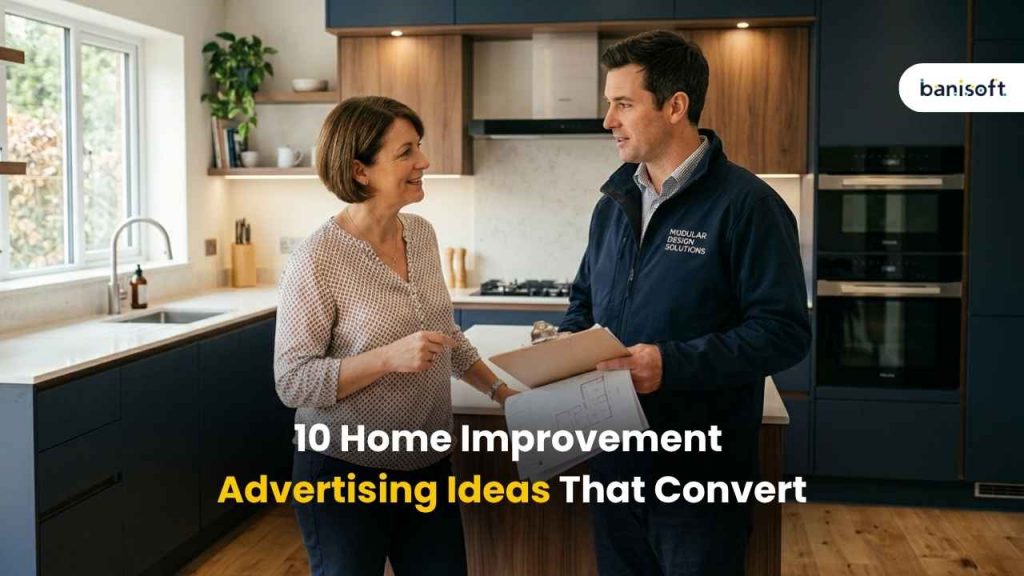
10 Home Improvement Advertising Ideas That Convert
Key Takeaways –
- The U.S. home improvement market is valued at $620 billion in 2025 and projected to grow at 4.1% CAGR through 2027 — making it one of the most lucrative niches for contractors who advertise smartly.
- Google Local Services Ads (LSAs) now deliver leads at an average of $53 per lead with a 43.9% booking rate — the most cost-effective paid channel available to home improvement contractors in 2026.
- Contractors who run before-and-after visual campaigns on Instagram and Facebook see 2–3x higher engagement rates than text-based ads.
- An FAQ section, schema markup, and structured content are now required to appear in Google AI Overviews — pure brand awareness is no longer enough.
- The top-performing contractors allocate 5–15% of projected revenue to advertising, spread across Google, social, and local SEO channels.
Introduction: Why Smart Advertising Is Now Non-Negotiable for Home Improvement Contractors
The home improvement industry has never been more competitive — or more rewarding for contractors who know how to market themselves effectively.
The U.S. home improvement market reached $620 billion in 2025 (Zippia, 2026) and the global market is valued at $931.6 billion, projected to surpass $1.4 trillion by 2035 (Global Market Insights, 2026).
In 2026 alone, total market growth is forecast at 3.5% — with homeowners increasingly choosing to renovate rather than relocate due to elevated mortgage rates and constrained housing supply.
But here is the problem most contractors face: the market is growing, and so is the competition.
Google Local Services Ads adoption among contractors jumped from 28% in 2021 to approximately 70% in 2026. New business openings in home services hit an all-time record in 2024, according to Yelp. Every channel is getting more competitive, and ad costs are rising — costs rose for 69% of home services businesses in 2025 alone.
The contractors who win in this environment are not the ones spending the most. They are the ones advertising the smartest.
In this guide, we break down 10 proven home improvement advertising ideas that actually convert in 2026 — with platform-specific tactics, real budget benchmarks, and strategies built for local contractors, not national retailers.
What Is Home Improvement Advertising?
Home improvement advertising refers to all paid and organic promotional activities that home improvement contractors, remodelers, and renovation companies use to attract homeowners who need their services.
This includes paid search ads (Google Ads, LSAs), social media advertising (Facebook, Instagram, TikTok), content marketing, email campaigns, and local SEO — all working together to generate qualified leads and booked jobs.
Effective home improvement advertising is not just about getting impressions or clicks. It is about reaching the right homeowner at the right moment — when they are actively searching for a contractor, comparing quotes, or ready to schedule a consultation.
The State of Home Improvement Advertising in 2026: Key Benchmarks
Before picking your advertising channels, understand what the numbers actually look like today:
- Average Google LSA cost per lead: $53 nationally, ranging from $25–$40 in smaller markets to $90+ in competitive metros (SearchLight Digital, February 2026)
- LSA booking rate: 43.9% — meaning nearly half of LSA leads become paying customers
- Google Ads (non-branded) cost per lead: $149 on average — 64% more expensive than LSAs
- Facebook/Meta CPL: $30–$60 for local home improvement campaigns
- Average remodeling project ticket via LSA: $1,826
- Average ROAS on LSA spend: 7.84x across 888 tracked contractors
- Recommended advertising budget: 5–15% of projected annual revenue
- 56% of homeowners with a project in mind plan to hire a professional (Porch Research)
These numbers matter because they tell you where to put your budget first — and how to evaluate whether your campaigns are working.
10 Home Improvement Advertising Ideas That Convert in 2026
Idea 1: Start With Google Local Services Ads (LSAs) — The Highest-ROI Channel
What It Is
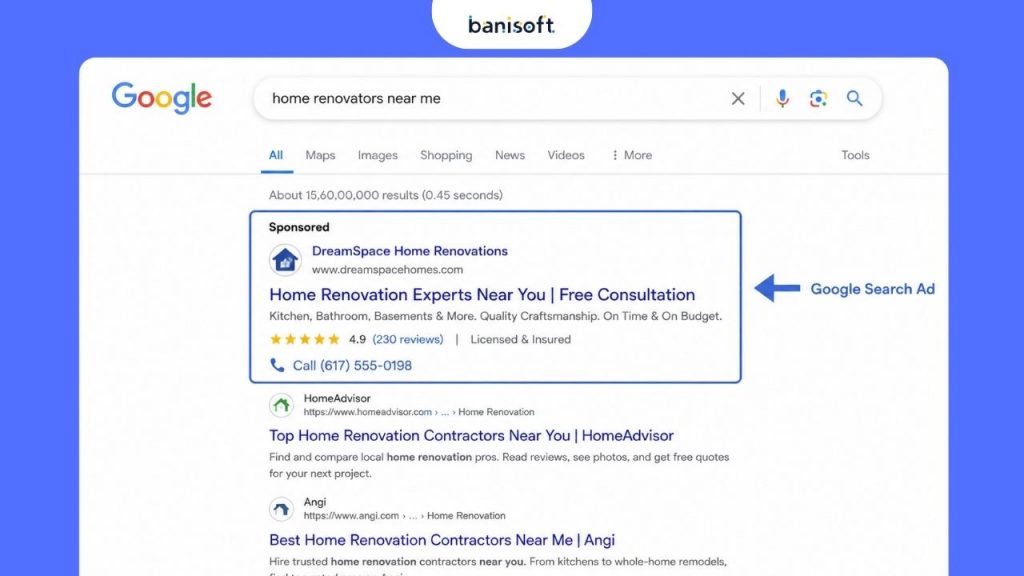
Google Local Services Ads are pay-per-lead ads that appear at the very top of Google search results — above regular Google Ads and organic results. Unlike standard PPC where you pay per click, LSAs only charge you when a qualified lead contacts you directly.
Why Local Services Ads Work for Home Improvement in 2026
- The math is simple: at $53 average cost per lead with a 43.9% booking rate, contractors are acquiring paying customers for an average of $233 — against an average job ticket of $1,826.
- That is a closed ROAS of 7.84x on a channel that also displays the “Google Guaranteed” badge, which builds immediate trust with homeowners.
- LSAs appear above all other ad formats on mobile, where 60–70% of high-intent contractor searches now happen. If you are not running LSAs, you are invisible to most ready-to-hire homeowners.
Best For: HVAC, plumbing, electrical, roofing, general contractors, landscaping
Implementation Tips:
- Complete your Google Business Profile fully before activating LSAs — GBP reviews and LSA ratings are now combined in one display
- Earn at least 5–10 reviews before going live; review velocity matters more than total count
- Configure your service area and job categories precisely — Google discontinued credits for mismatched leads in 2025, so you pay for every lead that comes in, qualified or not
- Set up a rapid response system — LSA leads who are contacted within 5 minutes are 9x more likely to convert
Budget Guidance: Start with $1,000–$2,000/month. Expect 15–40 leads at $53 average CPL depending on your trade and market.
Idea 2: Use Before-and-After Photos Strategically — Not Just as Decoration
What It Is
Before-and-after photo content is the most persuasive visual format for home improvement contractors. It shows transformation, proves capability, and creates the emotional response (“I want that for my home”) that drives inquiry.
Why It Works in 2026
Visual transformation content consistently outperforms text-based advertising in home improvement — before-and-after posts on Instagram generate 2–3x higher engagement than standard promotional posts.
On Facebook, image carousels showing a project journey (demo day → mid-project → finished reveal) generate significantly higher saves and shares than single-image ads.
This is not just about aesthetics. It is about proof. Homeowners hiring a contractor are making decisions that involve thousands of dollars and months of disruption.
A high-quality before-and-after sequence answers the question they are silently asking: “Can you actually do what you say you can do?”
Best For: Kitchen and bathroom remodels, landscaping, exterior work, flooring, painting
Implementation Tips:
- Always photograph in the same lighting conditions — inconsistent lighting makes transformations look less dramatic even when the work is excellent
- Shoot “before” photos the moment you start, not after demolition has begun
- Add text overlays in Canva or Adobe Express: “Kitchen Remodel — Chicago, IL — 14 Days”
- Include a specific, low-friction CTA: “Want results like this? Get a free quote in 24 hours” with your phone number or a link to your contact form
- Repurpose the same content across Instagram, Facebook, Pinterest (high-value for home improvement), and your Google Business Profile
Best For: Instagram, Facebook Ads, Pinterest, Google Business Profile posts
Idea 3: Run Google Search Ads Targeting High-Intent, Location-Specific Keywords
What It Is
Google Search Ads (traditional PPC) target homeowners actively searching for services at the exact moment of intent. Unlike brand-awareness advertising, search ads reach people who are already looking for a contractor.
Why It Works in 2026
Search intent is the closest thing to guaranteed demand generation in advertising. Someone typing “kitchen remodeling contractor near me” or “roof repair [city]” is not browsing — they are shopping. The only question is whether they find you or your competitor.
For remodeling keywords, expect $8–$18 CPC for kitchen and bath terms (BGCollective, 2026). Emergency service keywords (HVAC, plumbing) run $15–$40 per click. Monthly budgets of $1,500–$3,000 are appropriate for single-location businesses targeting a 20–30 mile radius.
Best For: All home improvement contractors as a complement to LSAs
Implementation Tips:
- Build separate campaigns for emergency/repair work versus planned renovation projects — they have fundamentally different buyer psychology and bidding strategies
- Prioritize long-tail, location-modified keywords: “bathroom renovation contractor [city]” converts far better than “home improvement” alone
- Add negative keywords aggressively from day one: DIY searches (“how to install flooring yourself”), job searches (“roofing jobs hiring”), and unrelated services drain budget without producing leads
- Always use call extensions so homeowners can phone you directly from the ad without visiting your website
- Create dedicated landing pages for each service — never send paid traffic to your homepage
Budget Guidance: $1,500–$3,000/month for a single-location contractor. Track cost per lead, not cost per click.
Idea 4: Personalize Your Ads to the Specific Homeowner Segment You Are Targeting
What It Is
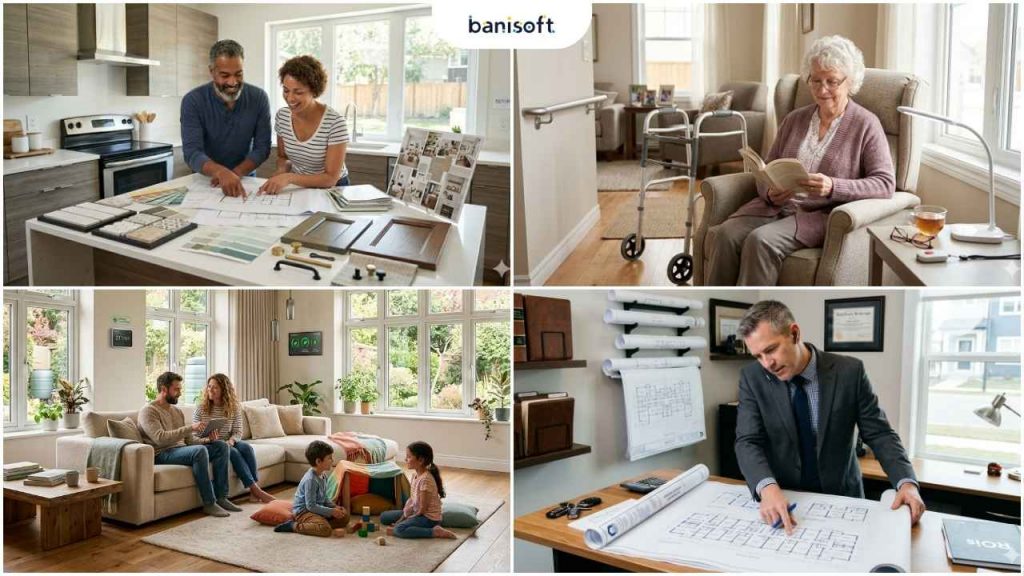
Generic home improvement ads that speak to “all homeowners” are the most common — and least effective — approach. Personalization means creating distinct ad creative, messaging, and offers for specific segments: new homeowners, aging homeowners adapting their homes, rental property investors, homeowners planning to sell, and so on.
Why It Works in 2026
Homeowners are not a monolithic audience. A 35-year-old who just moved into a fixer-upper has completely different motivations, timelines, and objections than a 65-year-old looking for accessibility modifications or a landlord who needs a quick, durable kitchen renovation for a rental property.
When your ad speaks directly to their specific situation — rather than generic messaging — relevance scores improve, click-through rates increase, and the leads you generate are better qualified.
Implementation Tips:
- Use Facebook’s detailed targeting to reach homeowners by age, life event (recently moved), income bracket, and interests (home renovation, interior design)
- Create separate ad sets for each segment with different headlines, images, and CTAs
- Mention local context in copy: reference neighbourhood names, local climate (“Chicago winters are tough on roofs”), or local landmarks to signal that you are a local business, not a national aggregator
- Test different value propositions by segment: new homeowners respond to “Get it right from the start,” aging homeowners respond to “Safe, beautiful, built to last”
Best For: Facebook Ads, Instagram Ads, Google Display campaigns
Idea 5: Make Seasonal Advertising Work Harder With a 12-Month Campaign Calendar
What It Is
Seasonal advertising aligns your promotions with the natural peaks in homeowner demand throughout the year. Most contractors are reactive — they advertise when they are slow. The best ones are proactive — they advertise before demand peaks so they are fully booked when it arrives.
Why It Works in 2026
Home improvement demand follows predictable seasonal patterns. Roofing, gutters, and exterior work peak in spring and fall. HVAC surges in summer and winter. Kitchen and bathroom remodels see increased interest in early spring when homeowners start planning. Indoor projects dominate the winter months.
Running ads at the same level year-round wastes budget during low-demand periods and leaves money on the table during peaks.
2026 Seasonal Campaign Calendar:
- January–February: Indoor renovation campaigns (bathrooms, kitchens, basements) — homeowners are planning spring projects
- March–April: Exterior projects launch — decks, landscaping, roofing inspections, painting
- May–June: Summer renovation campaign — peak project season, highest competition, increase budgets
- July–August: HVAC, cooling, and energy efficiency campaigns
- September–October: Pre-winter exterior work — roofing, gutter replacement, weatherproofing
- November–December: Indoor work, holiday gifting angle (“Give your family a new kitchen”), and pre-booking for January
Implementation Tips:
- Use seasonal urgency authentically: “Book your spring deck installation now — our calendar fills by March” is honest and effective
- Build seasonal campaigns 4–6 weeks ahead of demand peaks — Google’s algorithm needs time to optimize
- Increase budgets by 20–40% during your peak season; pull back during historically slow months
Idea 6: Build Trust Before the Sale — Become the Expert Homeowners Turn To
What It Is
Expert positioning advertising means using your content and ads to demonstrate knowledge, share insights, and solve problems — before asking for the sale. This builds the trust that converts browsers into buyers.
Why It Works in 2026
Homeowners researching a major renovation project spend weeks or months gathering information before contacting a contractor. If your brand appears consistently during that research phase — answering their questions, educating them about the process, and demonstrating expertise — you become the natural first call when they are ready to hire.
This is especially powerful in 2026, when Google AI Overviews, Perplexity, and ChatGPT are increasingly the first places homeowners turn to for answers. A contractor whose website provides genuinely helpful, well-structured information gets cited in those AI answers — essentially earning free top-of-SERP placement.
Implementation Tips:
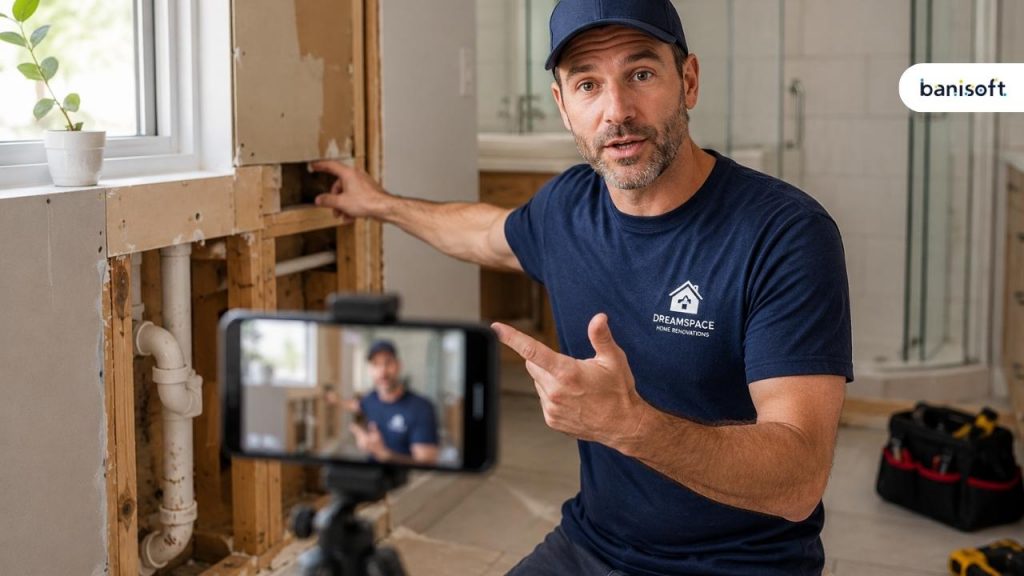
- Create short video answers to the most common questions you hear from homeowners: “How long does a kitchen remodel take?”, “What is the difference between a remodel and a renovation?”, “How do I vet a contractor?”
- Promote these as educational ads on YouTube and Facebook — “Watch before you hire any contractor” style hooks perform exceptionally well
- Write blog posts that answer specific project questions (“How much does a bathroom remodel cost in [city]?”) and run them as promoted posts on Facebook to homeowners in your service area
- Share tips on your Google Business Profile weekly — this signals active expertise to Google and keeps your profile fresh
Best For: YouTube pre-roll ads, Facebook video ads, LinkedIn (for commercial/B2B contractors), Google Business Profile
Idea 7: Lead With Value, Not Just Services — The ROI Messaging Framework
What It Is
Value-led advertising focuses on the outcomes and returns homeowners get from their investment, not just what the service is. Instead of “We install new kitchens,” the message becomes “A kitchen remodel returns 60–80% of its cost at resale — and you get to enjoy it every day until then.”
Why It Works in 2026
With elevated mortgage rates keeping homeowners in place longer, the ROI narrative is more relevant than ever. Homeowners who cannot afford to move are investing in the home they have. They want to know their money is well spent — not just on a new kitchen, but on a smart financial decision.
Data from the 2025 Remodeling Impact Report shows that bathroom remodels deliver 66–71% ROI at resale, kitchen upgrades return 52–72%, and energy efficiency improvements (windows, HVAC) can reduce utility costs by 15–30% annually.
Implementation Tips:
- Add ROI data to your ad copy and landing pages: “Kitchen remodel average ROI: 62% at resale. Get your free design consultation.”
- Create a “Home Value Calculator” on your website that estimates project ROI based on home value, location, and project type — then promote it as a lead magnet
- Use before/after property valuations in case study content where available
- Frame seasonal promotions around financial timing: “Lock in 2026 pricing before material costs rise.”
Best For: Google Search Ads, Facebook Ads, email marketing, landing pages

Idea 8: Use Video Advertising to Show What Photos Cannot
What It Is
Video advertising allows you to show the process, the team, the quality of craftsmanship, and the personality behind the business — all of which build the trust that static images cannot convey alone.
Why It Works in 2026
Short-form video now dominates homeowner content consumption. TikTok and Instagram Reels have become legitimate discovery channels for home improvement inspiration — contractors with strong short-form video presence report significant organic reach to homeowners in their target age demographics (35–55-year-olds now represent a major and growing TikTok audience).
On paid platforms, video ads consistently outperform static image ads in home improvement categories: Facebook video ads average 2–3x higher click-through rates than image ads for home services.
Video Content Types That Convert:
- Project walkthroughs: 60–90 second time-lapse of a project from start to finish with your team on camera
- Client testimonial videos: A homeowner filmed in their renovated space, in their own words — no script, no talking head interview — just genuine reaction
- “What to expect” videos: “Here is what happens on day one when we start your kitchen remodel” — this removes the anxiety of hiring a contractor
- Educational shorts: “3 things to ask before hiring any contractor” — positions you as the trusted expert while pre-qualifying viewers
Implementation Tips:
- Film vertically (9:16 ratio) for all short-form platforms; horizontally (16:9) for YouTube
- 15–30 second videos perform best on Instagram Reels, TikTok, and Facebook Stories
- 2–5 minute project walkthroughs perform best as YouTube pre-roll ads and Facebook in-feed video
- Always add captions — 85% of social video is watched without sound
Idea 9: Create Urgency With Time-Sensitive Offers — The Right Way
What It Is
Time-sensitive offers use genuine scarcity — limited calendar availability, pre-season pricing, or project slots — to accelerate decision-making by homeowners who are interested but have not yet committed.
Why It Works in 2026
Fear of missing out (FOMO) is a well-documented psychological driver in purchasing decisions. The key word is “genuine” — fake countdown timers and fabricated urgency have trained modern consumers to be skeptical. The offers that work in 2026 are tied to real constraints that homeowners can understand and verify.
A roofing contractor with a six-week backlog in April has a genuinely limited spring calendar. A kitchen remodeler who books three months out can honestly offer a “priority booking” for homeowners who decide before a specific date. These constraints are real — use them.
High-Converting Urgency Offers for Contractors:
- “Spring project slots filling up — only 4 spots remaining in May” (only use if true)
- “Lock in 2026 material pricing before Q3 increases — book before July 1st”
- “Free design consultation for projects booked before [date]” — lowers barrier to first contact
- “10% off projects starting in January–February” — fills your slow season calendar
Implementation Tips:
- Use Facebook Lead Ads format for urgency campaigns — homeowners can submit their information without leaving the app, which significantly increases conversion rate
- Use real deadlines tied to your actual calendar, not arbitrary countdowns
- Pair urgency with a specific, low-friction CTA: “Book a free quote call” or “Check availability” — not just “Contact us”
- Run these as retargeting ads to people who have already visited your website — they know who you are; the offer is the final push
Idea 10: Make Customer Testimonials and Reviews the Core of Your Advertising
What It Is
Testimonial and review advertising uses the words and experiences of your past clients as the primary advertising content — in paid ads, on your website, in Google Business Profile posts, and in video content.
Why It Works in 2026
Social proof is not a nice-to-have — it is a prerequisite. Research shows that 72% of consumers will not engage with a business until they have read reviews. For home improvement specifically, where homeowners invite strangers into their homes and commit to multi-thousand-dollar projects, trust is the primary purchase driver.
Google’s LSA algorithm actively rewards review velocity. Contractors who earn 2–4 new reviews per month consistently outperform competitors with more total reviews but lower recent activity. Google interprets fresh, ongoing reviews as a signal of active, quality service.
Implementation Tips:
- Build review collection into your project closeout process — send a text message with your Google Business Profile review link within 24 hours of job completion while the experience is fresh
- For video testimonials: ask clients to record a 30-second selfie video in the finished space — authenticity outperforms professional production in this format
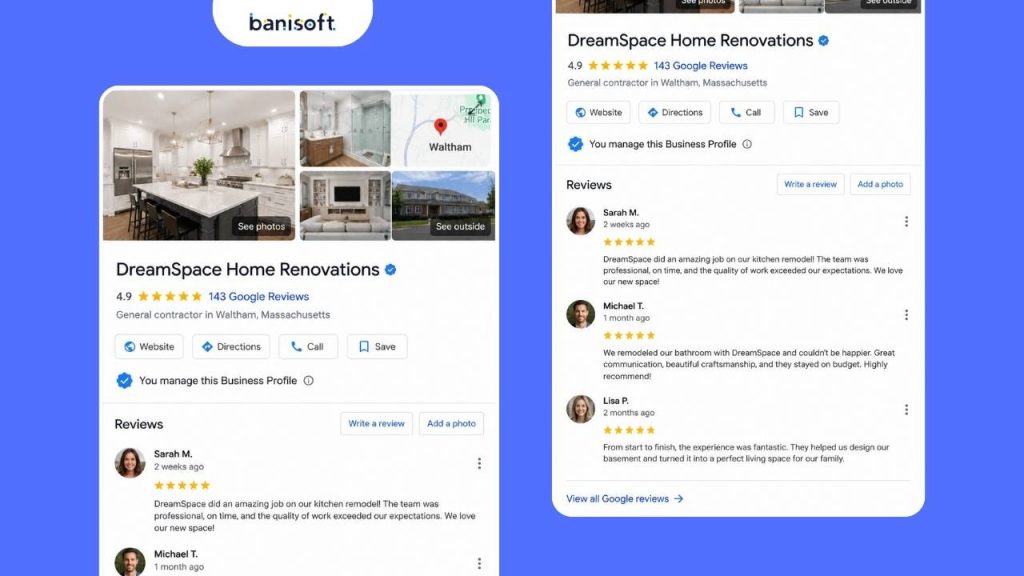
- Feature your Google rating and total review count in your paid ad copy: “⭐ 4.9/5 · 143 Google Reviews” — this improves CTR by 15–25%
- Create a dedicated testimonial page on your website and run Facebook retargeting ads to website visitors pointing them to that page
- Respond to every review, positive and negative — Google rewards engagement and homeowners read owner responses
Platform-Specific Tips:
- Google Business Profile: Post a new review-based update weekly (“Another happy customer in [neighborhood]”)
- Facebook Ads: Run testimonial carousel ads featuring 3–5 client quotes with project photos
- Instagram: Story highlight reel dedicated to client reactions and reveals
Best For: Quick Reference Guide
| Advertising Channel | Best For | Average CPL | Recommended Monthly Budget |
| Google Local Services Ads | Emergency services, all trades | $53 avg ($25–$90) | $1,000–$2,500 |
| Google Search Ads | Planned renovations, high-intent | $25–$110 | $1,500–$3,000 |
| Facebook / Instagram Ads | Brand awareness, retargeting | $30–$60 | $800–$2,000 |
| Before/After Visual Content | All contractors | Organic | $200–$500 (creative) |
| Video Ads (YouTube/Reels) | Trust building, brand awareness | $15–$40 | $500–$1,500 |
| Review/Testimonial Ads | Conversion acceleration | Low (retargeting) | $300–$800 |
| Email Marketing | Repeat clients, referrals | Very low | $100–$300 |
How Much Should You Budget for Home Improvement Advertising?
One of the most common questions contractors ask is: how much should I actually spend?
The industry benchmark is 5–15% of projected annual revenue allocated to marketing and advertising. For a contractor doing $500,000 in annual revenue, that means $25,000–$75,000 per year, or roughly $2,000–$6,000 per month across all channels.
Budget allocation by channel (recommended starting point):
- Google Local Services Ads: 35–40% of budget (highest ROI channel)
- Google Search Ads: 25–30% of budget
- Social media ads (Facebook/Instagram): 15–20% of budget
- Content and video creation: 10–15% of budget
- Email and retargeting: 5–10% of budget
Adjust based on your specific trade. Emergency services contractors (HVAC, plumbing) should weight LSAs and Google Search more heavily. Renovation and remodeling contractors benefit more from visual channels like Instagram and video.
The metric that matters most is not cost per click. It is cost per lead and cost per booked job. A $90 lead that becomes a $15,000 kitchen remodel is far better than a $20 lead from a platform that never converts.
Common Mistakes Home Improvement Contractors Make With Advertising
Avoiding these five mistakes will save you significant budget:
- Sending paid traffic to your homepage. Your homepage is designed for everyone. A homeowner clicking an ad for “bathroom remodeling” should land on a page specifically about bathroom remodeling — with relevant images, a clear CTA, and social proof from bathroom projects. Dedicated landing pages consistently convert 2–5x better than homepages.
- Running ads without tracking calls and form fills. If you cannot connect your advertising spend to actual leads and booked jobs, you are making budget decisions blind. Set up Google Analytics 4, Google Ads conversion tracking, and call tracking from day one.
- Going dark in slow seasons. The contractors who maintain consistent advertising year-round own top-of-mind awareness when demand returns. Going quiet for three months teaches Google’s algorithms to deprioritize your account and forces you to rebuild momentum every spring.
- Ignoring negative keywords. Without a robust negative keyword list, Google will serve your ads to people searching for “home improvement jobs,” “DIY bathroom remodel,” or “home improvement stores near me” — clicks that cost real money and will never become clients.
- Treating reviews as optional. In 2026, your Google rating and review count appear in LSA listings, Google Business Profile, and increasingly in AI-generated search summaries. A contractor with 50 recent 5-star reviews will beat a better craftsman with 10 old reviews on every paid channel.
Frequently Asked Questions About Home Improvement Advertising
What is the most effective advertising channel for home improvement contractors in 2026?
Google Local Services Ads deliver the best return for most contractors — an average of $53 per lead with a 43.9% booking rate and 7.84x ROAS, based on data from 888 contractors tracked in February 2026. They appear above all other paid results and display the Google Guaranteed badge, which builds immediate trust with homeowners.
How much do Google Ads cost for home improvement companies?
Google Local Services Ads average $53 per lead nationally (ranging $25–$90 depending on trade and market). Traditional Google Search Ads average $8–$18 CPC for kitchen and bath keywords, $15–$40 CPC for emergency services, and a cost per lead of $25–$110 depending on your service category and targeting.
What is a good cost per lead for a home improvement contractor?
Industry benchmarks from LocaliQ (2025) show average CPLs of $165 for construction and general contractors, $228 for roofing and gutters, and $200 for doors and windows via Google Ads. Google LSAs significantly undercut these at $53 average. A “good” CPL depends entirely on your average job value — a $53 lead that closes a $5,000 bathroom tile job is excellent; a $150 lead that closes a $40,000 kitchen remodel is even better.
Do before-and-after photos actually work for contractor advertising?
Yes — consistently. Visual transformation content generates 2–3x higher engagement than text-based ads for home improvement on Instagram and Facebook. The psychological mechanism is clear: homeowners can see themselves in the result. High-quality project photos are the single most cost-effective content investment a contractor can make.
What is Google Local Services Ads and how does it work for contractors?
Google Local Services Ads (LSAs) are a pay-per-lead advertising format where you pay only when a homeowner contacts you directly through the ad — not per click. Your listing shows the Google Guaranteed or Google Screened badge (requiring a background check and license verification), your rating, and a click-to-call button. They appear at the very top of Google search results, above regular Google Ads and organic listings.
Is Facebook advertising worth it for home improvement companies?
Yes, particularly for planned renovation projects and brand awareness. Facebook Ads average $30–$60 CPL for local home improvement campaigns and excel at targeting specific homeowner demographics (age, income, life events like “recently moved”). Facebook and Instagram are most effective as a complement to Google, not a replacement — Google captures existing demand while Facebook creates new demand.
How do I measure the ROI of home improvement advertising campaigns?
Track four metrics: cost per lead (total ad spend ÷ total leads), lead-to-appointment rate, appointment-to-close rate, and average project value. Multiply close rate by average project value to calculate revenue per lead, then compare to your CPL. A contractor paying $53/lead with a 44% booking rate and $1,826 average ticket is generating $803 in revenue per lead acquired — that is the number that tells you whether advertising is working.
What makes a home improvement ad convert instead of just getting clicks?
Four elements: a clear, specific headline that matches what the homeowner searched for; visual proof of your work quality (before-and-after photos or video); a trust signal (Google rating, years in business, license badge); and a low-friction CTA that makes the next step obvious and easy (“Book a free 15-minute quote call” outperforms “Contact us” significantly).
Conclusion: Build a System, Not Just Campaigns
The difference between contractors who grow consistently and those who chase leads reactively is this: the top performers treat advertising as a system, not a series of one-off campaigns.
That system starts with Google LSAs capturing high-intent demand at the top of the funnel. It is reinforced by search ads for planned projects, visual content on social channels building trust and familiarity, reviews providing social proof, and retargeting ads converting interested homeowners who have not yet booked.
Each element supports the others. Your reviews improve your LSA ranking. Your before-and-after content gives your social ads their creative. Your educational videos build the trust that makes your testimonial ads close.
Start with the highest-ROI channel for your trade — Google Local Services Ads for most contractors — get your tracking in place, and build from there. The home improvement market is growing. The contractors who advertise consistently and measure everything will capture a disproportionate share of that growth. Ready to build a home improvement advertising strategy that generates consistent, qualified leads? Banisoft specializes in Google Ads, LSAs, and full-funnel digital marketing for home improvement contractors.
Get in touch for a free audit of your current advertising and a custom strategy for your market.
Sources: Zippia Home Improvement Industry Statistics 2026 · Global Market Insights Home Improvement Market Report 2026 · SearchLight Digital LSA Benchmark Report (February 2026) · LocaliQ 2025 Home Services Search Advertising Benchmarks · BGCollective Google Ads Statistics for Remodelers 2026 · Talk24 Home Services Platform Lead Costs 2026 · Joint Center for Housing Studies Home Improvement Spending Projections 2026
10 Home Improvement Advertising Ideas That Convert Read More »