
8 SEO Tips to Boost Your Cleaning Business Online
Maintaining an impressive Google profile may seem like it’s just for digital companies, but should your home cleaning service ignore it? Think again. Consider these points:
- “Near Me” searches have increased by more than 200%.
- 97% of people learn about local businesses primarily through the Internet.
- 64% of consumers use Google Business Profiles to find contact details.
- The typical Google Business Profile gets around 33 clicks each month.
Clearly, whether you’re running a small cleaning business or a large janitorial service, having a solid online presence is essential for your success.
Now, the burning question is: how can you have a solid presence online? You’re in the right place! This blog will walk you through the top 10 SEO tips to elevate your cleaning business online!
Optimize Your Website for Local SEO
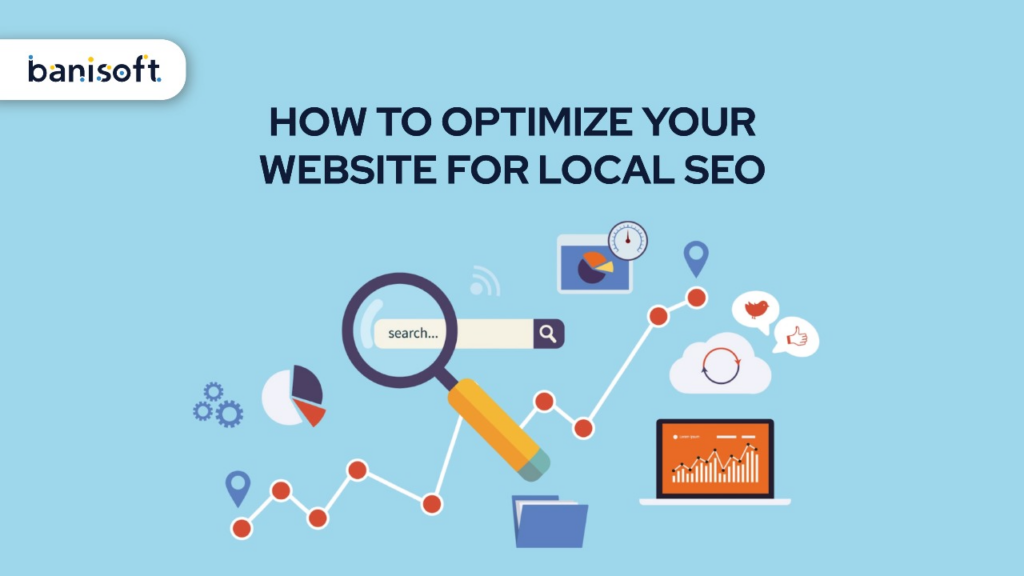
Looking to attract more clients, enhance your brand visibility, and outpace your rivals? Local SEO is your golden ticket—here’s how:
- Localized Traffic Targeting: Local SEO allows cleaning businesses to focus on specific areas, drawing in relevant local clientele. By optimizing your site and content with location-specific keywords, you boost your chances of appearing in local searches when potential clients look for cleaning services in your vicinity.
This targeted strategy connects you with individuals actively seeking your services, making them more likely to become paying customers.
- Boosted Online Presence: In today’s digital age, most people rely on the internet to find local services. Implementing local SEO strategies can enhance your cleaning business’s online presence, making it easier for potential clients to discover you.
Higher rankings on search engine results pages (SERPs) convey credibility and trust, leading to increased organic traffic and better conversion rates.
- Improved Brand Recognition: Local SEO helps cleaning businesses build a solid online presence and increase brand recognition within their target market. You can bolster your brand’s reputation by consistently optimizing your site, creating valuable content, and interacting with local customers through social media and online directories.
As more individuals become familiar with your business, they are more likely to choose you over competitors when they need cleaning services.
- Positive Customer Feedback: Customer reviews significantly influence opinions and purchase decisions. Local SEO can assist your cleaning business in collecting more positive reviews by simplifying the process for satisfied customers to leave feedback.
Managing and responding to reviews can build trust and credibility with potential clients. Positive reviews also enhance local rankings, as search engines prioritize businesses with solid reputations.
Extra Tip – Premier Tools for Local SEO: Google Business Profile, Semrush Local, and BrightLocal
Leverage Relevant Keywords
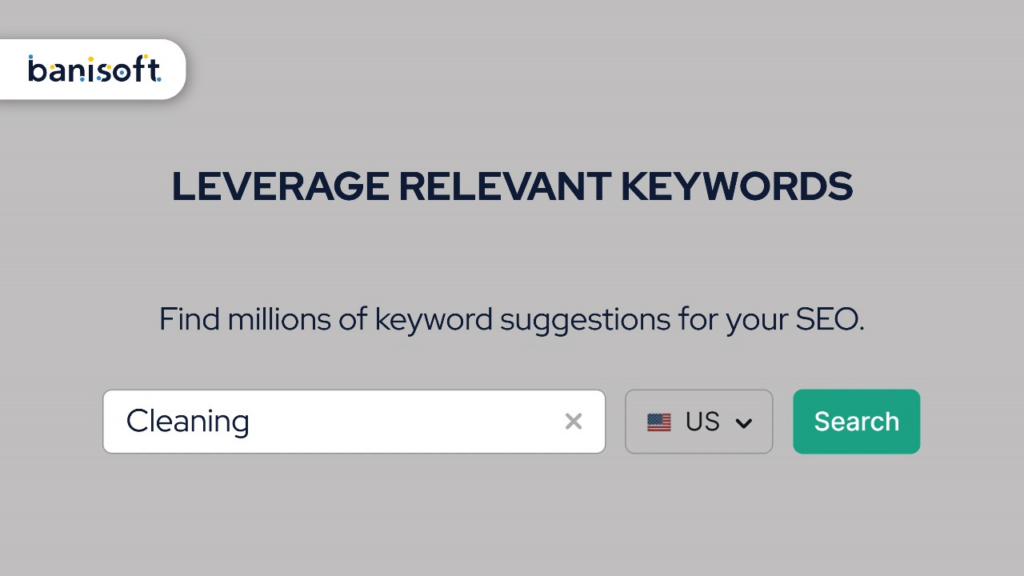
Ever wonder why keyword research is so vital? Keep on reading to find out!
Keyword research is a fundamental part of SEO. It focuses on discovering the terms and phrases that people commonly use when searching for specific information.
Keywords are essential for enhancing the user experience by helping businesses understand what their audience is looking for. This understanding allows them to create content that meets those needs.
By targeting the right keywords, companies can produce content that is not only relevant but also informative and valuable to their audience.
Additionally, keyword research is crucial for gaining a competitive advantage. It enables brands to identify market gaps and create content that addresses these needs, distinguishing themselves from competitors.
Tips for Finding and Using Relevant Keywords:
- Know Your Target Audience: Understanding your target audience is essential when choosing the right keywords. During your research, consider their demographics, interests, and pain points.
- Study Your Competitors: Observe your competitors’ activities and the keywords they are targeting. This can provide valuable insights and help generate ideas for your keyword strategy.
- Use Long-Tail Keywords: Long-tail keywords are more specific and less competitive than general keywords. For example, rather than just “cleaning services,” consider using phrases like “residential and commercial cleaning services.”
- Apply Keyword Modifiers: Adding modifiers such as “best,” “top,” or “buy” to your keywords can help attract more targeted traffic by making them more specific. This strategy is particularly effective for capturing high-intent keywords and driving valuable traffic to your site.
- Utilize Location-Based Keywords: If your business has a physical location, incorporating location-based keywords can help attract local customers.
Examples of Effective Keywords for Your Cleaning Services Online:
- Commercial cleaning services
- Office cleaning
- Commercial cleaning services near me
- Office cleaning services near me
Create High-Quality Content

To truly appreciate why high-quality content is vital for SEO, first understand how search engines function.
Search engines like Google operate complex algorithms to scan websites and evaluate their content.
These algorithms consider various factors, such as keyword usage, relevance, and user experience, to decide a website’s ranking on the search results page.
Quality content is crucial for both search engines and users. From a search engine’s perspective, top-tier content signals a website’s relevance and authority.
By delivering valuable and informative content, a website can significantly enhance its chances of rising higher on the search results page.
High-quality content makes a website appealing and valuable for users. It keeps them engaged and coming back for more.
Quality content contains elements like informative blog posts, engaging videos, and helpful guides that assist users in finding what they need.
Various content types can improve SEO, such as:
- Blog posts: Consistently publishing relevant and informative blog posts can boost a website’s visibility and ranking on search engines.
- Videos: Videos are highly engaging content that can enhance a website’s user experience and keep visitors on the site longer.
- Infographics: Infographics are a visually attractive way to present complex information, making them highly shareable and linkable.
Remember, by creating quality content that is both relevant and engaging, businesses can enhance their SEO and draw more organic traffic to their websites.
Best Practices for Crafting SEO-Friendly Content
- Conduct thorough keyword research.
- Place keywords strategically.
- Create compelling titles and headings.
- Improve readability and formatting.
- Optimize images and multimedia.
- Incorporate internal and external links.
- Speed up page load times.
- Update content consistently.
- Use meta descriptions effectively.
- Encourage social sharing.
- Pay attention to content length.
- Monitor and analyze performance.
- Focus on user experience (UX).
- Write with your target audience in mind.
- Utilize long-tail keywords.
- Develop evergreen content.
Optimize On-Page SEO
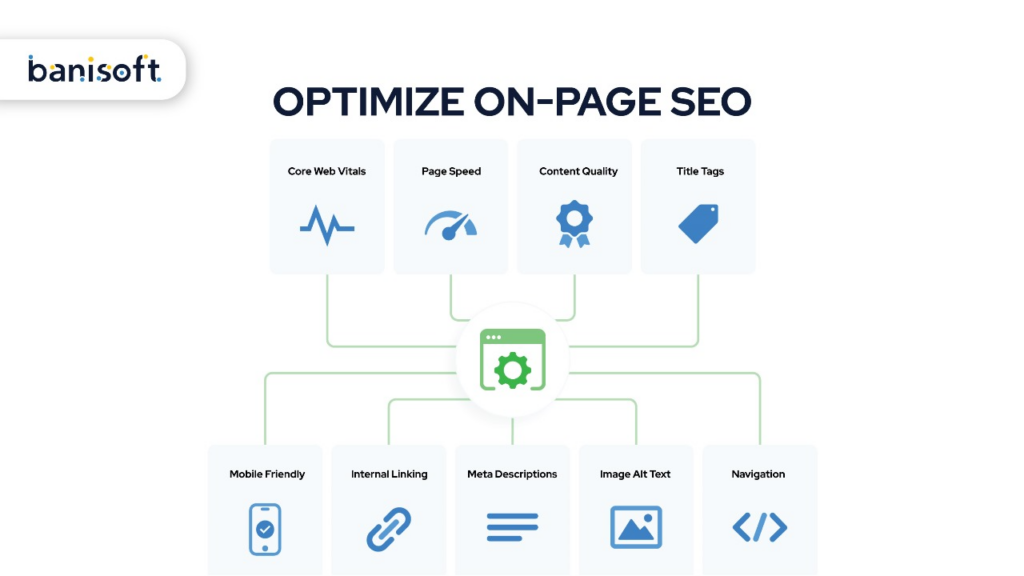
So, what’s the deal with on-page optimization in SEO?
On-page SEO involves fine-tuning your web pages to draw organic traffic and improve your site’s rankings on the search engine results pages (SERPs).
This includes optimizing a page’s HTML, internal links, metadata (such as the meta title, meta description, and keyword density), and posting top-notch, relevant content and images. Thanks to on-page SEO, when you combine these aspects, you enhance your webpage.
Why is on-page SEO crucial?
On-page SEO helps search engines analyze your website and its content to determine if it’s relevant to a searcher’s query.
Google constantly updates its algorithm to better understand a searcher’s intent and provide results that meet their needs. As Google’s algorithm evolves, so should your website.
It’s essential that your website and its content, including what’s visible to users (like media, content, images) and what’s visible to search engines (like meta data, HTML), are optimized according to the latest practices from companies like Google and Bing.
This ensures search engines can understand your site and rank it correctly.
Essential On-Page SEO Elements:
- Keyword Research
- Visual Content
- Page Titles
- Headers
- Meta Descriptions
- Image Alt-Text
- Structured Markup
- Page URLs
- Internal Linking
- Mobile Responsiveness
- Site Speed
Building Backlinks
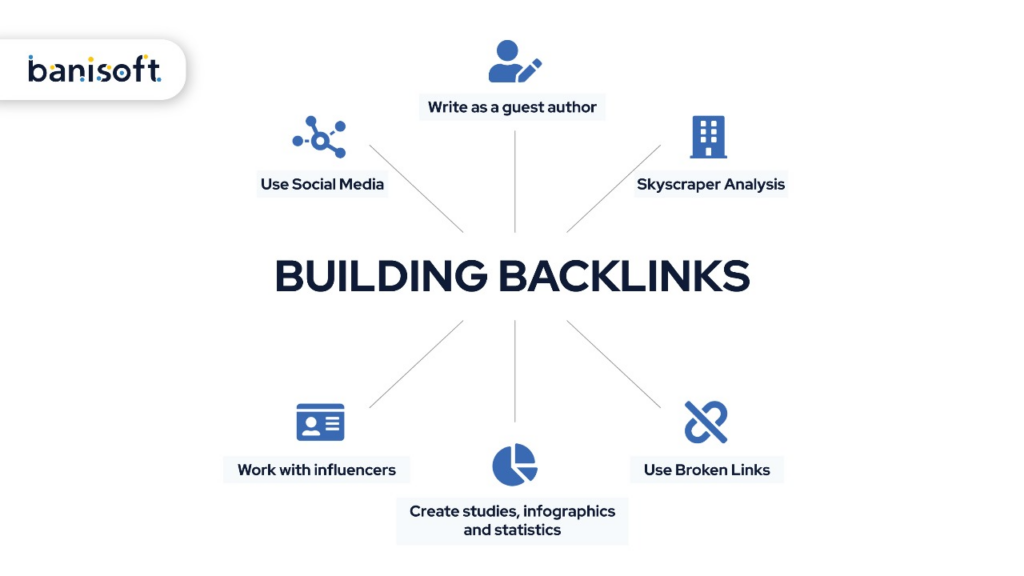
What are Backlinks?
Also called “inbound” or “incoming” links, backlinks occur when one website hyperlinks to another. For instance, if a digital marketing site (Website A) links to a blog post about digital marketing strategies on another site (Website B), Website B gains a vote of confidence – or backlink – from the digital marketing site.
Backlinks are essential for SEO because they signal to Google that another resource values your content enough to link to it within its own content.
As your website gets more backlinks, search engines suspect that your site has valuable content that is worth ranking well on the SERPs.
Top Methods for Acquiring High-Quality Backlinks:
- Guest Posts/Blogging: The ultimate give-and-receive scenario! Write an excellent article for your target website and offer it for free, ensuring you include a backlink to your site within the article.
- Skyscraper Technique: The Skyscraper Technique consists of building backlinks through this effective process:
- Identifying successful content that has attracted many links.
- Creating superior content.
- Promoting that content to those who linked to the original piece.
- Simply put: Craft exceptional content and show it to people who will appreciate it.
Improve Website Speed
Let’s dive into how your website’s speed impacts SEO and user experience.
Website loading time is a critical factor for both user experience and
SEO performance. Slow load times can result in higher bounce rates, lower engagement, and unhappy users.
This can negatively affect user experience and, consequently, your SEO rankings. Conversely, faster load times can enhance user experience, increase engagement, and improve your SEO rankings.
Some Best Practices to Speed Up Your Website:
- Minimize the Number of HTTP Requests
- Upgrade to HTTP/2
- Optimize Image Sizes
- Utilize a Content Delivery Network (CDN)
- Develop Mobile-First Code
Top Website Speed Test Tools in 2024:
- Google PageSpeed Insights
- GTMetrix
- Pingdom Website Speed Test
- Dareboost
- Uptrends
Guarantee Mobile-Friendliness
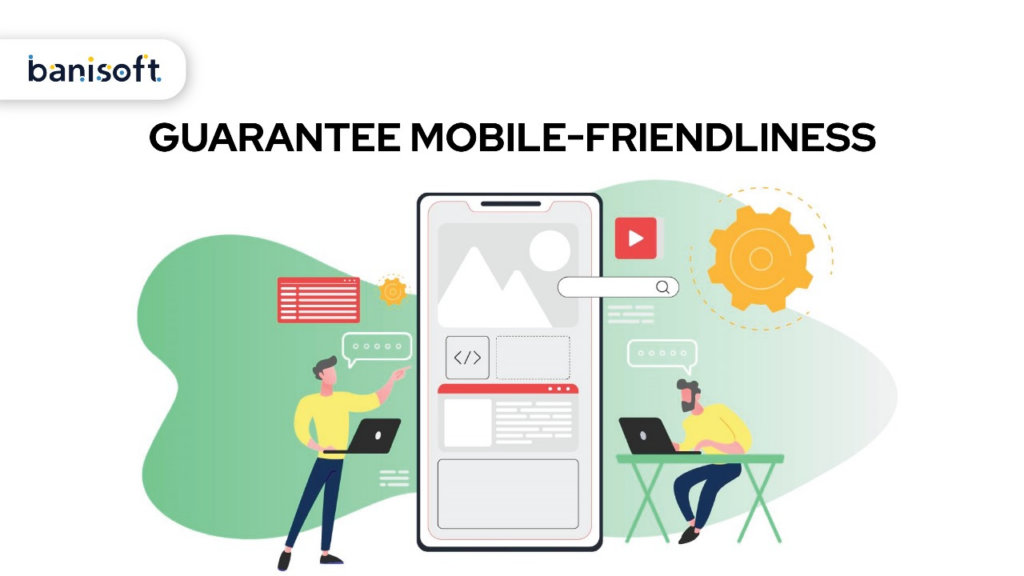
In essence, a mobile-friendly website is one that’s designed to display correctly on smaller screens, such as iPhones, Android smartphones, or tablets.
Standard desktop websites don’t render well on these devices, but a mobile-optimized site adapts to the smaller screen size, formatting the content and interface in a user-friendly way. This includes:
- Larger, easy-to-read text
- Mobile-friendly navigation
- Touch-friendly buttons and elements
- Faster download speed
Why a Mobile-Friendly Website Matters
It’s clear that people are increasingly accessing the internet using a range of devices. It’s no longer safe to assume visitors to your company’s website will use a traditional desktop or laptop. Many are likely using tablets or smartphones.
Traditional websites, even those created just a few years ago, weren’t typically designed for mobile display and perform poorly on modern devices.
While some industries have quickly adapted by transitioning their websites to mobile-friendly formats, many decision-makers still aren’t aware of how crucial this is for their business’s bottom line.
Having a mobile-friendly website offers several significant advantages, including:
- Enhanced search visibility
- Improved user experience
- Boosted lead generation
- Strengthened brand identity
Top Free Tools to Test Your Site’s Mobile-Friendliness:
- Google Search Console: Mobile-Friendly Test
- Google PageSpeed Insights
- Bing: Mobile Friendliness Test Tool
Leveraging Social Media to Improve SEO
How Does Social Media Affect SEO?
Social media can significantly impact your SEO and search rankings. It can drive traffic to your site, boost brand visibility, and help with link building.
When search engines detect high traffic from social media, it enhances your site’s credibility and relevance.
While social signals might not directly influence search engine rankings, an active social media presence can increase website visits, improve brand recognition, encourage content sharing (leading to backlinks), and indicate content relevance and quality.
Together, these elements contribute to better SEO performance.
The main point here is to post engaging content that’s likely to be clicked on.
Doing so increases the chances of users finding your social profiles, engaging with your content, and possibly investing in your product or service.
Many brands succeed by capitalizing on trending topics. Nowadays, social platforms include search features that let users look up anything they’re interested in.
Using effective SEO tactics on social media makes your product or service more likely to appear in user searches. Once they find your product or service, they’ll probably visit your social media profile to learn more.
Strategies to Use Social Media to Improve SEO:
- Share content
- Increase your followers
- Engage with your audience
- Understand what your audience wants
- Use hashtags
Key Social Media Platforms for Cleaning Businesses:
You can showcase your services, build trust, and attract new clients by harnessing the power of platforms like Facebook, Instagram, and LinkedIn.
Final Words
Optimizing your cleaning company website can be tricky, but it doesn’t have to be. Local SEO experts like BANISOFT can help.
Our team speaks the language of search engines and can fine-tune your website to rank higher. Plus, they’ll create content that grabs attention and brings in new customers.
Don’t miss out! Contact BANISOFT today and see how our professionals can boost your online presence!
8 SEO Tips to Boost Your Cleaning Business Online Read More »