
 Summarize in ChatGPT
Table of Contents
- Who Is This Guide For?
- Why Dental Marketing ROI Matters More Than Lead Volume
- What Is Dental Marketing ROI?
- What Should Dental Clinics Track to Measure ROI?
- The Four Levels of Dental Marketing ROI Tracking
- Why Calls, Forms and Bookings Should Not Be Treated the Same
- How to Track Phone Calls from Dental Marketing
- How to Track Website Forms and Appointment Requests
- How to Track Online Bookings
- How to Track Google Business Profile Leads
- How to Track Paid Campaign ROI for Dentists
- How to Connect Marketing Data with Front Desk Performance
- Dental Marketing ROI Dashboard: What Should It Include?
- A Practical Framework to Track Dental Marketing ROI
-
Common Mistakes Dental Clinics Make When Tracking ROI
- Mistake 1: Measuring Traffic Instead of Patients
- Mistake 2: Counting Every Lead as a Success
- Mistake 3: Ignoring Missed Calls
- Mistake 4: Not Tracking Treatment Value
- Mistake 5: Sending All Traffic to the Homepage
- Mistake 6: Not Reviewing Front Desk Performance
- Mistake 7: Looking Only at Cost Per Lead
- Mistake 8: Not Using Source Tracking
- Dental Marketing ROI Checklist for Clinic Owners
- How ROI Tracking Helps Dental Clinics Get More Patients
- What Should Clinics Review Every Month?
- Natural CTA Section
- Conclusion
- Frequently Asked Questions
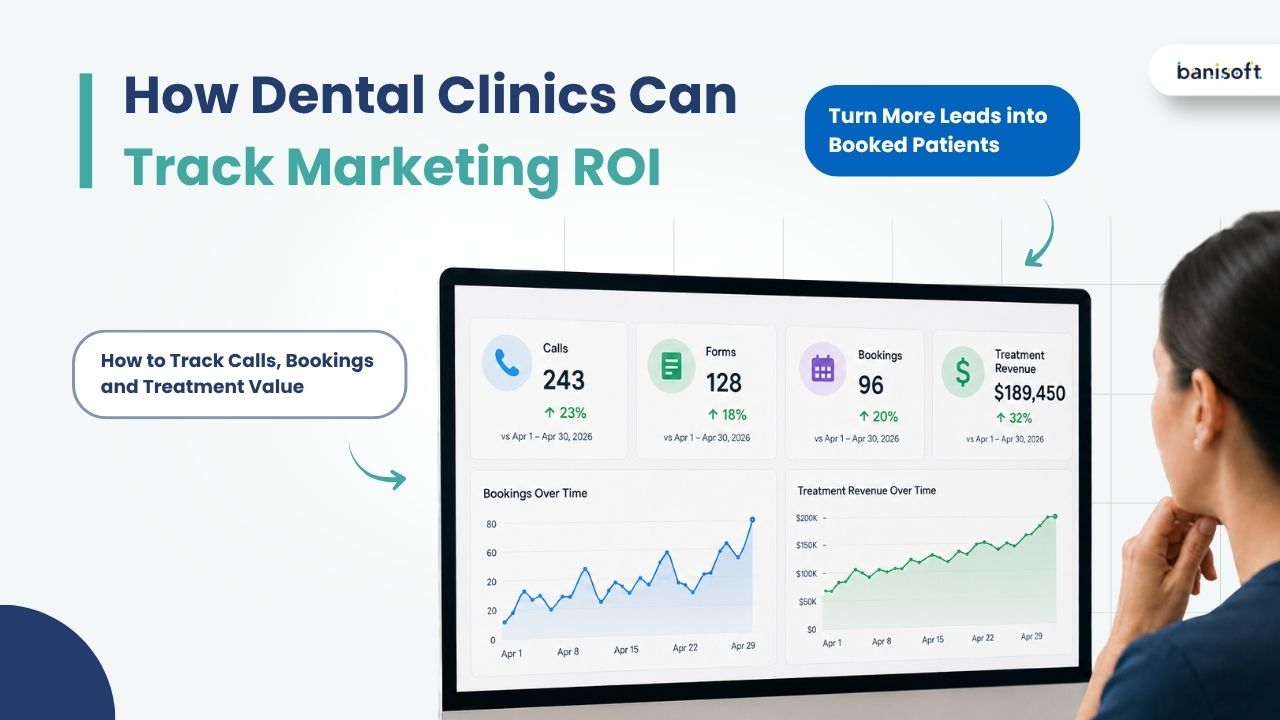
Many dental clinics spend money on marketing but still cannot answer one simple question: which marketing channels are actually bringing in booked patients and treatment revenue?
Dental marketing ROI should not be measured only by website traffic, ad clicks, call volume, or form submissions. A proper ROI tracking system connects every enquiry — calls, forms, online bookings, Google Business Profile actions, and front desk conversations — to booked appointments, attended visits, accepted treatment plans, and treatment value.
This matters because marketing for dental practices is becoming more competitive. Clinics that want to get more dental patients need more than visibility. They need clear tracking that shows which campaigns drive real patient growth and which only generate activity.
Who Is This Guide For?
This guide is for dental clinic owners, dentists, practice managers, and decision-makers who want clearer answers from their marketing.
It is especially useful if your clinic is investing in:
- Google Business Profile optimization
- Local search growth
- Google Ads
- Paid lead generation
- Landing pages
- Website conversion improvements
- Review generation
- Content marketing
- Call tracking
- Online booking systems
- Front desk follow-up
The purpose of this article is simple: to help dental clinics understand whether their marketing is creating leads, booked patients, treatment value, and revenue growth.
Why Dental Marketing ROI Matters More Than Lead Volume
Dental marketing ROI matters because lead volume alone does not show whether marketing is profitable. Clinics need to know which inquiries became booked appointments, which patients attended, and which treatments generated revenue.
Many clinics look at monthly reports and see numbers like:
- Website traffic increased
- Google profile views improved
- Ads generated clicks
- Calls increased
- Forms were submitted
- Social engagement improved
These numbers can be useful, but they do not prove business growth.
A clinic may receive 100 inquiries in a month, but if only 20 are qualified and only 10 book appointments, the actual performance picture looks very different. Another clinic may receive fewer leads, but if those leads are for higher-value treatments such as implants, Invisalign, veneers, crowns, or full-mouth rehabilitation, the business impact may be much stronger.
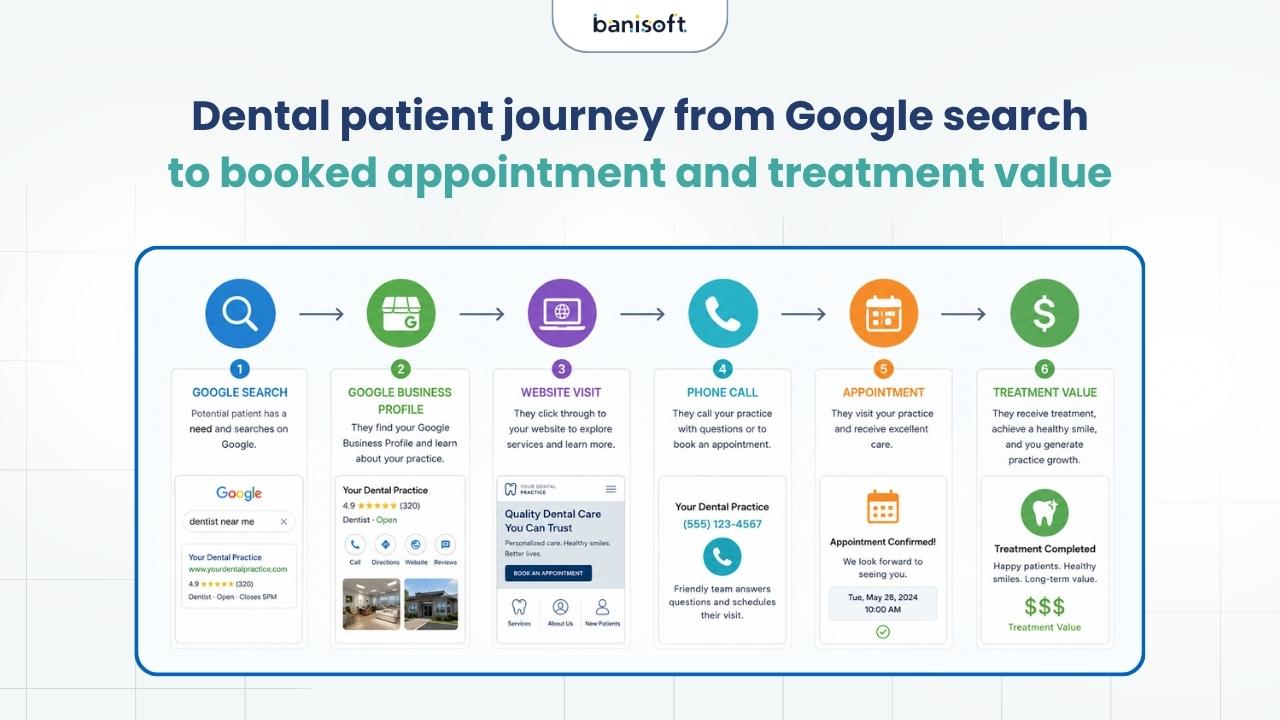
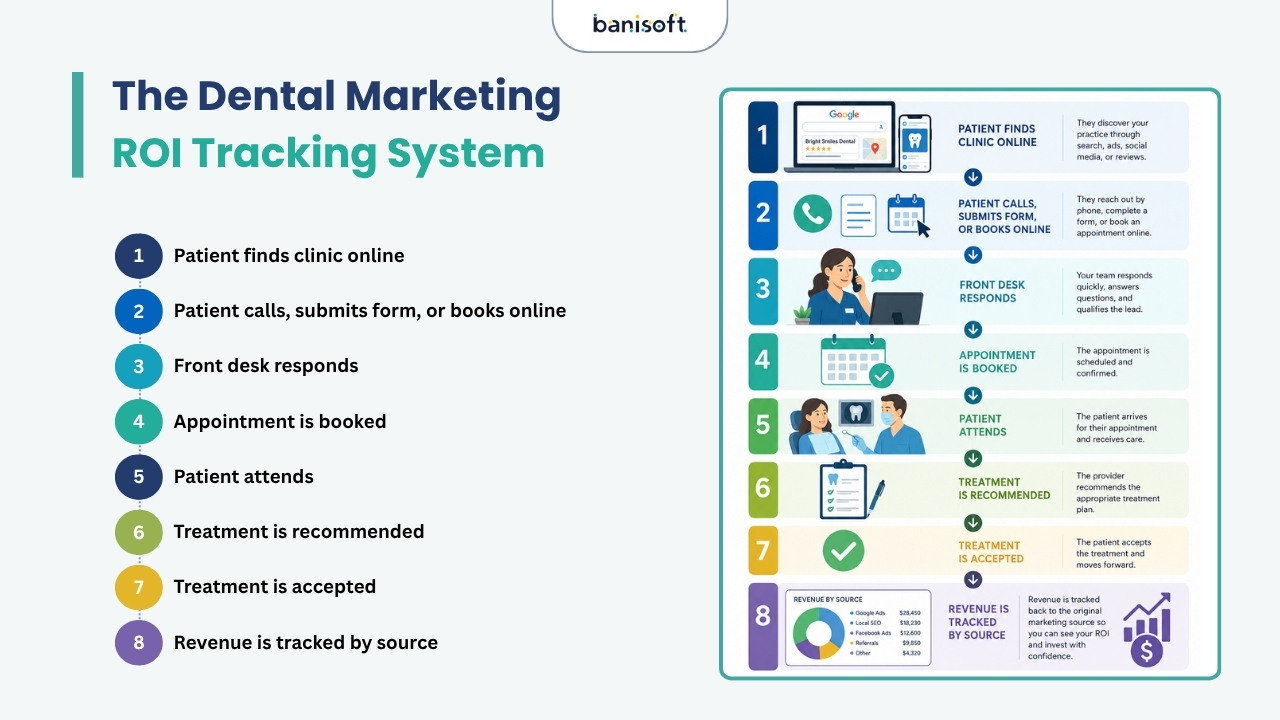
This is why dental marketing ROI needs to be measured through the full patient journey:
Visibility → enquiry → booking → attended appointment → treatment plan → accepted treatment value → revenue
That is the difference between basic marketing reporting and meaningful business tracking.
What Is Dental Marketing ROI?
Dental marketing ROI measures the revenue your clinic generates from marketing relative to the marketing spend.
The simple formula is:
Marketing ROI = Revenue from marketing – Marketing cost ÷ Marketing cost × 100
However, dental clinics should be careful when calculating ROI. Do not calculate ROI only from estimated inquiries or assumed treatment value. Whenever possible, use:
- Actual booked appointments
- Attended appointments
- Accepted treatment plans
- Completed treatment value
- Repeat visit value
✦ Example only:
A clinic may generate 50 new patient inquiries from Google Ads and local search. But if only 18 books, 14 attend, and 8 accept treatment, the ROI should be judged based on those final outcomes, not just the original 50 inquiries.
What Should Dental Clinics Track to Measure ROI?
Dental clinics should track calls, forms, online bookings, Google Business Profile actions, appointment quality, missed calls, follow-ups, treatment types, treatment values, and revenue by source.
A strong tracking system should answer these questions:
- Where did the patient come from?
- Did they call, submit a form, or book online?
- Which service were they interested in?
- Was the call answered?
- Did the inquiry become an appointment?
- Did the patient attend?
- Was treatment recommended?
- Was treatment accepted?
- What revenue was generated?
- Which channel should receive more focus next month?
Most clinics do not need complicated reporting. They need practical, accurate, decision-making data.
The Four Levels of Dental Marketing ROI Tracking
A useful system tracks performance in four levels.
» Level 1: Visibility Metrics
Visibility metrics show whether your clinic is being found online.
These include:
- Website impressions
- Organic website visits
- Google Business Profile views
- Google Maps visibility
- Keyword visibility
- Local search presence
- Paid ad impressions
- Paid ad clicks
- Review growth
- Branded searches
- Non-branded searches
These numbers indicate whether people can find your clinic, but they do not show whether patients are booking appointments.
💡 Expert Tip: Visibility is important, but it is only the first step. A clinic can be seen by many people and still lose patients if the website, phone handling, reviews, or booking process is weak.
» Level 2: Lead Metrics
Lead metrics show whether potential patients are taking action.
These include:
- Phone calls
- Contact form submissions
- Online booking clicks
- Appointment requests
- WhatsApp or chat inquiries
- Email enquiries
- Click-to-call actions
- Google Business Profile calls
- Landing page form submissions
For dental clinics, calls are often one of the most valuable lead types. A patient with tooth pain, a broken tooth, wisdom tooth discomfort, or an urgent dental issue may not have time to browse many pages. They may simply call the clinic that looks trustworthy and available.
This is why tracking calls properly is essential.
» Level 3: Booking Metrics
Booking metrics indicate whether leads are converting into appointments.
These include:
- Total enquiries
- Qualified enquiries
- Appointments booked
- Calls answered
- Calls missed
- Call-back rate
- Booking rate
- No-show rate
- Cancellation rate
- Rescheduled appointments
- Time taken to respond to forms
- Time taken to call back missed inquiries
This level is where many clinics discover hidden problems.
For example, a clinic may say, “Our marketing is not working,” but the tracking may reveal that the campaign generated 70 calls, 22 were missed, and many form inquiries were answered after 24 hours.
In that situation, the issue may not only be marketing. It may also be response time, front desk training, follow-up, or appointment conversion.
» Level 4: Revenue and Treatment Value Metrics
Revenue metrics show whether patient acquisition is profitable.
These include:
- Treatment type requested
- Treatment plan value
- Accepted treatment value
- Completed treatment value
- Revenue from new patients
- Average treatment value
- Cost per lead
- Cost per booked appointment
- Cost per acquired patient
- Revenue by source
- Revenue by service
- Repeat patient value
This is especially important for higher-value dental services such as:
- Dental implants
- Invisalign or clear aligners
- Cosmetic dentistry
- Veneers
- Crowns and bridges
- Smile makeovers
- Root canal treatment
- Dentures
- Emergency dental care
- Teeth whitening
- Full-mouth rehabilitation
A clinic may generate fewer implant inquiries than general check-up inquiries, but the revenue impact can be much higher. This is why clinics should not judge campaigns only by the number of leads.
Why Calls, Forms and Bookings Should Not Be Treated the Same
Calls, forms, and bookings have different levels of intent. A booked appointment is usually more valuable than a basic form inquiry, and an attended appointment is more valuable than both.
Many dental clinics make the mistake of grouping all inquiries into one number.
For example:
- 1 accidental call click
- 1 price-shopping form enquiry
- 1 serious implant consultation request
- 1 emergency dental call
- 1 confirmed online booking
These are not equal.
A better reporting system separates inquiries by quality and stage.
Example of Lead Quality Segmentation
| Lead Type | Intent Level | What to Track |
| Website visit | Low to medium | Source, page, service interest |
| Click-to-call | Medium | Page, device, source |
| Completed form | Medium | Service, location, response time |
| Phone conversation | Medium to high | Answered/missed, duration, outcome |
| Online booking | High | Source, appointment type, status |
| Attended appointment | Very high | Treatment need, next step |
| Accepted treatment | Highest | Treatment value and revenue |
When clinics track this way, they stop asking only, “How many leads did we get?” and start asking, “Which leads became real patients?”
How to Track Phone Calls from Dental Marketing
Direct answer: Dental clinics should track call sources, call durations, missed calls, answered calls, booking outcomes, and treatment interest.
Phone calls are one of the most important conversion points for dental clinics, especially for urgent or high-intent services.
A proper call tracking setup should help you understand:
- Which channel generated the call
- Which campaign generated the call
- Which landing page generated the call
- Whether the call was answered
- How long the call lasted
- What service the patient asked about
- Whether the patient booked
- Whether the patient attended
- Whether treatment was accepted
For paid campaigns, phone call tracking can show which ads and keywords generated calls. For organic and local search, call tracking should be managed carefully to ensure the clinic maintains consistent business name, address, and phone number across key listings.
💡 Expert Tip: Missed call tracking is one of the most overlooked parts of marketing for dental practices. If the clinic is generating calls but not answering them, the campaign may look weaker than it really is.
How to Track Website Forms and Appointment Requests
Direct answer: Every form submission should be tracked by source, service, landing page, location, and follow-up outcome.
A website form should not simply send an email to the clinic inbox. It should help the clinic understand patient intent.
Useful form tracking fields include:
- Name
- Phone number
- Preferred location
- Service of interest
- New or existing patient
- Preferred appointment time
- Source
- Landing page
- Campaign
- Submission time
For dental clinics, shorter forms often work better for urgent services. Longer forms can be useful for consultation-based services, but they may reduce completion rates if they ask for too much information too early.
Good form tracking should show:
- Which pages generate form inquiries
- Which services generate serious inquiries
- How quickly the team responds
- How many forms become booked appointments
- Which forms are spam or low quality
How to Track Online Bookings
Direct answer: Online bookings should be tracked from the first click to the confirmed appointment, not just from button clicks.
Many clinics add a “Book Appointment” button but do not know how many users actually complete the booking.
Track:
- Booking button clicks
- Started bookings
- Completed bookings
- Abandoned bookings
- Appointment type
- Location selected
- New versus returning patient
- Source of booking
- Attendance status
If many people click the booking button but do not complete the appointment, the issue may be:
- Too many booking steps
- Confusing appointment categories
- Limited available times
- Slow booking platform
- Poor mobile experience
- Lack of pricing or consultation information
- No clear option for urgent appointments
This type of tracking helps improve conversion, not just reporting.
How to Track Google Business Profile Leads
Direct answer: Dental clinics should track calls, website clicks, direction requests, reviews, appointment link clicks, and patient source data from Google Business Profile.
Google Business Profile is one of the most important assets for patient acquisition for local clinics.
Patients often compare clinics based on:
- Distance
- Reviews
- Ratings
- Photos
- Services
- Opening hours
- Business description
- Recent updates
- Questions and answers
- Appointment options
A patient may call directly from Google Maps without visiting your website. If you only track website forms, you may miss a major part of your patient acquisition journey.
Track these Google Business Profile actions:
- Phone calls
- Website clicks
- Direction requests
- Booking link clicks
- Review growth
- Review quality
- Service-related search terms
- Photo engagement
- Peak enquiry days and times
💡 Expert Tip: Do not judge your Google profile only by views. Actions matter more. A smaller number of views with more calls and bookings can be more valuable than high visibility with low engagement.
How to Track Paid Campaign ROI for Dentists
Paid campaign ROI should be measured by cost per qualified lead, cost per booked appointment, cost per acquired patient, and treatment value — not only cost per click.
Google Ads and paid lead generation can help clinics reach patients faster, especially for high-intent services.
Paid campaigns may be used for:
- Emergency dentist inquiries
- Dental implant consultations
- Invisalign consultations
- Cosmetic dentistry
- Teeth whitening
- New patient offers
- Location-specific campaigns
- Seasonal promotions
However, paid campaigns can become expensive if tracking is weak.
A clinic should review:
- Which keywords generated calls
- Which ads generated form submissions
- Which campaigns generated booked appointments
- Which services produced high-quality leads
- Which search terms wasted budget
- Which landing pages converted best
- Which leads became treatment revenue
A low cost per lead is not always good. If the leads do not book, attend, or accept treatment, they may not be valuable.
A higher cost per lead may be acceptable if the campaign attracts serious patients for higher-value treatments.
How to Connect Marketing Data with Front Desk Performance
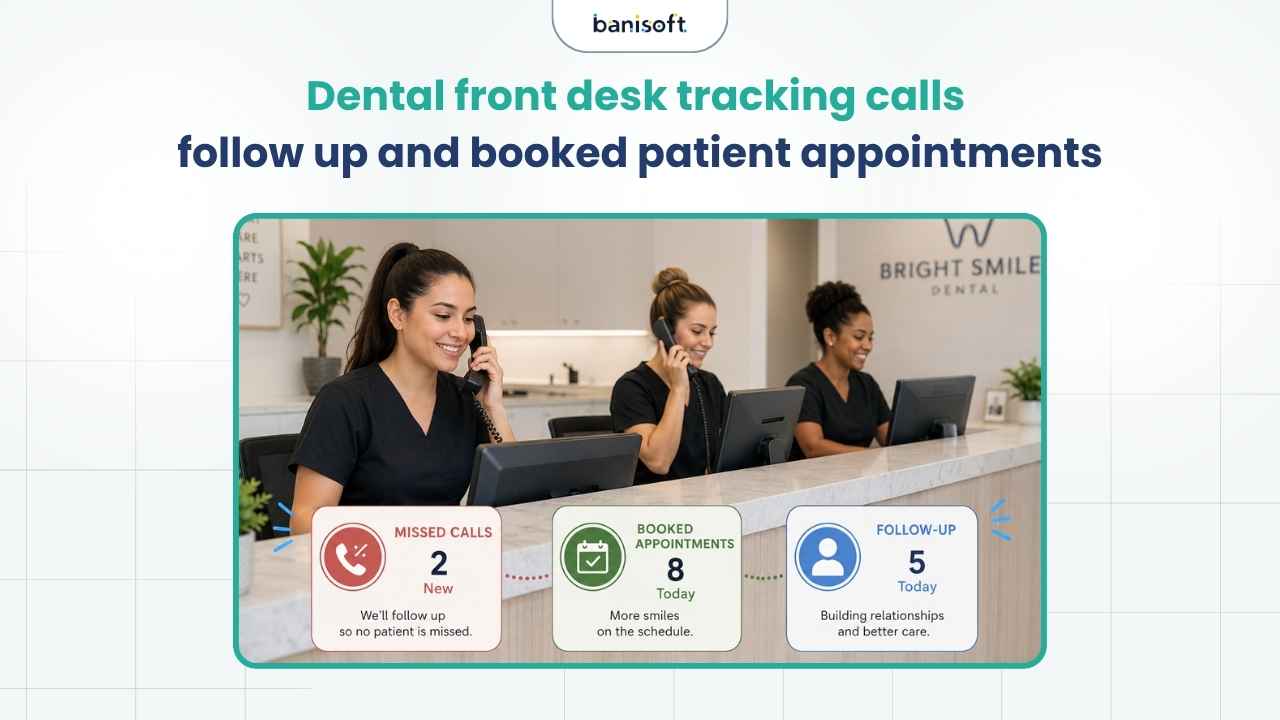
Marketing ROI depends on both lead generation and lead handling. Calls, forms, and booking requests need fast, professional follow-up.
This is one of the most important parts of dental patient acquisition.
A clinic may invest in strong marketing, but still lose patients because:
- Calls are missed
- Calls are rushed
- Pricing questions are handled poorly
- Forms are answered too late
- No one follows up after missed calls
- The team does not ask how the patient found the clinic
- Urgent enquiries are not prioritized
- There is no script for new patient calls
- There is no tracking of booking outcomes
Marketing brings the opportunity. The front desk often decides whether that opportunity becomes a patient.
What Front Desk Teams Should Track
- Total calls received
- Calls answered
- Calls missed
- Calls returned
- Average response time
- Forms followed up
- Booking rate
- No-show rate
- Cancellation reason
- Service requested
- Patient source
- Notes from the conversation
Dental Marketing ROI Dashboard: What Should It Include?
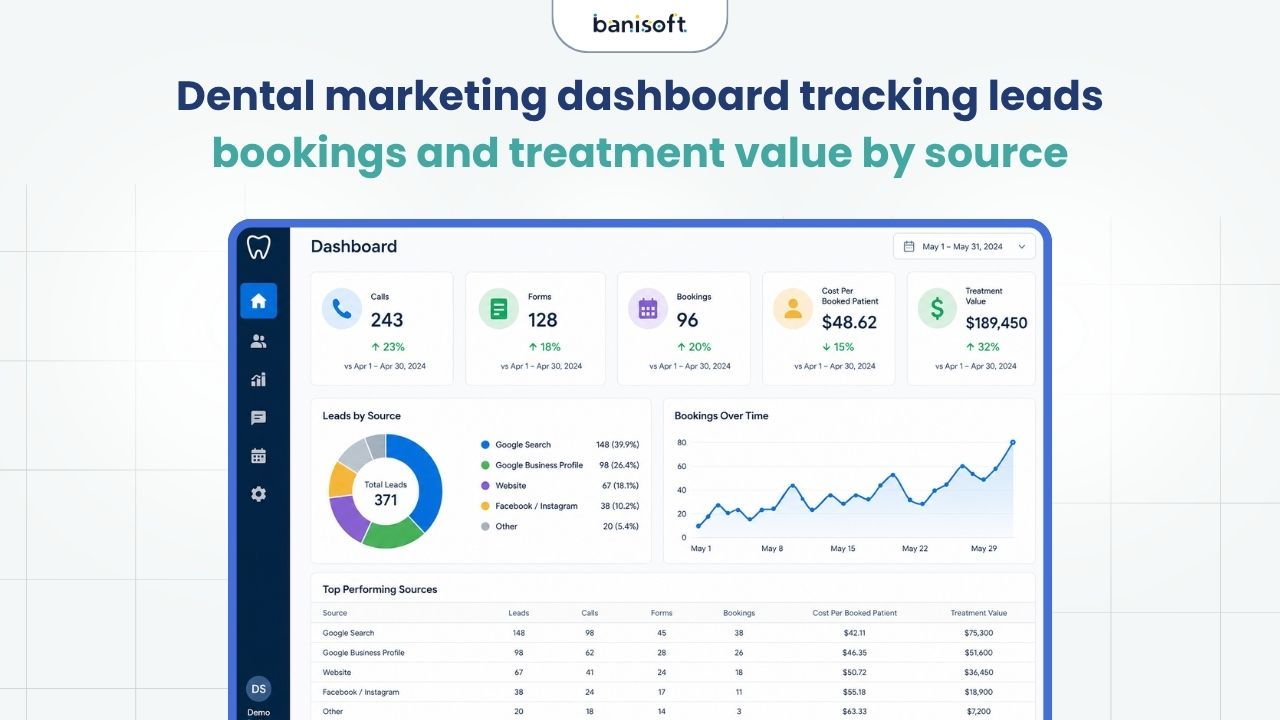
A useful dental marketing ROI dashboard should show visibility, enquiries, bookings, missed opportunities, treatment value, and revenue by source.
A good dashboard should be simple enough for clinic owners to understand and detailed enough for the marketing team to make decisions.
Recommended Dashboard Sections
| Dashboard Section | What to Include | Why It Matters |
| Visibility | Website traffic, profile views, ad impressions, local visibility | Shows whether patients can find the clinic |
| Enquiries | Calls, forms, chats, booking clicks | Shows patient interest |
| Lead Quality | Qualified leads, spam leads, service type | Shows whether leads are useful |
| Booking Performance | Booked appointments, missed calls, response time | Shows conversion from enquiry to appointment |
| Attendance | Attended visits, no-shows, cancellations | Shows real patient flow |
| Treatment Value | Recommended treatment, accepted treatment, revenue | Shows business impact |
| Channel ROI | Cost per lead, cost per booking, revenue by source | Shows where to invest next |
A dashboard should not only report numbers. It should explain what needs to be improved.
A Practical Framework to Track Dental Marketing ROI
Use this step-by-step system to improve your clinic’s tracking.
» Step 1: Define Your Main Conversion Goals
Start by deciding which actions matter most.
For most dental clinics, the primary conversion goals are:
- New patient phone call
- Completed contact form
- Confirmed online booking
- Consultation request
- Emergency appointment request
- High-value treatment enquiry
Secondary actions may include:
- Click-to-call button
- Directions click
- Booking button click
- Service page visit
- Downloaded patient form
- Review interaction
Do not treat every action equally. A confirmed appointment is more important than a button click.
» Step 2: Track Every Lead Source
Each enquiry should have a source.
Common sources include:
- Google organic search
- Google Business Profile
- Google Ads
- Facebook Ads
- Email campaigns
- Referral websites
- Direct website visits
- Local directories
- Offline campaigns
- Patient referrals
This helps the clinic understand which channels are generating leads for dentists and which channels are generating booked patients.
» Step 3: Track Calls and Forms Separately
Calls and forms behave differently.
Phone calls usually show stronger urgency. Forms may show research-based intent. Online bookings may show the highest level of readiness.
Track each separately:
- Calls from website
- Calls from Google profile
- Calls from ads
- Forms from service pages
- Forms from landing pages
- Online booking requests
- Chat or WhatsApp inquiries
This gives a clearer view of patient behavior.
» Step 4: Record the Treatment Interest
Every lead should be tagged by service interest.
For example:
- General check-up
- Hygiene appointment
- Emergency dental care
- Dental implants
- Invisalign or clear aligners
- Teeth whitening
- Root canal treatment
- Wisdom tooth extraction
- Veneers
- Crowns
- Dentures
- Cosmetic dentistry
- Family dentistry
This helps the clinic understand which services are attracting demand and which services need better marketing, stronger pages, or improved offers.
» Step 5: Connect Leads to Booked Appointments
This is where tracking becomes more useful.
For every inquiry, record:
- Did the patient book?
- If not, why not?
- Was the patient unavailable?
- Was price the objection?
- Did the clinic fail to respond quickly?
- Was the service not suitable?
- Was the patient outside the service area?
- Did the patient call another clinic?
This information helps improve marketing and operations.
» Step 6: Track Attended Appointments
Booked appointments are important, but attended appointments matter more.
Track:
- Booked appointments
- Attended appointments
- No-shows
- Cancellations
- Reschedules
If a campaign generates many bookings but many no-shows, the clinic may need better confirmation reminders, deposits, pre-appointment communication, or patient qualification.
»Step 7: Add Treatment Value
Now connect marketing to revenue.
Track:
- Treatment recommended
- Treatment plan value
- Treatment accepted
- Treatment completed
- Revenue collected
- Follow-up visits
- Repeat patient value
This helps you understand true dental marketing ROI.
For example, one channel may generate many low-value inquiries, while another may generate fewer but better patients. Without tracking the value of treatment, the clinic may invest in the wrong channel.
» Step 8: Review and Optimize Monthly
Every month, review:
- Which channel generated the most inquiries?
- Which channel generated the most bookings?
- Which channel generated the highest treatment value?
- Which services performed best?
- Which landing pages need improvement?
- Which campaigns wasted budget?
- Which calls were missed?
- Which forms were not followed up?
- Which service should receive more focus next month?
This turns reporting into strategy.
Common Mistakes Dental Clinics Make When Tracking ROI
● Mistake 1: Measuring Traffic Instead of Patients
Website visits are useful, but they are not the end goal. The clinic needs to know how many visitors became calls, forms, bookings, attended appointments, and treatment revenue.
● Mistake 2: Counting Every Lead as a Success
Not every lead is valuable. Some are spam. Some are price shoppers. Some are outside the area. Some do not book. Segment leads by quality, service type, and appointment outcome.
● Mistake 3: Ignoring Missed Calls
Missed calls can quietly reduce patient growth. If a clinic gets 60 calls but misses 18, that is a major conversion issue.
● Mistake 4: Not Tracking Treatment Value
If the clinic only tracks lead volume, it may not know which channels produce higher-value patients. Treatment value tracking helps clinics make smarter marketing decisions.
● Mistake 5: Sending All Traffic to the Homepage
High-intent patients need service-specific pages or landing pages. An implant patient, an Invisalign patient, an emergency patient, and a hygiene patient all need different information.
● Mistake 6: Not Reviewing Front Desk Performance
Marketing and front desk performance are connected. A strong campaign can fail if calls are not answered properly or forms are not followed up quickly.
● Mistake 7: Looking Only at Cost Per Lead
Cost per lead is useful, but cost per booked patient and revenue per patient are more important. A cheap lead is not valuable if it never becomes a patient.
● Mistake 8: Not Using Source Tracking
If the clinic does not record whether a patient came from Google, ads, social media, referrals, or the website, it cannot measure ROI properly.
Dental Marketing ROI Checklist for Clinic Owners
Use this checklist to review your current tracking setup.
⮞ Website and Landing Page Tracking
- Website traffic is tracked.
- Important inquiry actions are tracked.
- Click-to-call buttons are tracked.
- Contact forms are tracked.
- Booking button clicks are tracked.
- Service pages are reviewed separately.
- Landing page conversion rates are reviewed.
- Mobile performance is checked.
- Thank-you pages or confirmation events are tracked.
⮞ Google Business Profile Tracking
- Calls from Google profile are reviewed.
- Website clicks are reviewed.
- Direction requests are reviewed.
- Appointment link clicks are tracked where possible.
- Reviews are monitored.
- Review themes are reviewed.
- Business hours and services are updated.
- Profile actions are compared month by month.
⮞ Paid Campaign Tracking
- Calls from ads are tracked.
- Website calls from ads are tracked.
- Forms from ads are tracked.
- Cost per lead is reviewed.
- Cost per booked appointment is reviewed.
- Search terms are reviewed.
- Low-quality keywords are excluded.
- Campaigns are reviewed by service.
- Landing pages are tested.
⮞ Front Desk and Booking Tracking
- Missed calls are tracked.
- Answered calls are tracked.
- Call-back time is tracked.
- Form response time is tracked.
- Booking rate is tracked.
- No-show rate is tracked.
- Cancellation reasons are recorded.
- Staff asks how patients found the clinic.
- Lead source is entered into the system.
⮞ Treatment Value Tracking
- Service requested is recorded.
- Treatment recommended is recorded.
- Treatment value is recorded.
- Accepted treatment is tracked.
- Completed treatment is tracked.
- Revenue is connected to source.
- High-value services are reported separately.
- Repeat visit value is reviewed where possible.
How ROI Tracking Helps Dental Clinics Get More Patients
ROI tracking helps clinics get more patients by showing where inquiries are coming from, where patients are dropping off, and which channels should be improved or scaled.
When tracking is done properly, a clinic can make better decisions.
For example:
- If calls are increasing but bookings are low, improve front desk handling.
- If forms are increasing but quality is poor, improve targeting and page messaging.
- If a landing page gets traffic but no calls, improve trust signals and calls to action.
- If Google profile views are high but calls are low, improve reviews, photos, services, and appointment prompts.
- If paid ads generate expensive but high-value implant patients, scaling may make sense.
- If social media generates engagement but few appointments, adjust expectations and tracking.
- If organic search brings fewer but better patients, invest more in content and service pages.
The goal is not just to collect data. The goal is to use data to improve patient acquisition.
What Should Clinics Review Every Month?
A monthly dental marketing ROI review should include:
- Total inquiries by source
- Calls, forms, and bookings by channel
- Qualified leads by service
- Booked appointments
- Attended appointments
- Missed calls
- Form response time
- No-shows and cancellations
- Treatment value by source
- Cost per lead
- Cost per booked appointment
- Cost per acquired patient
- Best-performing services
- Weakest-performing campaigns
- Next month’s action plan
The most useful report does not only say what happened. It explains what to fix, what to scale, and what to stop.
Natural CTA Section
If your dental clinic is investing in marketing but still does not know which channels are driving patient bookings, it may be time to improve your tracking.
A proper marketing audit can show:
- Which channels generate calls
- Which pages convert patients
- Which campaigns waste budget
- Which calls are missed
- Which forms are not followed up
- Which services generate better patient value
- Which marketing activities support revenue growth
Need help building a clearer patient acquisition system? Our team can review your website, Google Business Profile, paid campaigns, landing pages, call tracking, and conversion journey to help your clinic improve visibility, inquiries, bookings, and patient growth.
Conclusion
Dental marketing ROI is not about counting clicks, traffic, or leads in isolation. It is about understanding which marketing efforts turn into real patient conversations, booked appointments, attended visits, accepted treatment plans, and revenue.
For dental clinic owners, this level of tracking brings clarity. It shows where marketing is working, where leads are being lost, and where the clinic should invest next.
The strongest dental practices do not only ask, “How many leads did we get?” They ask, “Which leads became patients, which patients accepted treatment, and which channels helped us grow?”
If your clinic wants more predictable growth, start by tracking the full journey from inquiry to treatment value. Once that journey is clear, improving marketing performance becomes much easier.
Frequently Asked Question
What is dental marketing ROI?
Dental marketing ROI measures the revenue your clinic generates from marketing relative to the amount you spend. It should include calls, forms, bookings, attended appointments, accepted treatment plans, and treatment revenue. This gives a clearer picture than only tracking website traffic or ad clicks.
How do dental clinics know if their marketing is working?
A dental clinic can know marketing is working by tracking the full patient journey. This includes the source of the inquiry, whether the patient called or submitted a form, whether they booked, attended, or accepted treatment. Good marketing should create measurable opportunities for patients.
Should dentists track calls or only online bookings?
Dentists should track both. Many patients still prefer calling, especially for urgent dental needs. Online bookings are also important because they show high intent. Tracking both calls and bookings helps clinics understand how different patients prefer to contact the practice.
Why aren’t my dental leads converting into bookings?
Dental leads may not convert into bookings due to missed calls, slow follow-up, poor landing-page messaging, weak trust signals, price objections, unclear service information, or front-desk handling issues. The best way to diagnose the problem is to track every stage from inquiry to booked appointment.
What is more important: cost per lead or cost per booked patient?
Cost per booked patient is usually more important. Cost per lead only tells you how much it costs to generate an inquiry. Cost per booked patient shows how much it costs to generate an actual appointment. For high-value treatments, treatment revenue should also be reviewed.
How can clinics track the value of treatment from marketing?
Clinics can track treatment value by recording the lead source, service requested, appointment status, recommended treatment, accepted treatment plan, and completed treatment value. This may require coordination between the marketing team, front desk, CRM, and practice management system.
What should a dental marketing dashboard include?
A useful dashboard should include website traffic, calls, forms, bookings, missed calls, response time, Google Business Profile actions, paid campaign results, cost per lead, cost per booked appointment, treatment value, and revenue by source. It should also include clear recommendations.
How often should dental clinics review marketing ROI?
Dental clinics should review marketing ROI monthly. Weekly checks can help identify urgent issues such as missed calls, broken forms, or campaign waste, but a monthly review gives a clearer picture of trends, patient quality, booking performance, and revenue impact.