 Summarize in ChatGPT
Table of Contents
- Who Is This Guide For?
- Why Is Your Dental Clinic Not Ranking on Google Maps?
- How Does Google Decide Which Dental Clinics Appear on Google Maps?
- SEO vs Google Maps SEO for Dental Clinics
- 1. Your Google Business Profile Is Incomplete or Weak
- 2. Your Business Category May Not Be Set Correctly
- 3. Your Services Are Not Clearly Added to the Profile
- 4. Your Website Does Not Support Local SEO Properly
- 5. You Do Not Have Strong Location Pages
- 6. Your Reviews Are Weak, Old, or Not Relevant Enough
- 7. Your Competitors Have Stronger Prominence
- 8. Your Name, Address, and Phone Number Are Inconsistent
- 9. Practitioner Listings May Be Competing With the Main Clinic Listing
- 10. Your Photos and Visual Trust Signals Are Weak
- 11. You Are Targeting Keywords That Are Too Broad
- 12. Your SEO Work Is Not Connected to Patient Conversion
-
Practical Framework: How to Improve Google Maps Ranking for a Dental Clinic
- Step 1: Audit Your Current Google Maps Visibility
- Step 2: Review Your Google Business Profile
- Step 3: Match Profile Services with Website Pages
- Step 4: Strengthen Reviews and Reputation
- Step 5: Improve Local Website Signals
- Step 6: Build Local Authority
- Step 7: Track Calls, Directions, Website Clicks, and Bookings
-
Common Mistakes Dental Clinics Make with Google Maps SEO
- Mistake 1: Thinking Website SEO Automatically Improves Maps Rankings
- Mistake 2: Not Updating Google Business Profile Regularly
- Mistake 3: Using Generic Service Pages
- Mistake 4: Ignoring Reviews Until There Is a Problem
- Mistake 5: Copying Competitor Categories Without Strategy
- Mistake 6: Not Tracking Calls Properly
- Mistake 7: Using Stock Photos Instead of Real Clinic Photos
- Google Maps Ranking Checklist for Dental Clinics
- Conclusion: Dental Clinic Not Ranking on Google Maps? Look Beyond Basic SEO
- Frequently asked questions
Your dental clinic may be investing in SEO, publishing content, and updating your website, yet still not appearing where it matters most: in Google Maps results when nearby patients search for a dentist.
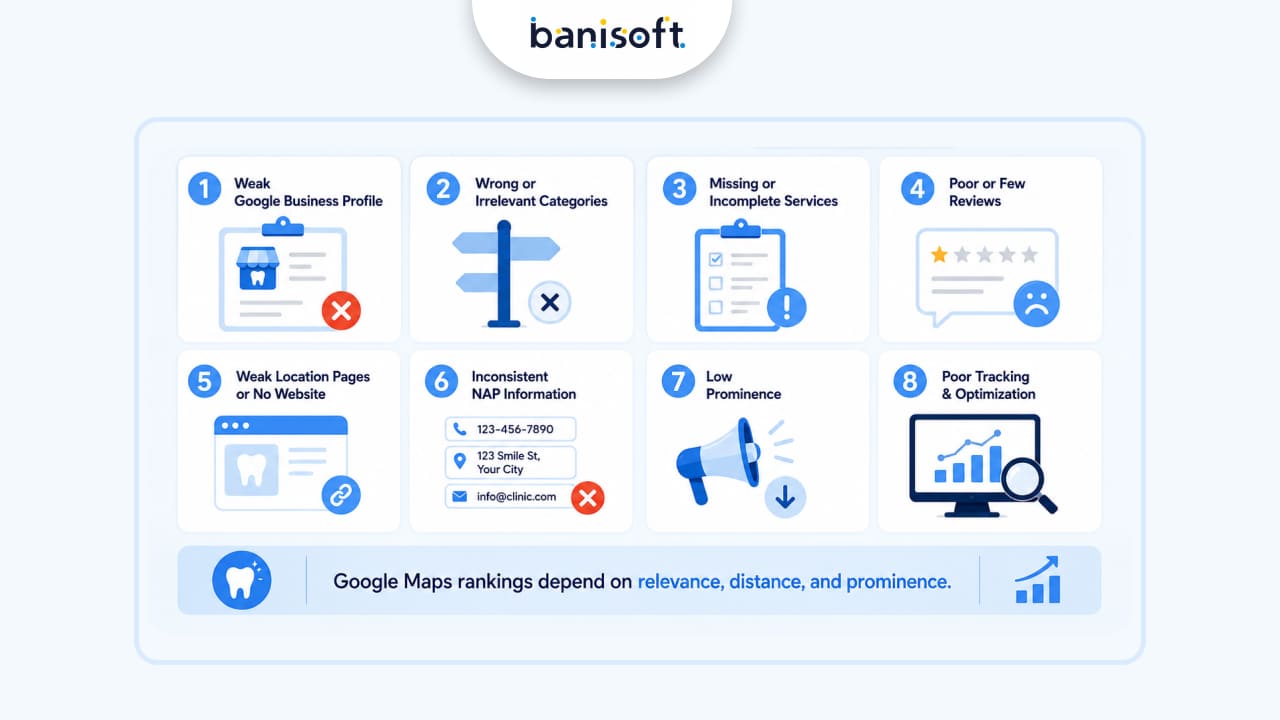
If your dental clinic is not ranking on Google Maps, the problem is usually not “SEO” in general. Google Maps visibility depends heavily on local signals such as Google Business Profile relevance, distance, prominence, reviews, service information, location signals, website authority, and how well your clinic matches the patient’s search intent. Google explains that local rankings are mainly based on relevance, distance, and prominence, and there is no way to request or pay Google for a better local ranking.
For dental clinics, this matters because patients often make quick decisions from Google Maps. They compare reviews, distance, opening hours, photos, services, and booking options before they even visit your website.
Who Is This Guide For?
This guide is for:
- Dental clinic owners
- Dentists managing their own local visibility
- Practice managers responsible for patient appointments
- Multi-location dental groups
- Dental clinics already investing in SEO but not seeing enough Google Maps visibility.
- Clinics that want more calls, direction requests, website visits, and appointment bookings from local search
This advice is based on practical dental marketing experience across Google Business Profile optimization, local SEO, organic traffic, paid campaigns, review strategy, landing pages, tracking, and lead generation.
Why Is Your Dental Clinic Not Ranking on Google Maps?
Short answer: Your dental clinic may not be ranking on Google Maps because your Google Business Profile, website, reviews, location signals, service relevance, or local authority are weaker than competing clinics.
Many dental clinics think website SEO and Google Maps SEO are the same. They are connected, but they are not identical.
Your website can rank organically and still have weak Maps visibility. Your Google Business Profile can get views and still fail to appear for high-intent searches like:
- dentist near me
- emergency dentist near me
- dental clinic in [city]
- Invisalign dentist near me
- teeth whitening near me
- dental implants in [city]
- family dentist near me
- root canal dentist near me
Google Maps ranking depends on how well your clinic matches the local search results. Google’s local ranking documentation says relevance, distance, and prominence work together to help Google show the best match for a search.
How Does Google Decide Which Dental Clinics Appear on Google Maps?
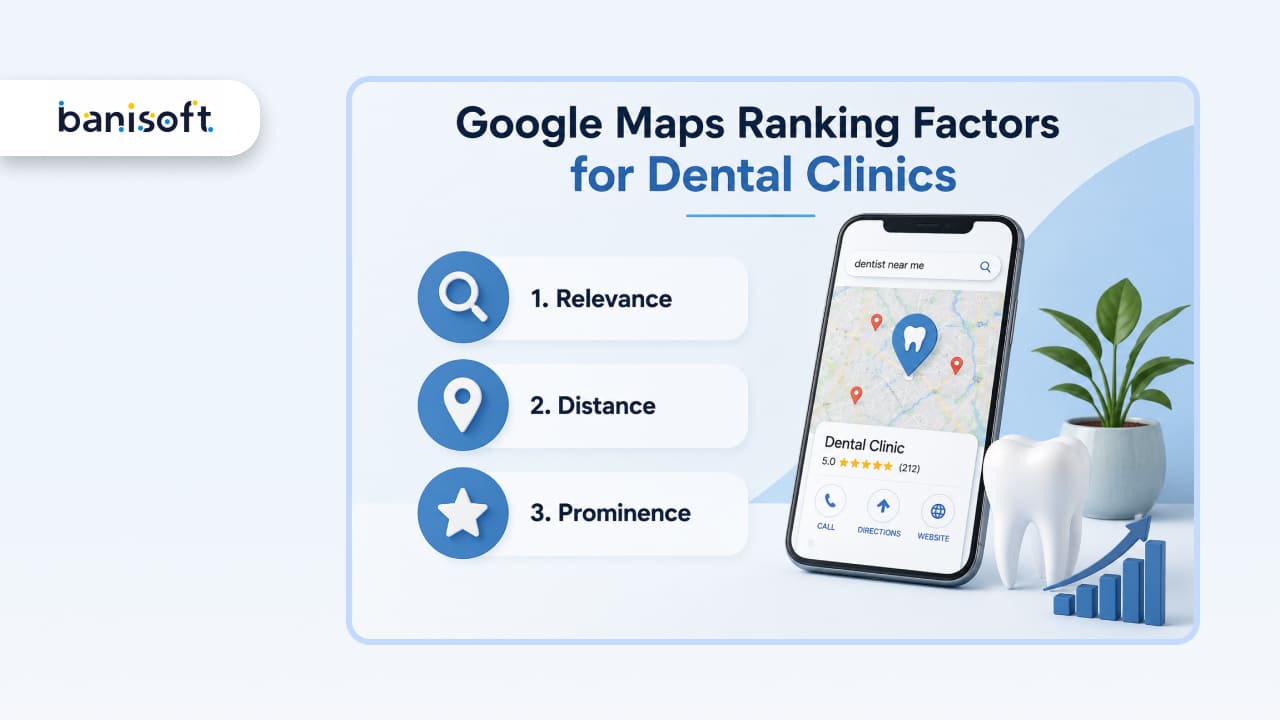
Short answer: Google mainly considers relevance, distance, and prominence when ranking local businesses in Maps and local search.
Let’s translate that into dental clinic language.
| Google Local Ranking Factor | What It Means for Dental Clinics | Example |
| Relevance | Does your clinic match what the patient searched for? | A patient searches “Invisalign dentist near me,” but your profile does not clearly mention Invisalign. |
| Distance | How close is your clinic to the searcher or searched location? | A patient searches from downtown, but your clinic is farther away than other relevant clinics. |
| Prominence | How well-known, trusted, and authoritative your clinic appears online | Strong reviews, consistent information, links, citations, and website authority can support prominence. |
Google also says that complete and accurate business information helps it better understand and match a business to relevant searches.
💡 Expert Tip
Do not judge your Maps ranking from only one search on your own phone. Google Maps results can change based on the searcher’s location, search term, device, history, and proximity. Track multiple keywords from different points around your service area.
SEO vs Google Maps SEO for Dental Clinic
Short answer: Traditional SEO helps your website rank. Google Maps SEO helps your clinic appear in local map results. A dental clinic usually needs both.
| Area | Website SEO | Google Maps SEO |
| Main Asset | Website pages and content | Google Business Profile |
| Main Goal | Rank service pages and blogs | Appear in Maps/local pack |
| Key Signals | Content, backlinks, technical SEO, internal links | GBP relevance, proximity, reviews, categories, local prominence |
| Best For | Treatment research and service-page ranking | Local calls, directions, nearby patient searches |
| Dental Example | “Dental implants cost in Toronto” blog | “Dental implants near me” map result |
A strong dental marketing strategy should connect both. Your Google Business Profile should direct users to strong treatment pages, and your website should reinforce your local relevance with location pages, service pages, schema markup, and helpful content.
1. Your Google Business Profile Is Incomplete or Weak
Short answer: If your Google Business Profile is incomplete, outdated, or poorly optimized, Google may struggle to understand when to show your clinic.
For many dental clinics, the Google Business Profile is the most important local SEO asset. Google allows verified businesses to update important details such as address, hours, contact information, photos, and other profile information to help customers find and learn about the business.
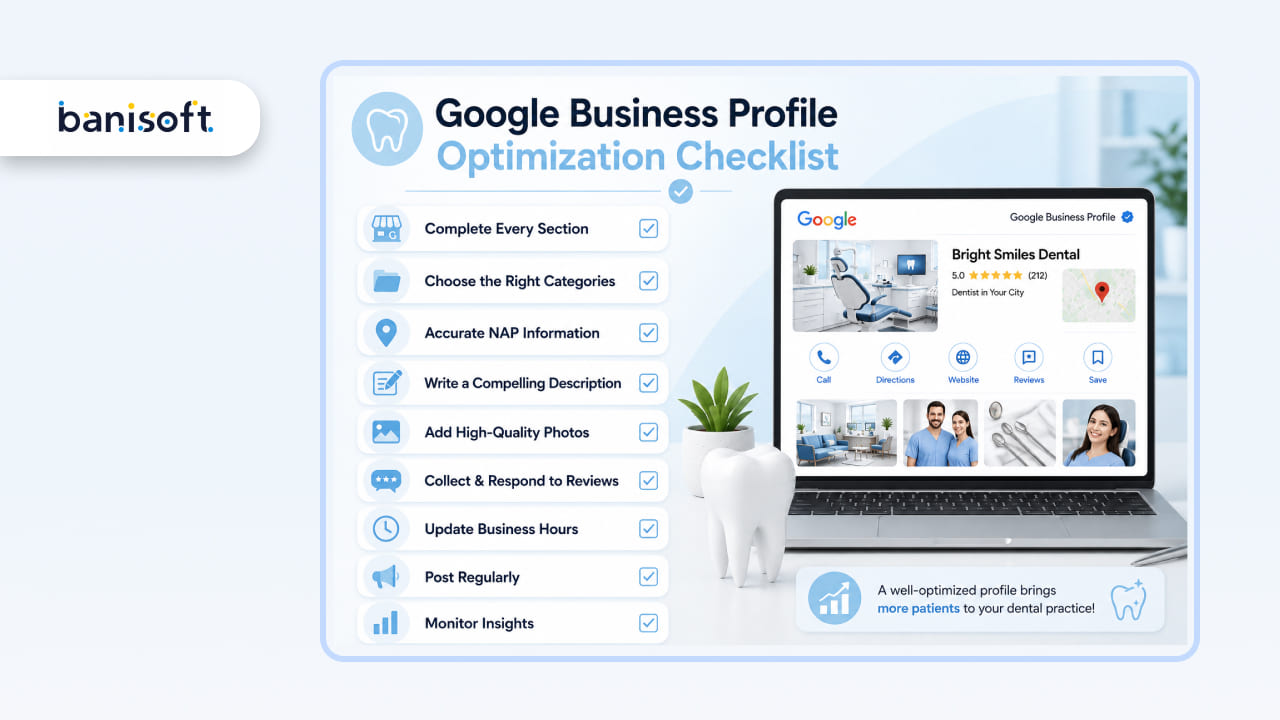
Your dental clinic profile should include:
- Correct clinic name
- Accurate address
- Correct phone number
- Updated opening hours
- Appointment link
- Website link
- Primary dental category
- Secondary categories where relevant
- Treatment services
- Clinic description
- Photos of exterior, interior, reception, treatment rooms, and team where appropriate
- Regular review responses
- Holiday hours
Dental Example »
A clinic may offer Invisalign, dental implants, teeth whitening, and emergency dentistry, but the Google Business Profile only says “Dentist.” That weakens relevance for treatment-specific searches.
💡 Expert Tip
Review your Google Business Profile every month. Dental clinics often update their hours, services, team members, booking links, offers, and photos, yet the profile remains outdated.
2. Your Business Category May Not Be Set Correctly
Short answer: The wrong primary category can reduce your relevance for dental searches.
Your primary category tells Google what your business mainly is. For most general dental clinics, the primary category should align with the core business, such as “Dentist” or the most relevant dental category in your market.
Secondary categories may help if they accurately represent services or specialties, but they should not be used carelessly.
Common Category Mistakes
- Using a broad or unrelated business category
- Selecting categories based only on competitors without checking accuracy
- Not adding relevant secondary categories
- Using categories for services that are not actually provided
- Setting different categories inconsistently across multiple locations
Google’s Business Profile guidelines are designed to keep local business information accurate and high-quality, and businesses should follow them to avoid profile issues or potential removal of their information.
3. Your Services Are Not Clearly Added to the Profile
Short answer: If your profile does not clearly list dental services, it may not match treatment-specific searches.
Dental clinics should use the services section properly. Add important treatments such as:
- General dentistry
- Emergency dentistry
- Family dentistry
- Cosmetic dentistry
- Invisalign or clear aligners
- Dental implants
- Teeth whitening
- Root canal treatment
- Dental crowns
- Veneers
- Wisdom tooth extraction
- Pediatric dentistry, if offered
- Preventive dental care
Each service should be real, accurate, and supported by your website.
Dental Example »
If a patient searches “emergency dentist near me,” Google needs signals that your clinic actually provides emergency dental care. This should be clear on your profile and your website.
4. Your Website Does Not Support Local SEO Properly
Short answer: Google Maps visibility can be affected by your website’s local relevance, service pages, and authority.
Your Google Business Profile and website should support each other.
If your profile says you provide dental implants but your website has no dental implants page, weak content, no location information, and no clear appointment CTA, your local relevance may be weaker than that of a competitor with a strong implant page.
Your dental website should include:
- Clear contact information
- Location page for each clinic
- Dedicated service pages
- Treatment-specific FAQs
- Dentist/team information
- Reviews or patient trust signals
- Internal links between services and location pages
- Clear appointment CTAs
- Mobile-friendly design
- Schema markup where appropriate
Google’s people-first content guidance recommends creating content that is useful for people and demonstrates real experience and expertise, rather than content written only for search rankings.
💡 Expert Tip
For dental clinics, your service pages should not read like generic medical definitions. They should answer real patient questions: cost factors, treatment steps, suitability, pain, recovery, appointment expectations, and when to contact the clinic.
5. You Do Not Have Strong Location Pages
Short answer: If you have multiple clinics or serve multiple areas, weak location pages can limit local relevance.
A location page should not be a thin page with only a clinic address and map. It should help patients understand why that clinic is relevant to their area.
A strong dental location page should include:
- Clinic name, address, and phone number
- Opening hours
- Parking or transit information
- Nearby landmarks
- Services available at that location
- Dentist/team information for that location
- Appointment CTA
- Embedded Google Map
- Reviews relevant to that location
- Local FAQs
- Internal links to major treatment pages
Example Location Page Structure »
H1: Dentist in [City/Area]
Sections: About the clinic, services, emergency dental care, dentist/team, reviews, location and parking, FAQs, appointment booking.
Common Mistake »
Multi-location dental groups often copy the same content across every location page and only changing the city name. This does not create strong local relevance.
6. Your Reviews Are Weak, Old, or Not Relevant Enough
Short answer: Reviews influence patient trust and can support local prominence, but they must be real, recent, and ethically earned.
Dental patients read reviews because dental care is personal. They want to know if the clinic is professional, gentle, clean, reliable, and good at explaining treatment options.
A healthy review strategy should focus on:
- Consistent review requests
- Recent reviews
- Real patient language
- Professional responses
- Service-specific themes where available
- Ethical review collection
- No fake reviews
- No review gating
- No misleading incentives
Dental Example »
If your competitor has recent reviews mentioning “emergency dental appointment,” “Invisalign,” “root canal,” or “dental implants,” and your reviews are older or generic, your competitor may look more relevant and trustworthy to patients.
💡 Expert Tip
Do not create fake reviews or ask staff to write reviews. That can damage trust and may violate platform guidelines. Build a process where real patients are asked at the right time and given a simple way to share feedback.
7. Your Competitors Have Stronger Prominence
Short answer: Sometimes your clinic is doing SEO, but competitors have stronger overall local authority.
Google describes prominence as how well-known a business is, and it may be based on information Google has about a business from across the web, including links, articles, directories, and review count and score.
For dental clinics, prominence may be supported by:
- Strong Google reviews
- Local citations
- Consistent business information
- Quality backlinks
- Local PR mentions
- Dental association profiles
- High-quality service pages
- Strong brand searches
- Active Google Business Profile
- Strong website authority
- Positive patient engagement signals
Common Scenario »
A dental clinic says, “We have better doctors, so why is the competitor ranking higher?”
The answer may be that Google has stronger online signals for the competitor. Better dentistry does not automatically translate into better local visibility unless the online presence communicates it clearly.
8. Your Name, Address, and Phone Number Are Inconsistent
Short answer: Inconsistent business information can confuse users and weaken trust signals.
Your clinic’s name, address, and phone number should be consistent across:
- Google Business Profile
- Website
- Footer
- Contact page
- Location pages
- Social profiles
- Dental directories
- Local citations
- Appointment platforms
- Insurance/dental provider listings
Common Issues »
- Old address still appearing online
- Different phone numbers across directories
- Clinic name written differently on different platforms
- Tracking numbers used incorrectly
- Old practitioner listings competing with the clinic listing
💡 Expert Tip
If you use call tracking, set it up carefully so you do not create inconsistent NAP signals across important listings.
9. Practitioner Listings May Be Competing With the Main Clinic Listing
Short answer: In some cases, individual dentist profiles can compete with the main dental clinic profile.
Dental clinics sometimes have separate Google profiles for practitioners. This can be useful in some cases, but it can also create confusion if not managed properly.
Potential problems include:
- Dentist profile ranking instead of the clinic
- Duplicate or outdated practitioner listings
- Patient calls going to the wrong listing
- Inconsistent categories
- Confusing address or phone information
- Reviews split across different profiles
This should be reviewed carefully, especially for multi-dentist clinics, orthodontists, oral surgeons, and practices with multiple specialists.
10. Your Photos and Visual Trust Signals Are Weak
Short answer: Photos may not directly resolve ranking issues on their own, but they strongly influence patient trust and engagement.
Google says businesses can add photos and videos to help complete their Business Profile and make it more attractive to customers. Exterior photos can help customers recognize the business when visiting.
For dental clinics, useful photos include:
- Exterior clinic photo
- Reception area
- Treatment room
- Dentist/team photo
- Waiting area
- Technology/equipment where appropriate
- Parking or building entrance
- Branded clinic signage
Common Mistake »
Some dental clinics only upload a logo or stock images. That does not help patients feel confident about visiting the clinic.
11. You Are Targeting Keywords That Are Too Broad
Short answer: Ranking for “dentist near me” is valuable, but it is not the only Maps opportunity.
Dental clinics should also focus on service-specific local searches.
Examples:
| Broad Search | Better Treatment-Specific Search |
| dentist near me | emergency dentist near me |
| dental clinic near me | Invisalign dentist near me |
| dentist in [city] | dental implants in [city] |
| family dentist | family dentist accepting new patients |
| cosmetic dentist | veneers dentist near me |
| teeth cleaning | dental cleaning near me |
Treatment-specific visibility can often produces higher-quality leads because the patient already knows what they need.
12. Your SEO Work Is Not Connected to Patient Conversion
Short answer: Ranking is important, but the real goal is calls, bookings, and new patients.
Some clinics improve rankings but still do not get enough appointment requests because the conversion journey is weak.
Check whether your website and profile make it easy to:
- Call the clinic
- Request an appointment
- Book online
- Find the address
- Check hours
- Understand services
- Read reviews
- Learn about the dentist/team
- Ask questions
- Choose the right treatment page
Practical Framework: How to Improve Google Maps Ranking for a Dental Clinic
Use this step-by-step framework before assuming SEO “does not work.”
Step 1: Audit Your Current Google Maps Visibility
Search from different locations around your clinic for:
- dentist near me
- dental clinic near me
- emergency dentist near me
- Invisalign dentist near me
- teeth whitening near me
- dental implants near me
- root canal dentist near me
- family dentist near me
- dentist in [city/area]
Record:
- Where your clinic appears
- Which competitors appear above you
- Their reviews
- Their categories
- Their services
- Their photos
- Their website quality
- Their location pages
- Their treatment pages
Step 2: Review Your Google Business Profile
Check:
- Primary category
- Secondary categories
- Services
- Description
- Appointment link
- Website link
- Hours
- Photos
- Reviews
- Review responses
- Products/services section if available
- Holiday hours
- Duplicate listings
- Practitioner listings
Step 3: Match Profile Services with Website Pages
If your profile lists Invisalign, implants, emergency dentistry, or whitening, your website should have strong pages for those services.
Each page should include:
- Treatment overview
- Who it is for
- What to expect
- Cost factors where appropriate
- FAQs
- Location relevance
- Dentist/team trust signals
- Appointment CTA
Step 4: Strengthen Reviews and Reputation
Build a consistent review process.
Track:
- New reviews per month
- Average rating
- Review themes
- Service-specific mentions
- Response rate
- Negative review patterns
- Competitor review gap
Step 5: Improve Local Website Signals
Add or improve:
- Location pages
- Local schema
- Service schema where appropriate
- Internal linking
- Contact page
- Footer NAP
- Embedded map
- Local FAQs
- Dentist bios
- Treatment pages
Step 6: Build Local Authority
Look for ethical ways to improve local prominence:
- Dental directories
- Local healthcare directories
- Local business directories
- Sponsorships
- Community involvement
- Dental association profiles
- Local PR
- High-quality backlinks
- Educational content worth referencing
Step 7: Track Calls, Directions, Website Clicks, and Bookings
Do not measure Maps SEO only by ranking.
Track:
- Calls from Google Business Profile
- Direction requests
- Website clicks
- Appointment link clicks
- Form submissions
- Calls from website
- Booked appointments
- Service type enquiries
- New patient value
Common Mistakes Dental Clinics Make with Google Maps SEO
Mistake 1: Thinking Website SEO Automatically Improves Maps Rankings
Website SEO helps, but Maps visibility depends on additional local signals like profile optimization, reviews, proximity, local prominence, and business relevance.
Mistake 2: Not Updating Google Business Profile Regularly
An outdated profile can hurt patient trust. Keep hours, services, photos, and appointment links current.
Mistake 3: Using Generic Service Pages
A page called “Our Services” is not enough. Each major treatment should have its own dedicated page.
Mistake 4: Ignoring Reviews Until There Is a Problem
Review generation should be consistent, ethical, and part of the patient experience.
Mistake 5: Copying Competitor Categories Without Strategy
Competitor research is useful, but your categories must accurately represent your real clinic services.
Mistake 6: Not Tracking Calls Properly
If you do not track phone calls and booked appointments, you may not know whether Google Maps visibility is producing real patient growth.
Mistake 7: Using Stock Photos Instead of Real Clinic Photos
Patients want to see the actual clinic, dentist, team, reception area, and environment before booking.
Why Your Dental Clinic Is Not Ranking on Google Maps Even After Doing SEO
Google Maps Ranking Checklist for Dental Clinics
Use this checklist to review your clinic’s local visibility.
Google Business Profile
- Business name follows Google guidelines
- Correct primary dental category selected
- Relevant secondary categories added
- Address is accurate
- Phone number is correct
- Website link works
- Appointment link added
- Hours are accurate
- Holiday hours updated
- Services added
- Description is clear and accurate
- Photos are recent and real
- Reviews are being answered
- Duplicate listings checked
- Practitioner listings reviewed
Website and Local SEO
- Dedicated page for each major treatment
- Location page for each clinic
- NAP details consistent
- Contact page updated
- Embedded map added
- Local FAQs included
- Dentist/team bios added
- Internal links between service and location pages
- Schema markup reviewed
- Mobile experience checked
Reviews and Trust
- Ethical review process in place
- Recent reviews being collected
- Service-specific review themes monitored
- Negative reviews handled professionally
- Reviews not copied, edited, or fabricated
- Team trained to ask for reviews appropriately
Tracking
- GBP calls monitored
- Direction requests reviewed
- Website clicks tracked
- Form submissions tracked
- Booked appointments measured
- Leads connected to treatment type
- Monthly reporting reviewed
- Phone calls tracked
Conclusion: Dental Clinic Not Ranking on Google Maps? Look Beyond Basic SEO
If your dental clinic is not ranking on Google Maps, it does not always mean your SEO has failed. It usually means your local visibility system needs a deeper review.
Google Maps ranking depends on more than website content. Your Google Business Profile, categories, services, reviews, proximity, local prominence, website quality, location pages, treatment pages, citations, and patient trust signals all work together.
The clinics that perform better in local search are usually the ones that make it easy for Google and patients to understand who they are, where they are, what treatments they offer, why they can be trusted, and how to book an appointment.
If your clinic depends on Google for new patients, a proper Google Business Profile and local SEO audit can show where visibility is being lost and what should be fixed first.
Frequently asked questions
Why is my dental clinic not ranking on Google Maps?
Your dental clinic may not be ranking on Google Maps because your Google Business Profile, categories, services, reviews, website, location signals, or local authority are weaker than competitors. Google mainly considers relevance, distance, and prominence when showing local results, so basic website SEO alone may not be enough.
Does SEO help dental clinics rank on Google Maps?
Yes, SEO can help, but Google Maps SEO also depends on local signals such as Google Business Profile optimization, reviews, proximity, categories, service relevance, citations, and local prominence. A strong website supports Maps visibility, but the profile itself also needs to be properly optimized.
How can dentists improve Google Maps ranking?
Dentists can improve Google Maps visibility by completing their Google Business Profile, selecting accurate categories, adding services, collecting genuine reviews, improving location pages, building treatment-specific service pages, keeping business information consistent, adding real clinic photos, and tracking calls and bookings.
Why is my competitor ranking higher with fewer reviews?
A competitor may rank higher with fewer reviews because Google Maps ranking is not based only on review count. Distance, relevance, business category, website authority, local citations, profile completeness, service relevance, and overall prominence can also influence local visibility.
How important is Google Business Profile for dental clinics?
Google Business Profile is very important for dental clinics because many patients use Google Maps to compare dentists before calling or booking an appointment. A complete and accurate profile can help patients see your services, location, hours, photos, reviews, and appointment options.
Can a dental clinic rank on Google Maps without a website?
A dental clinic can appear on Google Maps with only a Business Profile, but a strong website usually improves trust, service relevance, and conversion. For competitive dental services like Invisalign, implants, or emergency dentistry, dedicated service and location pages can boost local visibility.
How long does it take to improve Google Maps ranking for a dental clinic?
The timeline depends on competition, location, profile quality, reviews, website strength, and existing local authority. Some fixes, such as updating hours or services, can be done quickly, but meaningful local ranking improvements often require consistent work over time.
Should dental clinics use Google Ads if they are not ranking on Maps?
Google Ads can help dental clinics get visibility faster while local SEO and Google Maps optimization are being improved. Ads are especially useful for high-intent services like emergency dentistry, Invisalign, dental implants, and teeth whitening, but campaigns should be tracked properly.