
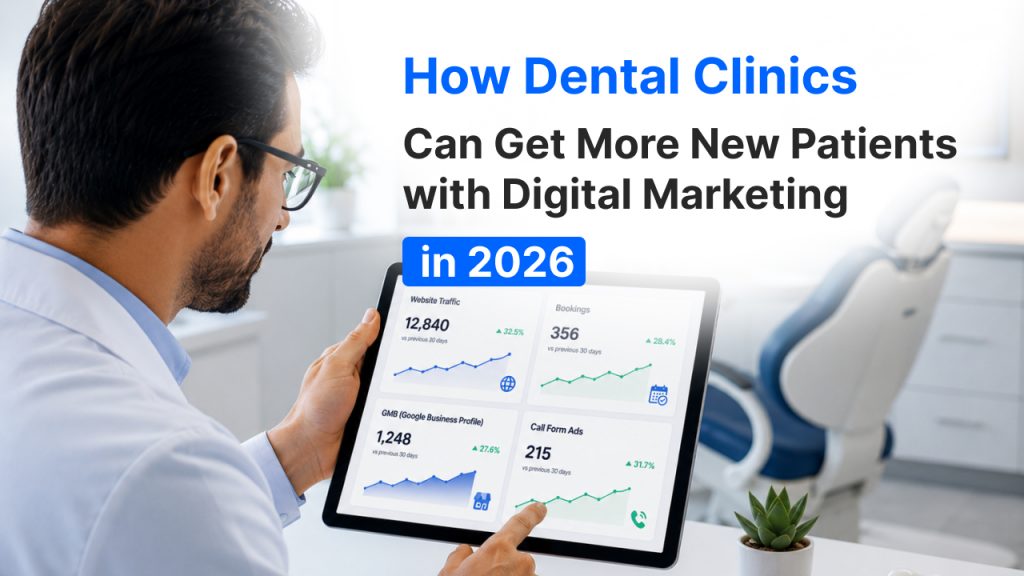
Digital Marketing for Dentist Clinic Growth in 2026: How to Get More New Patients
Table of Contents
- Why Dental Clinics Need a Different Marketing Strategy in 2026
- What Is Digital Marketing for Dental Clinics?
- How Dental Clinics Can Get More New Patients with Digital Marketing in 2026
- 1. Start with Google Business Profile Optimization
- 2. Build Local SEO Around Dental Patient Intent
- 3. Create Treatment-Specific Content That Answers Patient Questions
- 4. Use Google Ads When You Need Faster Patient Demand
- 5. Improve Your Website Conversion Journey
- 6. Build a Review Strategy That Supports Trust and Local SEO
- 7. Track Calls, Forms, Bookings, and Real Patient Outcomes
- Practical Framework: The 7-Step Dental Patient Growth System
- Digital Marketing Channels for Dental Clinics: What to Use and When
- Common Mistakes Dental Clinics Make with Digital Marketing
- Dental Clinic Digital Marketing Checklist for 2026
- Conclusion: Digital Marketing for Dental Clinic Growth Needs a System
- FAQ Section
Dentist clinics do not usually struggle because people do not need dentists. They struggle because the right patients do not always find them at the right moment.
In 2026, digital marketing for dentist clinic growth is not just about posting on social media or adding a few keywords to a website. A strong dental marketing system should help your clinic appear when patients search on Google, build trust before they call, convert website visitors into appointment requests, and track which channels are actually producing new patients.
For most dental practices, the strongest growth comes from combining Google Business Profile optimization, local SEO, service-specific content, Google Ads, patient reviews, conversion-focused landing pages, and proper call/form tracking. Google’s own guidance supports this people-first approach: useful content should demonstrate real expertise, answer the reader’s actual questions, and avoid being created only to manipulate rankings.
Google’s own guidance supports this people-first approach: useful content should demonstrate real expertise, answer the reader’s actual questions, and avoid being created only to manipulate rankings.
Who Is This Guide For?
This guide is written for:
- Dental clinic owners
- Dentists managing their own clinic growth
- Practice managers responsible for patient flow
- Multi-location dental groups
- Dental business decision-makers reviewing SEO, ads, or marketing vendors
The advice is based on hands-on dentist clinic marketing experience, including Google Business Profile optimization, organic traffic growth, paid Google Ads campaigns, review strategy, landing pages, and lead generation.
Why Dentist Clinics Need a Different Marketing Strategy in 2026
Short answer: Dentist clinics need a strategy that connects visibility, trust, appointment intent, and revenue—not just traffic.
Dental marketing has changed because patient behavior has changed. A potential patient may search “dentist near me,” compare Google reviews, check photos, visit the clinic website, read about services, look at opening hours, and then call or book online.
That means your clinic’s marketing must answer several questions before the patient contacts you:
- Is this clinic near me?
- Do they offer the treatment I need?
- Do they look professional and trustworthy?
- Are the reviews strong?
- Can I easily call, book, or request an appointment?
- Do they explain the treatment clearly?
- Are they available when I need them?
A dental clinic that only focuses on rankings but ignores reviews, website conversion, call tracking, and service-page quality will often get traffic without enough new patient bookings.
What Is Digital Marketing for Dentist Clinics?
Short answer: Digital marketing for dentist clinics is the use of online channels to attract, educate, convert, and retain dental patients.
It usually includes:
- Google Business Profile optimization
- Local SEO
- Dental website SEO
- Service pages for treatments
- Dental blogs and educational content
- Google Ads
- Landing pages
- Call tracking and form tracking
- Review generation
- Reputation management
- Social media presence
- Email/SMS follow-up
- Conversion rate optimization
For dental clinics, the goal is not just “more website visitors.” The goal is more qualified appointment requests from patients who are looking for dental care in your area.
How Dentist Clinics Can Get More New Patients with Digital Marketing in 2026
Short answer: Dentist clinics can get more new patients by building a marketing system around local visibility, trust signals, treatment-specific pages, paid search, reviews, and conversion tracking.
Here is the practical growth model:
- Show up when nearby patients search.
- Make your clinic look trustworthy.
- Build service pages for high-intent treatments.
- Use Google Ads for immediate demand.
- Improve calls, forms, and online booking.
- Track which campaigns produce actual patients.
- Keep improving based on data.
This is where many dental practices go wrong. They treat SEO, ads, reviews, and websites as separate tasks. In reality, they work together.
1. Start with Google Business Profile Optimization
Short answer: Your Google Business Profile is often the first impression a patient gets before visiting your website.
For local dental searches, your Google Business Profile can influence calls, direction requests, website visits, and trust. Google says verified businesses can update their profile details such as address, hours, contact info, and photos to help customers find and learn more about the business.
For dentist clinics, your profile should be more than a basic listing. It should clearly show:
- Correct clinic name, address, phone number, and hours
- Primary and secondary dental categories
- Treatment-specific services
- High-quality clinic photos
- Dentist/team photos where appropriate
- Appointment link
- Website link
- Regular updates/posts
- Review responses
- Accurate holiday hours
- Clear service areas if applicable
💡Expert Tip
Do not only optimize your Google Business Profile once. For dental clinics, it should be reviewed monthly. Check whether service information, photos, appointment links, hours, and reviews are still accurate.
2. Build Local SEO Around Dental Patient Intent
Short answer: Local SEO helps your dental clinic rank for searches from nearby patients who are ready to compare or book.
Examples of local dental searches include:
- Dentist near me
- Emergency dentist near me
- Dental clinic in [city]
- Invisalign dentist in [city]
- Teeth whitening near me
- Dental implants in [city]
- Family dentist in [area]
- Root canal dentist near me
Local SEO for dental clinics should include:
Location Pages
If your clinic has multiple locations, each location should have its own page with unique content. Do not copy the same content and only change the city name.
Each location page should include:
- Clinic address
- Local area served
- Services available at that location
- Parking or transit details
- Dentist/team information
- Appointment CTA
- Embedded map
- Local FAQs
- Reviews relevant to that location
Service Pages
Each major treatment should have a dedicated page. For example
- Emergency Dentistry
- Invisalign
- Dental Implants
- Teeth Whitening
- Veneers
- Root Canal Treatment
- Dental Crowns
- Family Dentistry
- Pediatric Dentistry
- Wisdom Tooth Extraction
A patient searching for “Invisalign dentist near me” should not land on a generic homepage. They should land on a page that answers their Invisalign questions and makes booking easy.
3. Create Treatment-Specific Content That Answers Patient Questions
Short answer: Dental content should help patients understand treatments, costs, timelines, suitability, and next steps.
Good dentist SEO is not just about adding keywords. It is about answering the questions patients have before they book.
For example, an Invisalign page or blog may answer:
- How does Invisalign work?
- Is Invisalign better than braces?
- How long does treatment take?
- Who is a good candidate?
- How much does Invisalign cost?
- Does insurance cover Invisalign?
- What happens during the consultation?
- How often are checkups needed?
This type of content helps with SEO, AI search visibility, and patient trust.
➯ Example
A generic blog title like “Benefits of Invisalign” may attract readers.
A stronger title would be:
“Invisalign Benefits: What Dental Patients Should Know Before Booking a Consultation”
This better matches decision-stage search intent.
4. Use Google Ads When You Need Faster Patient Demand
Short answer: Google Ads can help dental clinics generate leads faster, but only when campaigns are structured around patient intent and tracked properly.
SEO takes time. Google Ads can help when your clinic needs faster visibility for high-intent searches such as:
- emergency dentist near me
- same-day dentist
- Invisalign consultation
- dental implants near me
- teeth whitening appointment
- root canal dentis
But dental clinics should avoid running broad campaigns without intent filtering. Not every search has the same value.
Better Google Ads Structure for Dentist Clinics
| Campaign Type | Best For | Example Keywords | Risk If Poorly Managed |
| Emergency Dental Ads | Immediate patient demand | emergency dentist near me | High cost if not location-filtered |
| Invisalign Ads | High-value treatment leads | Invisalign consultation | Attracts price shoppers if landing page is weak |
| Dental Implant Ads | High-value cases | dental implants near me | Needs strong trust and consultation flow |
| General Dentist Ads | New patient acquisition | dentist near me | Can become too broad |
| Brand Ads | Protecting your clinic name | clinic name searches | Low risk, but still needs tracking |
Google Ads for healthcare-related businesses should also follow applicable laws, industry standards, and Google’s healthcare advertising policies.
💡Expert Tip
Do not judge dental Google Ads only by cost per lead. A lower-cost lead is not always better. Track lead quality, booked appointments, cancellations, treatment value, and whether the lead became a real patient.
5. Improve Your Website Conversion Journey
Short answer: A dental website should make it easy for patients to trust you and request an appointment.
Many dental websites get traffic but lose leads because the page does not answer enough questions or the booking process is unclear.
A conversion-focused dental page should include:
- Clear headline
- Treatment explanation
- Dentist/team trust signals
- Clinic location
- Reviews or testimonials
- Before/after examples where allowed and appropriate
- FAQs
- Insurance/payment information where relevant
- Prominent phone number
- Online booking button
- Mobile-friendly design
- Fast page loading
- Simple contact form
» Common Problem
A clinic may rank for “teeth whitening near me,” but the page only has two paragraphs, no price guidance, no FAQs, no dentist information, no reviews, and a weak CTA. That traffic may not convert.
6. Build a Review Strategy That Supports Trust and Local SEO
Short answer: Reviews influence patient confidence and can support local visibility when managed ethically.
For dental clinics, reviews matter because patients are often nervous, price-conscious, or unsure which clinic to trust.
Your review strategy should include:
- Asking happy patients at the right time
- Making the review process simple
- Responding professionally to reviews
- Avoiding fake or incentivized reviews
- Using service-specific review themes where available
- Monitoring negative feedback for operational improvements
For example, if your Invisalign page shows only general reviews about reception staff, it may not fully support the treatment page. If you have real patient reviews mentioning Invisalign, braces, cosmetic dentistry, or aligners, those may be more relevant—provided they are genuine and used with appropriate permission.
💡Expert Tip
Do not create fake reviews or edit reviews to make them sound better. Use real patient language. Trust is more important than perfect wording.
7. Track Calls, Forms, Bookings, and Real Patient Outcomes
Short answer: Dental clinics should track not only leads, but also which leads become appointments and patients.
Google Ads allows call conversion tracking to help understand which keywords, ads, ad groups, and campaigns drive valuable phone calls.
For dental clinics, basic tracking should include:
- Website form submissions
- Phone calls from website
- Calls from ads
- Calls from Google Business Profile
- Appointment booking clicks
- Online booking completions
- Lead source
- Booked appointment rate
- New patient rate
- Treatment type
- Revenue where possible
Without tracking, a clinic may keep spending money on campaigns that generate calls but not real patients.
Example Tracking Framework
| Metric | What It Tells You | Why It Matters |
| Impressions | How often your clinic appears | Visibility |
| Clicks | How many people visit your site | Interest |
| Calls | How many people contact you | Lead generation |
| Forms | How many people request info | Lead generation |
| Booked Appointments | How many leads convert | Business impact |
| Treatment Type | What services drive value | Revenue quality |
| Cost Per Booked Patient | True marketing efficiency | Budget decisions |
Our team can review your local rankings, Google Business Profile, website pages, calls, forms, and paid campaign setup.: Digital Marketing for Dentist Clinic Growth in 2026: How to Get More New Patients
Practical Framework: The 7-Step Dental Patient Growth System
Use this system to build a stronger digital marketing foundation for your dentist clinic.
› Step 1: Audit Your Current Visibility
Check where your clinic appears for:
- dentist near me
- dental clinic near me
- emergency dentist
- Invisalign dentist
- teeth whitening
- dental implants
- root canal
- family dentist
- location-specific searches
Review both Google Maps and organic search results.
› Step 2: Fix Google Business Profile Issues
Update:
- Categories
- Services
- Hours
- Photos
- Appointment links
- Website links
- Clinic description
- Review responses
- Holiday hours
› Step 3: Build or Improve Core Service Pages
Prioritize services that matter commercially:
- Emergency dentistry
- Invisalign
- Dental implants
- Teeth whitening
- Veneers
- Family dentistry
- Root canal
- Crowns and bridges
› Step 4: Create Helpful Content for Patient Questions
Write content that answers real patient concerns:
- Cost
- Pain
- Treatment time
- Recovery
- Suitability
- Insurance/payment
- Alternatives
- When to see a dentist
› Step 5: Use Google Ads for High-Intent Treatments
Run ads where patients show booking intent. Avoid broad, low-intent campaigns unless they are part of a larger awareness strategy.
› Step 6: Improve Conversion Points
Make sure every important page has:
- Phone CTA
- Appointment CTA
- Trust signals
- Reviews
- FAQs
- Location information
- Mobile-friendly layout
› Step 7: Track and Improve Monthly
Review monthly:
- Rankings
- GBP actions
- Calls
- Forms
- Bookings
- Cost per lead
- Cost per booked appointment
- Best-performing services
- Pages with traffic but weak conversion
Digital Marketing Channels for Dental Clinics: What to Use and When
| Channel | Best Use | Timeline | Notes |
| Google Business Profile | Local calls, directions, Maps visibility | Ongoing | Essential for local dental clinics |
| Local SEO | Long-term patient acquisition | Medium to long term | Builds organic visibility |
| Google Ads | Faster lead generation | Short term | Works best with strong landing pages |
| Service Pages | Treatment-specific rankings and conversion | Ongoing | Critical for Invisalign, implants, emergency dentistry |
| Blogs | Education and AI search visibility | Long term | Best when linked to service pages |
| Reviews | Trust and conversion | Ongoing | Must be ethical and real |
| Landing Pages | Paid campaign conversion | Short term | Should match ad intent |
| Email/SMS Follow-Up | Patient nurturing and reactivation | Ongoing | Useful for recalls and pending treatments |
Common Mistakes Dental Clinics Make with Digital Marketing
1. Targeting Only “Dentist Near Me
“Dentist near me” is valuable, but it is not the only keyword. Treatment-specific searches often show stronger intent.
A clinic should also target keywords around emergency dentistry, Invisalign, implants, whitening, veneers, root canal, and location-based treatment terms.
2. Sending All Traffic to the Homepage
A patient searching for “dental implants in [city]” should land on a dental implant page, not a generic homepage.
3. Running Google Ads Without Call Tracking
This makes it difficult to know which campaigns are producing serious enquiries.
4. Ignoring Google Business Profile
Many clinics update their website but neglect their Google profile. This can hurt local visibility and trust.
5. Publishing Generic Blogs
A blog like “Why Dental Health Is Important” may be educational, but it may not attract the right decision-stage patients.
Better topics include:
- How to know if you need emergency dental care
- Invisalign vs braces
- Dental implant cost factors
- Teeth whitening options
- What to expect during a root canal
6. Not Connecting Marketing to Revenu
Traffic is useful only when it leads to calls, bookings, and patient value.
Dental Clinic Digital Marketing Checklist for 2026
Use this checklist to review your clinic’s current marketing foundation.
Google Business Profile
- Correct clinic name, address, phone number
- Accurate business hours
- Correct dental categories
- Services added
- Appointment link added
- High-quality clinic photos
- Dentist/team photos where appropriate
- Review responses updated
- Holiday hours checked
Website and SEO
- Dedicated pages for major treatments
- Location page for each clinic
- Clear phone and booking CTA
- Mobile-friendly design
- Fast loading pages
- FAQs added to key service pages
- Internal links between blogs and service pages
- Schema markup added where appropriate
- Author/reviewer information included
Google Ads
- Campaigns separated by service intent
- Location targeting checked
- Negative keywords added
- Call tracking enabled
- Form tracking enabled
- Landing pages matched to ad intent
- Budget reviewed by treatment priority
Reviews and Trust
- Ethical review request process
- Recent reviews monitored
- Negative reviews handled professionally
- Service-specific reviews used where relevant
- Real team and clinic photos added
Tracking
- GA4 configured
- Google Search Console reviewed
- Google Ads conversions tracked
- Calls tracked
- Forms tracked
- Booked appointments measured
- Monthly report connects marketing to patient acquisition
Conclusion: Digital Marketing for Dentist Clinic Growth Needs a System
In 2026, digital marketing for dentist clinic growth should not be treated as a collection of random tactics. SEO, Google Business Profile, Google Ads, reviews, content, landing pages, and tracking should work together to create one patient acquisition system.
The clinics that usually perform better are not always the ones spending the most. They are often the ones that understand patient intent, build trust early, make booking easy, and measure what actually creates new patient appointments.
If your dental clinic depends on Google for new patients, a proper SEO, Google Business Profile, ads, and conversion audit can show where leads are being gained—or lost.
Frequently Asked Question
What is digital marketing for dental clinics?
Digital marketing for dental clinics is the use of online channels like Google Search, Google Business Profile, local SEO, Google Ads, reviews, content, landing pages, and tracking to attract new patients. The goal is not only to increase traffic, but to generate more qualified appointment requests from people actively looking for dental care.
How can a dental clinic get more new patients from Google?
A dental clinic can get more new patients from Google by improving its Google Business Profile, ranking service pages for treatment keywords, collecting genuine reviews, publishing helpful dental content, and using Google Ads for high-intent searches. The website should also make it easy for patients to call, book, or request an appointment.
Is SEO or Google Ads better for dentists?
SEO is better for long-term visibility and reducing dependency on paid traffic. Google Ads is better when a dental clinic needs faster leads for specific services like emergency dentistry, Invisalign, implants, or teeth whitening. Most clinics benefit from using both, with SEO building authority and ads supporting short-term patient demand.
Why is my dental clinic getting website traffic but not enough calls?
This usually happens when the website does not match patient intent or lacks strong conversion elements. Common issues include weak service pages, unclear CTAs, no online booking option, poor mobile experience, missing reviews, limited treatment information, or no trust signals. Tracking calls and forms can help identify the exact issue.
How important is Google Business Profile for dentists?
Google Business Profile is very important for dental clinics because many patients compare clinics directly from Google Maps and local search results. A well-optimized profile with accurate information, services, photos, reviews, and appointment links can support calls, direction requests, and website visits.
What dental services should clinics promote online?
Dental clinics should prioritize services that have strong patient demand and business value. These may include emergency dentistry, Invisalign, dental implants, teeth whitening, veneers, crowns, root canal treatment, family dentistry, and preventive care. The best services to promote depend on clinic capacity, margins, location, and patient demand.
How long does dental SEO take to work?
Dental SEO usually takes time because Google needs to crawl, understand, and compare your pages against competitors. Timelines depend on competition, website quality, content depth, Google Business Profile strength, reviews, and location. Clinics should measure progress through rankings, impressions, calls, forms, and booked appointments—not rankings alone.
Should dental clinics write blogs in 2026?
Yes, but only if the blogs answer real patient questions and support the clinic’s service pages. Generic blogs are less useful. Better topics include treatment costs, comparisons, symptoms, consultation expectations, recovery, and decision-making guides. Blogs can also support AI search visibility when written clearly and reviewed for accuracy.
Digital Marketing for Dentist Clinic Growth in 2026: How to Get More New Patients Read More »