
Author name: Gagandeep Singh

Gagandweep Singh has been helping businesses turn marketing spend into measurable revenue since 2001. As co-founder of Banisoft.com, he's spent 25+ years running SEO, paid ads, email automation, and full-funnel strategies for clients across the USA, Canada, and Australia — in industries from law and medical to real estate, SaaS, and ecommerce.He holds certifications from Google, Meta, and HubSpot. He writes about what actually moves the needle — not marketing theory, but the strategies that generate leads, lower acquisition costs, and build businesses that grow.

Why is Content-Length Important? Finding the Perfect Length for Various Content Types
 

We want to boost visibility on search engine results pages, attract more visitors, and hopefully gain new customers. 

But, how do we make that happen? By putting out amazing high-quality content, of course! 

Now, while we do agree that our top priority should be to produce unique, top-notch content that resonates with our readers, there’s more to it than just that! 

Content marketing isn’t just about having the best quality content; it’s also about finding the perfect balance between quality and quantity

Let’s break it down and make it crystal clear for you why content length is important!


Content length, meaning the number of words or characters in a piece like a blog post or article, is crucial for both audience engagement and search engine optimization (SEO)

As we all are aware how significantly content marketing boosts your SEO.

 But the content length can vary from short to long and detailed.

Content length matters because it affects how your audience interacts with your work and its visibility on search engine results pages (SERPs). Very short content may lack value, while overly lengthy content might overwhelm readers.

Content length is one of Google’s 200 ranking factors. 

Therefore, to improve your content’s performance, it is crucial to find the optimal length that engages your audience, meets search engine requirements, and helps achieve your content marketing goals.

So, what is the best length for website content for search engine optimization purposes?

This question often stumps SEO Teams and Copywriters. 

The truth is – there is no one-size-fits-all answer to this question, as the ideal content length for seo varies depending on the source.

HubSpot suggests that the ideal SEO content length is between 2,100 and 2,400 words based on their data, but they’ve also seen shorter blogs with less than 1,500 words perform well.

Hook Agency‘s research indicates that the best blog length for SEO in 2023 ranges from 1,760 to 2,400 words.

Additionally, SerpIQ conducted a study examining the top 10 search results by content length.

Here’s the Graph:
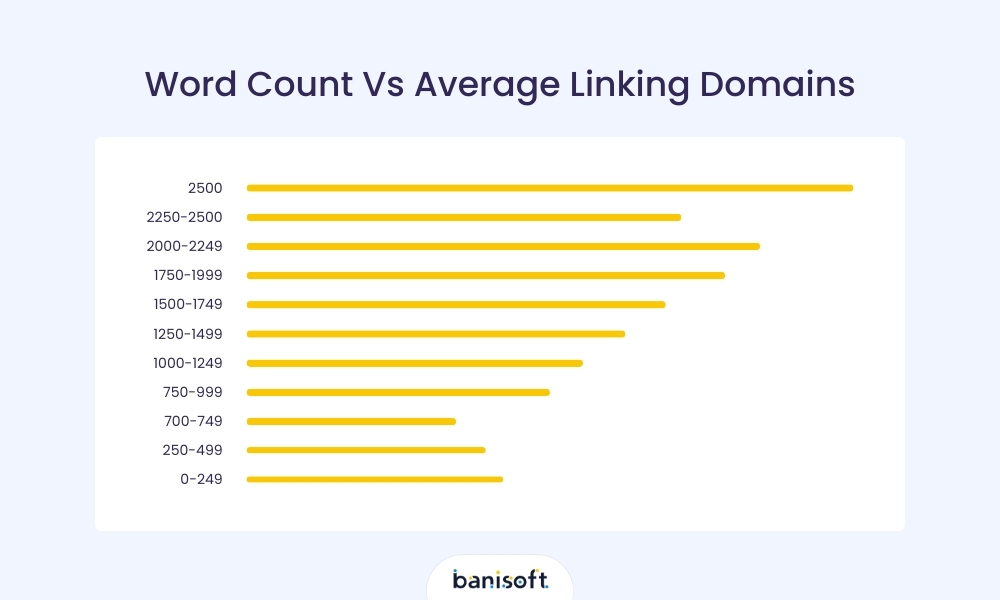


The first search result usually has 2,416 words, while the 10th result has 2,032 words. 

This indicates that Google favors websites with more content. It’s noteworthy that average blog post length doesn’t fall below 2,000 words.


So, is more always better? 


Not exactly. If you expand articles by adding extra phrases, unnecessary adjectives, and adverbs or intentionally taking a roundabout approach to the main point, you could turn away readers. 

So, simply having a higher word count won’t improve your search rankings. 

Instead of just focusing on higher word count, it’s essential to consider other vital factors when crafting content to meet SEO objectives.   


Understand Your Ideal Customer 

Take time to learn about your target audience’s interests and needs regarding content creation, format (video/images/text), and delivery platforms (social media/blogs). 

Once you know which content types engage your audience and how they prefer to receive them, you can create tailored content based on their preferences (short or long texts).

Additionally, consider the buyer’s journey stage. Select suitable content for each stage – shorter blog posts for awareness and longer ones for decision-making.


Understand Your Users’ Search Intent 


For a long time, SEO experts aimed for longer content, sacrificing usability. This resulted in overly lengthy articles that didn’t serve their purpose well. 

Instead, your writing should include keyword phrases that match users’ search intent – the number of questions it answers (and to what degree it answers them). 

Furthermore, when aiming for good-length content, make it detailed and informative on a single topic rather than providing brief overviews. 

This makes it more valuable, and search engines will rank your high-quality, comprehensive content higher than shorter pieces. 


Avoid Content Overlap

In simple terms, content overlap occurs when users and search engines are unsure about the main focus of an article.

For instance, if we try to write 2,000 words on “Pencils” without a clear plan, we might include information about “Pens” or “other stationary” when running out of pencil-related content. This happens because the goal is to reach the target word count at any cost.

However, this approach weakens the page’s keyword focus and fails to meet search intent.

Content overlap occurs when we discuss unrelated subjects like “stationary” to lengthen an article about “apples” and achieve the desired word count.

As a result, Google may struggle to determine which article to rank for the term “apples,” causing it to switch between them and hurting your overall ranking performance. Consider these three main factors when determining the best length for various content types.


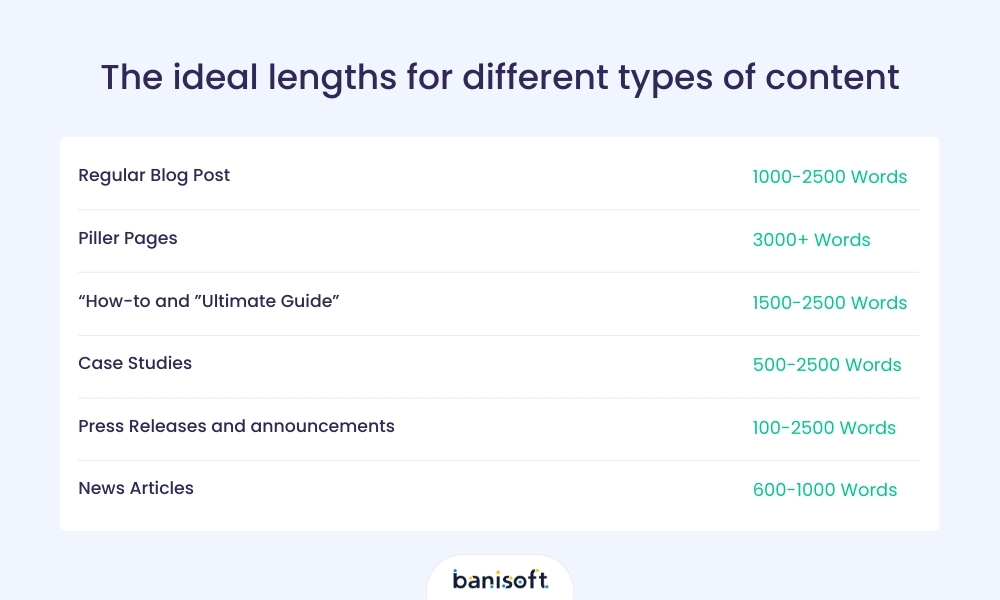
With these three essential factors in mind, let’s delve deeper into the ideal lengths for different types of content. 


Consider these three main factors when determining the best length for various content types.


1. Blogs: Typically under 1,500 words, focusing on opinions or experiences.

2. Articles: Over 1,500 words, emphasizing hard facts and education, with more detail and external sources.

Both serve different purposes, influencing their length.

Three common categories of blogs and articles are response, staple, and pillar, with the following ideal lengths:

1. Response posts (1,500 words): Quick answers to specific questions.

2. Staple posts (2,500 words): Long-form responses with extra information, like step-by-step how-tos.

3. Pillar posts (3,000+ words): Highly detailed content on high-volume search topics to boost SEO rankings.

The average ideal length ranges from 1,500 to 3,000 words, with a sweet spot around 2,500 words.


Ideal Website and Landing Page Length

When making a website page, you usually aim to: 

1. Rank high on search engines

2. Clearly explain your brand, product, or service

3. Prompt visitors to take action (via a CTA)

The first goal relies on page length and keywords, while the last two refer to the page’s content. To make a high-performing web page on Google and other search engines, learn how they analyze and categorize pages. 

Keywords and word count impact your ranking. Google’s algorithm prefers longer content of at least 300 words. Anything shorter is seen as low-quality, resulting in a lower SEO rank. 

Therefore, target a minimum of 300 words per web page.

But is there a maximum length? 

Your pages can be as long as needed, as long as the information serves its purpose. Word count matters, but an effective copy is more important. 

For example, a landing page for a new product should clearly and concisely describe your offerings while remaining engaging.


Sales collateral helps move the sales process forward by guiding customers through sales funnels. There are four key types:

1. Sales scripts: Read by sales representatives, not customers; a sales script should take 15-30 minutes to read aloud (500-1,500 words). However, the introduction should be shorter (3-5 minutes or 200-500 words) as it’s where customers decide to continue or end the conversation.

2. Brochures: Both physical and digital brochures promote products or services concisely. Aim for 200-350 words for general content and 350-450 words for more detailed information aimed at customers familiar with your business.

3. Fact sheets: These promotional materials present product or service features and benefits using bullet points. Keep them brief at around 200 words or less, as their purpose is to start the sales funnel process.

4. Pitch decks: Used to pitch products or services to clients, investors, or partners, these presentation-style materials should have no more than 20 slides with about 50-60 words per slide. Keep them concise for easy understanding.


Social media is highly crucial with its 4 billion users worldwide. To succeed, create well-performing, optimized content for each platform. The top text-based platforms are Twitter, Instagram, and Facebook.

Twitter (Tweets): Limited to 280 characters, ideal tweets range from 70 to 120 characters.

Instagram (Captions): The maximum limit is 2,200 characters; however, aim for shorter captions between 125 and 150 characters.

Facebook (Posts): With a 63,206 character limit, focus on posts between 50 and 200 characters for best results.


Guides and ebooks can greatly vary in length, depending on their purpose. Generally, they are used as lead magnets to encourage potential customers to take action.

Both guides and ebooks can be short-form or long-form. As lead magnets, they should be easy and quick to read, with a word count of 2,000 to 5,000 words. Ideally, lead magnets should be readable within 10 to 20 minutes.

Long-form guides and ebooks are usually sold as products, offering customers more detail and value. Their word count ranges from 5,000 to 10,000 words. 


Email marketing is great for nurturing leads and maintaining contact with potential and current customers. The ideal length of an email or newsletter varies for each part, including the subject line, preview text, and body text (or newsletter content).

Subject lines: This is the email’s first visible text and serves as its title. Keep it short and catchy, about 10 words or 50-60 characters.

Preview text: Found below the subject line, this text offers a quick summary of the email content. Aim for 30-90 characters to ensure it displays properly in recipients’ inboxes.

Email body copy: For standard emails, use 50-125 words since recipients spend roughly 10 seconds reading them. Shorter emails are easier to read and more likely to get a response or click.

Newsletter copy: Although newsletters cover multiple topics and link to longer content, keep them brief, with 200-300 words total or around 15-20 lines of text.


Optimizing content length is crucial for achieving online success, as it fosters increased sales, higher engagement, and a strong online presence. 

By adhering to the recommended lengths and considering your target audience’s preferences and search intent, you can create valuable and well-optimized content that resonates with both your readers and search engines.


Ready to Master Content Length and Boost Your Online Success?


Don’t let your content fall short or go overlooked. Understanding and implementing optimal content length strategies is key to capturing your audience and ranking higher.

Let’s refine your content strategy today with Banisoft!


Furthermore, to know 10 outstanding tips to slay content marketing please check out this blog post!!!

Why is Content-Length Important? Finding the Perfect Length for Various Content Types Read More »
SEO for dentists blog featured image

Why Your Dental Practice Needs a Specialized SEO Agency


Table of Content –

  1. Introduction to Dental SEO
  2. Key Benefits of SEO for Dentists
  3. Why Specialized SEO Matters
  4. Choosing the Right Dental SEO Agency: 8 Key Points
  5. Wrap up
  6. FAQs
SEO for dentists blog featured image

When business owners start dreaming about taking their company to the next level, their thoughts often stop at one big buzzword: Search Engine Optimization (SEO)! But for some reason, too many still pay no heed to SEO’s massive potential – mistakenly believing that “SEO’s only for  tech-savvy marketers, not for me.” 

Here we are chatting about something on everyone’s mind – Dentistry! It’s no secret that in the ultra-competitive world of dentists, staying visible online has become more crucial than ever. So, if your practice skips out on dental SEO agencies, you’re undoubtedly missing out. Let me break it down for you—why it matters! 

Why SEO is Essential for Dental Practises 

Let’s start with a pretty eye-opening fact: Did you know that 53.3% of website traffic comes from organic searches? 

The above fact describes that more than half of all people who view your website locate the business on a search engine. The better your site is visible on search engines, the more visitors you’ll likely get. And more visitors could mean more people walking through the doors of your dental practice looking for that winning smile. 

So, now that we’re both on the same page about how crucial SEO is for dental clinics, why don’t we dive a bit deeper and explore the outstanding benefits it can bring? 

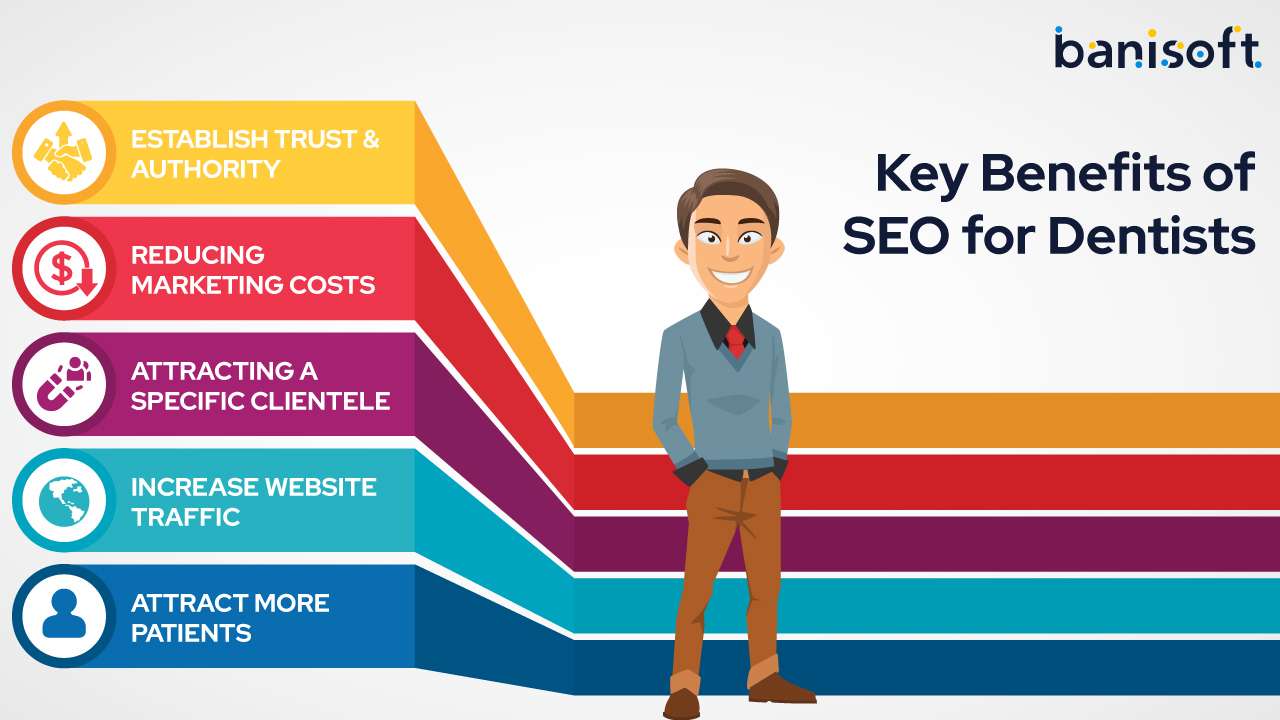
Key benefits of SEO for dentists


Establish Trust and Authority

When we’re curious about something, we often turn to Google first. This includes searching for dentists, whether we’re looking for the “best dentist near me” or specific services like “teeth whitening.” We also look up information on dental procedures and common dental issues. Having a website with relevant content is excellent, but if it’s not optimized for search engines (SEO), many potential patients might not find it. 

Conversely, if someone searches “What to expect from a root canal” and finds your detailed blog post high in the search results, they’re more likely to trust your site and stay longer. A low bounce rate, where visitors don’t leave your site quickly, signals to Google that your site is trustworthy and authoritative – that’s the power of SEO in establishing credibility and showcasing your expertise.

Reducing Marketing Costs

It’s a common misconception that adopting SEO services will make traditional marketing unnecessary and immediately reduce marketing costs. This is not the case. SEO isn’t a quick fix to cut marketing expenses. Instead, it offers a cost-effective strategy for sustained long-term growth.

For dentists, employing top-notch SEO practices—like improving website user experience, providing relevant information, and using popular search terms—can gradually boost interest in your practice. Over time, this increased online presence can reduce your reliance on more expensive traditional marketing methods.

Ultimately, while SEO doesn’t instantly decrease marketing costs, it is generally more affordable than conventional marketing strategies and can lead to lower overall expenses in the long run.

Attracting a Specific Clientele

Everyone will need a dentist at some point. But you face a lot of competition in reaching this broad audience. Instead, focus on detailed search engine optimization (SEO) tactics for dentists to stand out. By honing in on specific services, you can attract patients who are searching for particular treatments, which could prove more profitable than serving the average patient. Dental SEO can help you become known as an expert in areas such as:

– Dental Implants

– Veneers

– Root Canals

– Teeth Whitening

– Cosmetic Dentistry

– Dentures

Increase Website Traffic

It might seem obvious, but it’s important to emphasize how effective search engine optimization (SEO) for dentists can be in attracting more visitors to your website. By applying top-notch SEO strategies for dentistry, you can naturally draw more traffic to your site without relying on expensive pay-per-click (PPC) advertising.

Attract More Patients

Remember, SEO takes time to work. It might be weeks or even months before you see more traffic and, subsequently, more clients. But, by building a strong online presence, potential patients are more inclined to contact you for their first appointment. This approach lets you create relationships with new and existing patients online, especially those interested in specific dental treatments.

After learning about these advantages, you might be eager to get SEO services for your dental clinic. However, you’re missing a critical point. Wondering what it is? It’s all about the value of having a specialized Dental SEO company.

It’s a common misconception that search engine optimization (SEO) works the same way in every field, whether you sell products or provide healthcare services. This is not accurate. Fundamental SEO strategies do apply to all sectors, yet implementing a generic strategy won’t suffice for dental practices. 

Search engine algorithms are designed to deliver the most relevant content to users. That’s why hiring an agency with expertise in dental SEO matters so much. They can ensure your dental practice ranks highly in search results and attracts visitors who are looking for exactly what you offer.

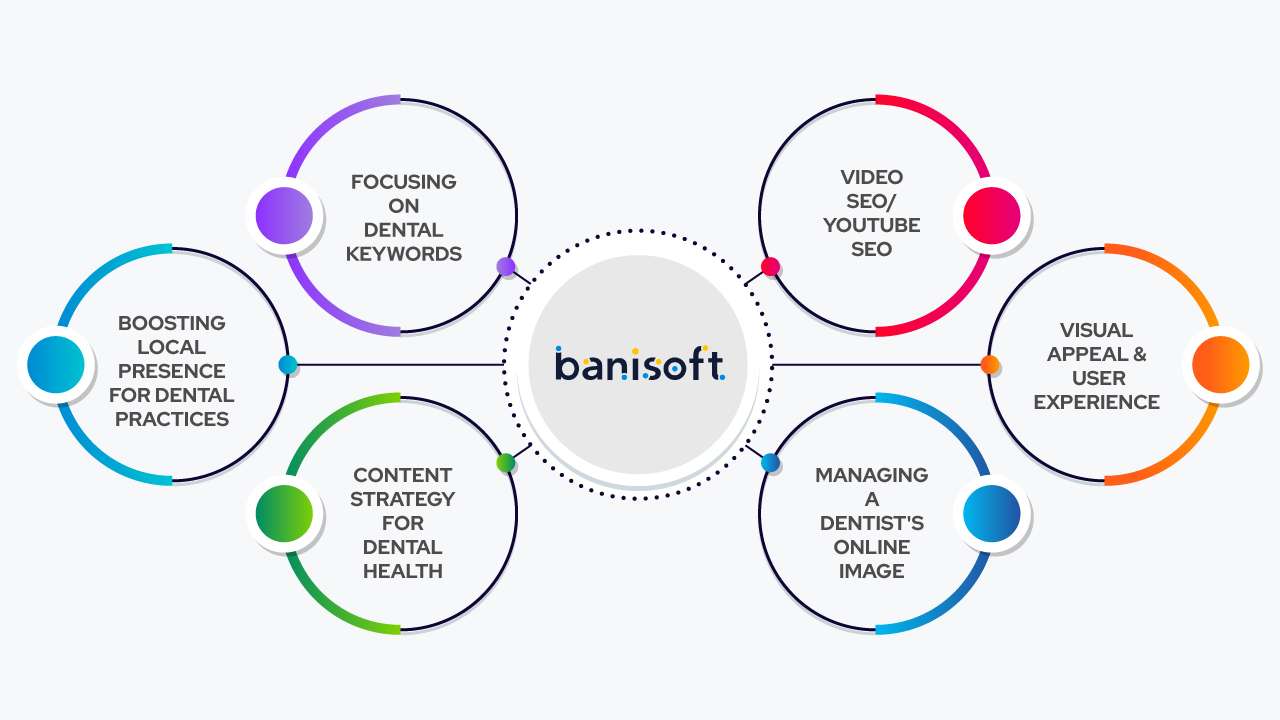
Let’s understand how dental SEO is unique compared to typical SEO. 

Banisoft's step by step process for Dental Seo

– Focusing on Dental Keywords

Dental SEO requires a tailored approach, targeting keywords specific to dentistry. A dental SEO expert knows that terms such as “best dentist in mohali,” “cosmetic dentistry in chandigarh,” or “orthodontic clinic near me” are vital for a dental business. By creating content with these keywords, a dental practice becomes more visible and appeals directly to those looking for dental services.

Boosting Local Presence for Dental Practices

Local SEO is crucial for dentists because people often look for healthcare providers close to home. A skilled dental SEO firm will make sure a dentist’s office shows up in nearby search results, with correct details like contacts, hours, and patient reviews. This helps future patients find and choose a dentist’s office quickly, increasing the number of visitors to the practice.

Content Strategy for Dental Health

Effective dental SEO is more than just adding lots of keywords to a website. It’s about teaching people who might become patients. Dental clinics should use expert specialized SEO services to share helpful information that deals with common dental health issues. 

For example, they could write simple articles on why it’s important to visit the dentist regularly, what the benefits of teeth whitening are, or what happens when you get dental implants. Sharing this kind of knowledge helps a clinic show that it knows its stuff and makes people more likely to trust it.

Managing a Dentist’s Online Image

For a dental practice to succeed, it must be seen as trustworthy and knowledgeable. Only an SEO firm that specializes in this field truly understands how important it is to carefully look after a dentist’s image online. They keep an eye on what patients say in online reviews and respond quickly and politely. 

When people read good comments from happy patients, they are more likely to choose that dentist. Bad reviews, however, can put someone off from going to that clinic. So, dentist SEO services also work out ways to build up a good image on the internet.

Visual Appeal and User Experience

Dental clinics aim to make their online image as attractive as their in-office services. SEO helps achieve this by highlighting the visual transformation patients undergo through dental work. By working with SEO experts who specialize in dental practices, these clinics create websites that are both easy to use and pleasant to look at.

Video SEO/YouTube SEO

SEO experts skilled in dental marketing also handle video SEO, aiming to elevate your videos’ visibility on YouTube. This involves strategies like optimizing video titles, descriptions, and tags with the right keywords to draw in viewers naturally. High-quality videos that engage viewers can rise in YouTube’s search results, especially if they’re popular with your audience. A specialized SEO agency is best suited to apply these tactics effectively.

Once you decide to invest in SEO services for your dental practice, it’s important to know how to pick the best SEO company for dentistry. 

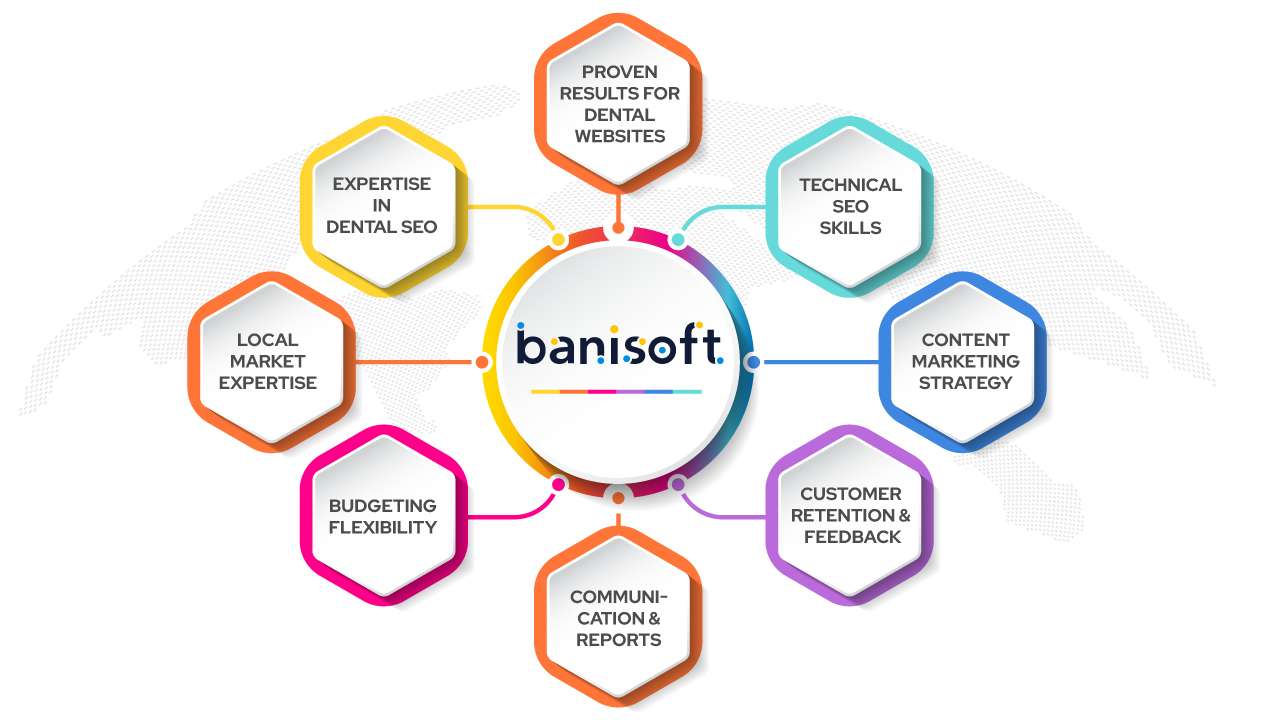
8 key points to choose right dental SEO agency

Expertise in Dental SEO

Make sure they have a strong track record of optimizing websites for dental professionals so that you can be confident in their understanding of your specific needs.

Proven Results for Dental Websites

Ask for dental practice examples that have helped rank better in search engine results. Client testimonials can also be valuable evidence of their success.

Technical SEO Skills

Evaluate their capability with technical SEO tasks such as optimizing individual pages (on-page SEO), enhancing website performance, building high-quality backlink profiles, ensuring your site is found in local searches, and effectively using Google tools like Analytics and My Business.

Content Marketing Strategy

Check how they create and share information. Useful implements include a blog, educational website, writing for dental publications, and networking with influential people.

Customer Retention and Feedback

Look for a high customer retention rate and positive feedback; it means customers are satisfied and likely to stay even when things change.

Communication and Reports

Clear communication and detailed reporting of traffic, rankings, sales, and key performance indicators are essential. Ensure you can quickly see and understand this information.

Budgeting Flexibility

Seek options that allow for monthly agreements or trial periods with lower budgets before committing to longer or costlier plans.

Local Market Expertise

Ensure they have the skills and tools needed to succeed in your specific area before initiating local marketing strategies or targeting potential clients.

Selecting the right dental SEO firm becomes simpler when you examine these factors for tangible and measurable success relevant to your practice.

Over 77% of people looking for dental services start their search online, often leading to booked appointments. Therefore, investing in good SEO (Search Engine Optimization) specifically for dental websites is essential to bring more visitors to your site and gain loyal patients.

Dental SEO is a specialized area that requires knowledge and experience. For top-notch results, consider getting help from our team, which specializes in handling SEO Services & Social Media Marketing for dentists.

Wondering how our team can significantly boost your business? Check out the success story of a healthcare client we worked with at Banisoft. We’re keeping their name private as they have requested.

Success Story in Dental SEO: Banisoft

Banisoft’s smart digital marketing strategies have dramatically increased our client’s business. Since the beginning of their campaign, the client’s website traffic has soared. By January 2024, they received over 15.8K visits, a massive jump from just 120 visits in June 2019. That’s a 130% increase! Alongside this visitor surge, the website became far more visible on Google; most of their main keywords now appear on the first page of search results. 

The website also keeps visitors interested longer – the bounce rate dropped by 37%. This means users stay on the site and interact more with the content. These impressive outcomes prove Banisoft’s digital marketing tactics are working well, making our clients more visible online and setting them up for long-term achievement.

What is dental SEO?

Dental SEO is tailoring traditional search engine optimization to help your dental practice show up more in online searches. It involves particular strategies to attract people looking for dental services.

Why should dentists invest in SEO?

Having a robust online presence is crucial for dentists to attract new patients who are searching for dental care. By improving your website and content based on what potential patients search for, you’ll get noticed more often and attract better leads. This can lead to more patients and business growth.

– How long does it typically take to see results from an SEO campaign?

Seeing improvements from SEO can vary from a few months to a year. It largely depends on how competitive your market is and the quality of your SEO techniques.

How can a dental practice ensure they choose the right SEO agency?

Choose an SEO agency with dental industry experience, a track record of successful outcomes, and ethical practices. Make sure they communicate well and understand your specific needs and goals.

What are the potential risks of not investing in SEO for a dental practice?

If you don’t use SEO, your practice may become less visible online, lose potential patients to competitors, and harm its reputation on the internet.

Why is it better to hire a specialized SEO agency rather than handle SEO in-house?

Handling SEO on your own can be resource-intensive. An expert SEO agency brings experience, tools, and knowledge, which saves you time and money.

Why Your Dental Practice Needs a Specialized SEO Agency Read More »

Scroll to Top