 Summarize in ChatGPT
Table of Content –
- Key Takeaways
- Key Benefits of SEO for Dentists
- Why Specialized SEO Matters
- Choosing the Right Dental SEO Agency: 8 Key Points
- Wrap up
- FAQs
Key Takeaways
Over 1.2 million monthly searches for “dentist near me” occur in the United States alone – 113,000 every single day – making Google the dominant patient acquisition channel for every dental practice in 2026. (Click-Vision, April 2026)
77% of new dental patients check online reviews before choosing a provider, and 71% search online before booking any dental appointment. (Web Tonic, July 2026 / Arch Dental Marketing, June 2026)
75% of dental patients never click past the first page of Google results – if your practice is not ranking on Page 1, it is invisible to three out of four people actively searching for your services. (Web Tonic, 2026)
Dental is classified as YMYL (Your Money or Your Life) by Google – meaning search engines apply the strictest E-E-A-T standards to dental websites. A generalist SEO agency that does not understand this framework will consistently underperform. (Marketing LTB, July 2026)
Google Business Profile signals account for 32% of Local Pack ranking weight – no other single factor comes close. Practices in the Local 3-Pack receive approximately 50% more phone calls than those ranked 4th or lower. (Web Tonic / SearchX, 2026)
Dental SEO-optimized content generates 3x more leads than paid advertising – at significantly lower long-term cost. (Click-Vision, April 2026)
32% of patients now use AI chatbots (ChatGPT, Google AI Overviews) for health information – a figure that doubled year-over-year in 2025, creating a new dental patient discovery channel that only specialized SEO can optimize for. (Patientfy / Rock Health, June 2026)
Introduction: The Patient Acquisition Landscape for Dentists Has Changed Permanently
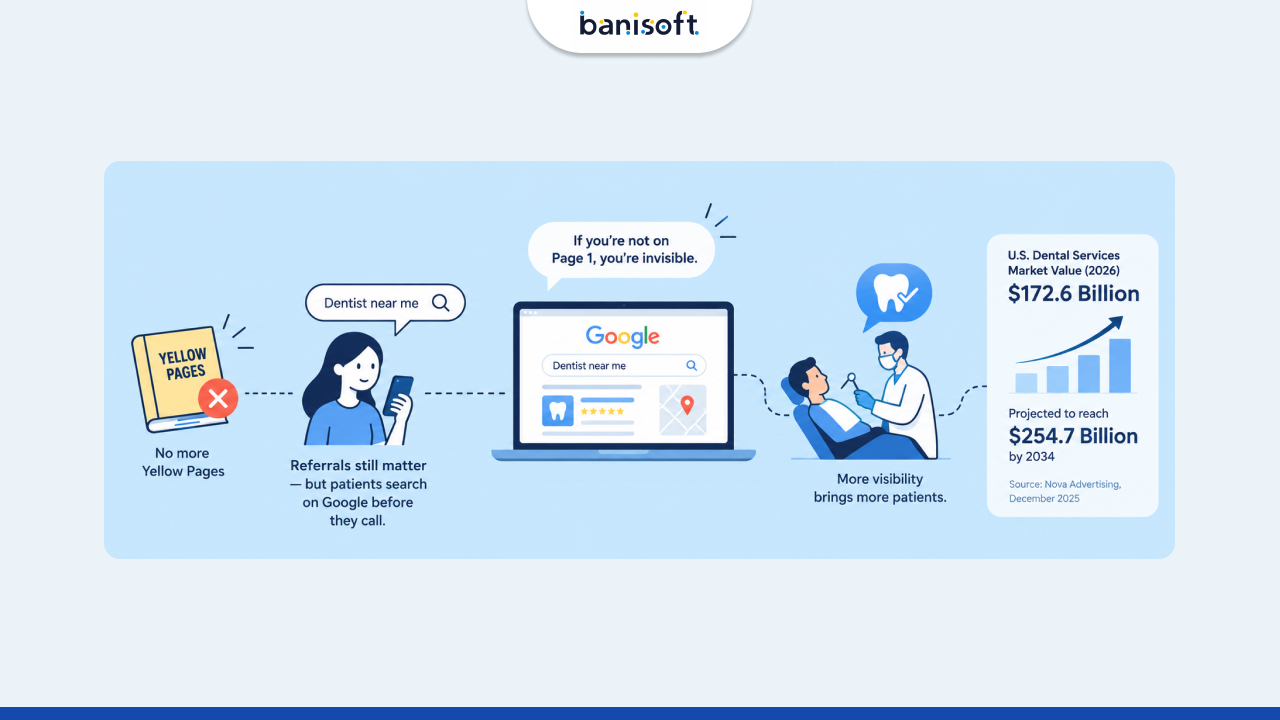
The way patients find a dentist in 2026 bears almost no resemblance to how they found one ten years ago. There are no Yellow Pages. Referrals from neighbors still matter, but they end at Google – the referred patient searches your name before they ever call. The dental practice on the best street corner in town is invisible if it does not rank on Page 1.
The numbers make the current reality stark. The U.S. dental services market is valued at $172.6 billion in 2026 and projected to reach $254.7 billion by 2034. (Nova Advertising, December 2025) That is a growing opportunity – but also a growing competitive field. The practices winning new patients consistently in this environment are not necessarily the ones with the best clinicians or the nicest waiting rooms. They are the ones with the strongest online visibility, the most compelling Google Business Profiles, the most reviews, and the most authoritative, trustworthy web presence.
This is not work that can be handed to a generalist marketing agency. Dental SEO operates under Google’s most stringent content standards, requires deep understanding of how patients search for healthcare services at different stages of dental awareness, and demands a reputation management approach that is both proactive and professionally compliant. This guide explains precisely why specialized dental SEO matters, what it involves, how to choose the right agency, and what results look like when done correctly.
When we’re curious about something, we often turn to Google first. This includes searching for dentists, whether we’re looking for the “best dentist near me” or specific services like “teeth whitening.” We also look up information on dental procedures and common dental issues. Having a website with relevant content is excellent, but if it’s not optimized for search engines (SEO), many potential patients might not find it.
Conversely, if someone searches “What to expect from a root canal” and finds your detailed blog post high in the search results, they’re more likely to trust your site and stay longer. A low bounce rate, where visitors don’t leave your site quickly, signals to Google that your site is trustworthy and authoritative – that’s the power of SEO in establishing credibility and showcasing your expertise.
What Is Dental SEO?
Dental SEO is the specialized practice of optimizing a dental practice’s website, Google Business Profile, online reputation, and content so that it ranks prominently when patients search for dental services in the practice’s area.
It differs from general SEO in three fundamental ways:
1. YMYL classification: Google classifies dental content as “Your Money or Your Life” – content that can directly affect a person’s health, safety, or financial wellbeing. This triggers Google’s most rigorous quality evaluation standards, including heightened E-E-A-T (Experience, Expertise, Authoritativeness, Trustworthiness) scrutiny. A generalist agency writing dental content without understanding YMYL compliance consistently produces content that Google’s algorithm actively discounts. (Marketing LTB, July 2026)
2. Healthcare-specific patient psychology: Dental patients do not make decisions the way retail consumers do. They are often anxious; they research extensively before committing, they read reviews from a trust-verification perspective rather than a product-comparison perspective; and their search behaviour moves through distinct stages – from general awareness (“what causes tooth sensitivity”) to local research (“best cosmetic dentist in [city]”) to booking intent (“emergency dentist open Saturday near me”). (W3era, 2026)
3. Local search dominance: Unlike most commercial keywords, dental searches are overwhelmingly local. Over 92% of dental search queries are long-tail keywords with local modifiers. (Click-Vision, April 2026) A specialized dental SEO agency understands how to build the geographic keyword coverage – city, neighborhood, suburb, ZIP, and “near me” variants – that captures this fragmented local demand across every corner of your service area.
The 2026 Dental Patient Search Reality: Why SEO Cannot Wait
Before examining what a specialized dental SEO agency does, you need to understand the scale of the patient acquisition opportunity you are either capturing or missing every day.
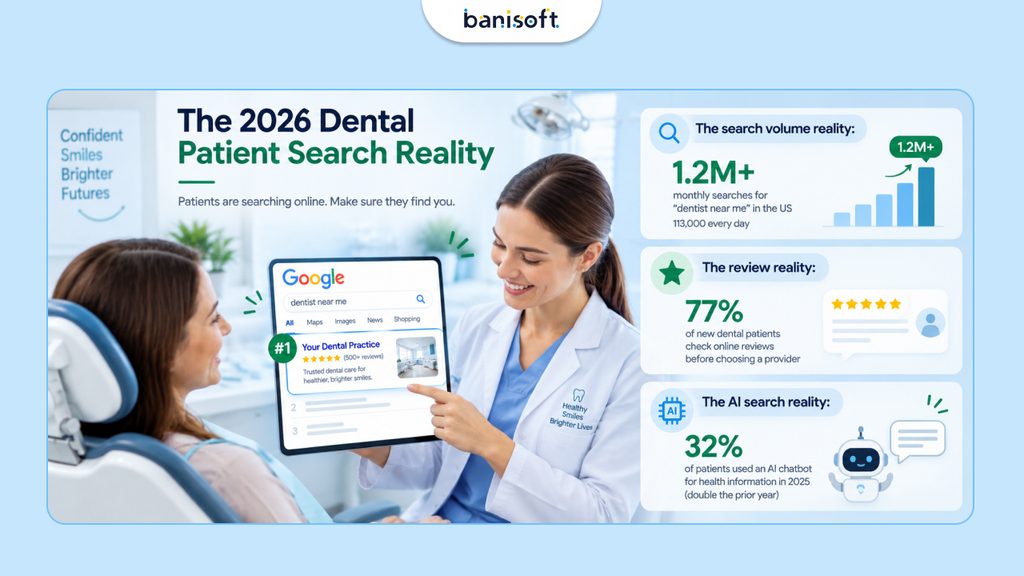
The search volume reality:
- Over 1.2 million monthly searches for “dentist near me” in the US – 113,000 per day. (Click-Vision, April 2026)
- 71% of patients use Google to find a dentist before booking. (Arch Dental Marketing, June 2026)
- 77% of patients search online before booking any healthcare appointment. (W3era, 2026)
- 93% of all online experiences begin with a search engine. (Click-Vision, April 2026)
- 75% of dental patients never scroll past Page 1 of Google results. (Web Tonic, 2026)
The review reality:
- 77% of new dental patients check online reviews before choosing a provider. (Web Tonic, July 2026)
- Two-thirds of patients screen out any practice rated below four stars – reviews are now a hard filter, not a differentiator. (Patientfy, June 2026)
- Practices need 100–200+ reviews to stand out in competitive local markets, and stale review profiles with no new reviews in 30+ days see declining visibility. (Web Tonic, July 2026)
The AI search reality:
- 32% of patients used an AI chatbot for health information in 2025, double the prior year. (Rock Health via Patientfy, June 2026)
- Patients are increasingly asking ChatGPT and Google AI Overviews for “the best dentist near me” – practices that appear in AI-generated answers gain patient acquisition visibility that does not exist on the traditional SERP.
What this means for your practice: If you are not ranking on Page 1, not visible in the Local 3-Pack, not collecting consistent reviews, and not present in AI-generated dental recommendations, you are invisible to the majority of new patients who are actively looking for a provider right now.
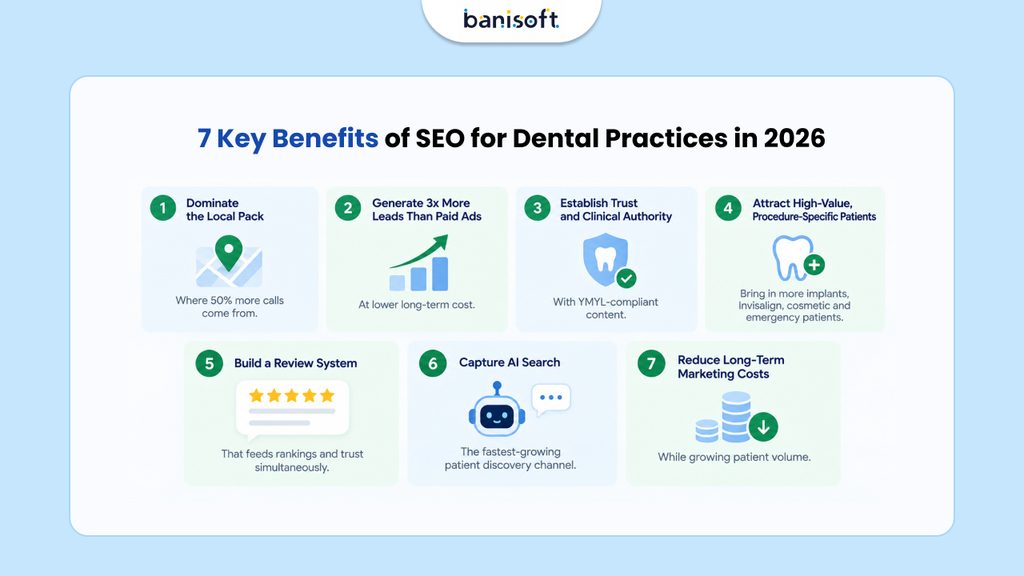
7 Key Benefits of SEO for Dental Practices in 2026
Benefit 1: Dominate the Local Pack – Where 50% More Calls Come From
Google Business Profile signals account for 32% of Local Pack ranking weight – the single largest factor in whether your practice appears in the map results at the top of the page. (SearchX, March 2026) Practices in the Local 3-Pack receive approximately 50% more phone calls than those ranked 4th or lower for the same search query.
The top 10% of dental practices generate 3x the profile actions – calls, website visits, and direction requests – compared to the average practice. (Web Tonic citing Practiwrite Q1 2026) That performance gap is almost entirely explained by GBP optimization quality: completeness of business information, number and recency of reviews, photo library depth, and posting frequency.
60% of smartphone users contact a business directly from search results via click-to-call – meaning a significant portion of your new patient calls are won or lost based entirely on your Local Pack visibility. (Growth Saloon via SOCi, 2026)
Benefit 2: Generate 3x More Leads Than Paid Advertising – at Lower Long-Term Cost
Dental SEO-optimized content generates three times more leads than paid advertising for the same marketing investment over a 12–24 month period. (Click-Vision, April 2026) Organic traffic converts at a 3.5% rate for dental practices – and the leads generated are higher intent than most paid traffic because they are self-selected through search behavior. (Click-Vision, April 2026)
The long-term economics are even more compelling. One dental practice in Manchester saw organic traffic grow 220% after a structured local SEO program, with monthly implant inquiries jumping from 12 to 41 – translating to an additional $180,000 in annual revenue from a single high-value service line. (SearchX, March 2026)
Paid advertising (Google Ads, Meta) generates immediate leads but stops the moment budget stops. SEO rankings, once earned, continue generating new patient inquiries indefinitely – and the cost per patient acquisition decreases over time as authority builds.
Benefit 3: Establish Trust and Clinical Authority With YMYL-Compliant Content
Google evaluates dental content under its most rigorous quality standards because health content directly affects patient wellbeing. The E-E-A-T signals that determine whether your content ranks – Experience, Expertise, Authoritativeness, Trustworthiness – are assessed differently for healthcare than for any other sector.
A specialized dental SEO agency understands that ranking dental content requires:
- Author credentialing – content attributed to a named, qualified dental professional with verifiable credentials
- Clinical accuracy – information that aligns with current dental guidelines and does not create patient harm risk
- Trust signals – professional association memberships, board certifications, before-and-after case documentation, patient testimonials in compliance with privacy regulations
- Content structure – medical content standards with clear differentiation between educational information and clinical advice
The dental SEO market in 2026 is bifurcating – agencies with genuine healthcare-native infrastructure are pulling ahead while generalist “we also do dental” agencies are being filtered out by Google’s core update priorities. (Wowbix Healthcare, 2026) A practice that hires a generalist agency to produce dental content is not just getting suboptimal results – it is actively risking content that Google’s algorithm penalizes.
Benefit 4: Attract High-Value, Procedure-Specific Patients
Not all dental patients are equal in revenue value. A new patient seeking a routine cleaning generates very different lifetime value from a patient seeking dental implants, Invisalign, or a full-mouth restoration. Dental SEO allows you to target the specific procedures that generate the highest revenue for your practice – and attract patients who are already researching those specific treatments.
Specific dental services that deliver the strongest SEO ROI include:
- Dental implants – highest CPC and highest patient lifetime value
- Invisalign and clear aligners – strong search volume driven by brand recognition
- Cosmetic dentistry – high-value procedures with strong local search demand
- Emergency dental services – highest urgency, immediate conversion intent
By building dedicated service pages for each high-value procedure – optimized for the specific search terms patients use at each stage of their research – a specialized dental SEO agency ensures your practice appears at the exact moment a high-value patient is ready to book.
Benefit 5: Build a Review System That Feeds Rankings and Trust Simultaneously
Reviews serve two functions in dental patient acquisition in 2026: they are a ranking signal in Google’s Local Pack algorithm, and they are a trust filter that determines whether a patient who finds your practice actually contacts you.
The review benchmarks for dental practices in 2026:
- Practices need 100–200+ reviews to stand out in competitive local markets. (Web Tonic, July 2026)
- Top-ranking practices average 250 reviews with 70-word descriptions in their GBP profiles. (Web Tonic citing Localo 2026 data)
- There is a nearly 3% lift in GBP conversions for every 10 new reviews a practice earns. (Shopify citing SOCi, June 2026)
- Two-thirds of patients screen out any practice below four stars – not as a preference but as a hard filter before even reading the listing. (Patientfy, June 2026)
A specialized dental SEO agency builds and manages a systematic review acquisition process that stays within Google’s review policies and dental professional ethics guidelines – ensuring consistent review velocity without triggering platform violations.
Benefit 6: Capture AI Search – The Fastest-Growing Patient Discovery Channel
32% of patients used a chatbot or AI tool for health information in 2025 – a figure that doubled in a single year. (Rock Health via Patientfy, June 2026) Patients are now asking ChatGPT “best dentist near me for dental implants” and “what to expect from a root canal” – and the answers AI systems provide are directly influencing which practices patients contact.
Getting cited in AI-generated dental recommendations requires content that is structured, factual, directly answering specific patient questions, and backed by clear E-E-A-T signals. A specialized dental SEO agency understands how to build FAQ sections, definition pages, and procedure explanation content that both satisfies Google’s quality standards and earns AI citation.
This is the most important emerging channel in dental patient acquisition, and it is the one most generalist agencies are not yet optimizing for. The practices that build AI search visibility now will have a structural advantage that compounds over the next three to five years.
Benefit 7: Reduce Long-Term Marketing Costs While Growing Patient Volume
Dental practices typically invest 4–7% of annual revenue in marketing, with new practices investing 15–20% of projected first-year revenue. Most practices now allocate 80% of their marketing budget to digital channels. (Click-Vision, April 2026)
Within that digital budget, SEO consistently delivers the lowest cost per acquired patient over a 12–24 month horizon compared to any other channel. The compound effect of ranking improvements – each position gained on Page 1 multiplies traffic without multiplying cost – means that the cost per new patient acquisition from organic search declines over time as the SEO foundation strengthens.
Why Specialised Dental SEO Matters: What Generalist Agencies Get Wrong
The dental SEO market in 2026 is clearly bifurcating between agencies that have built genuine healthcare expertise and those applying general commercial SEO frameworks to dental websites. The difference in outcomes is not marginal – it is fundamental.
The dental marketing landscape in 2026 requires specific technical and content expertise that generalist agencies consistently lack: understanding how YMYL content standards apply to dental health content, how Google evaluates dental provider credibility signals differently from commercial content, how to structure dental service pages for both high-intent treatment searches and informational research queries, and how review acquisition strategies must comply with professional ethics guidelines while still generating the review volume that local map pack rankings require. (Marketing LTB, July 2026)
Here is exactly how dental SEO differs from general SEO in practice:
YMYL and E-E-A-T Compliance – The Non-Negotiable Difference
Google applies dramatically stricter quality evaluation to dental content than to commercial content. A blog post about “the best kitchen knife” that contains minor inaccuracies causes minimal harm. A page about “symptoms of gum disease” or “when to see an emergency dentist” that contains inaccurate or misleading information can directly harm the patient who reads it.
A specialized dental SEO agency understands how to build high-trust, medically compliant content that satisfies search algorithms and prospective patients alike. (Adaptify, June 2026) This includes attributing content to named, credentialed authors, maintaining clinical accuracy in all procedure descriptions, and structuring content that Google’s quality raters can clearly evaluate against E-E-A-T criteria.
A generalist agency writing dental content under a generic “the team” byline, without verifiable credentials, produces content that Google systematically discounts in 2026’s quality-prioritizing algorithm environment.
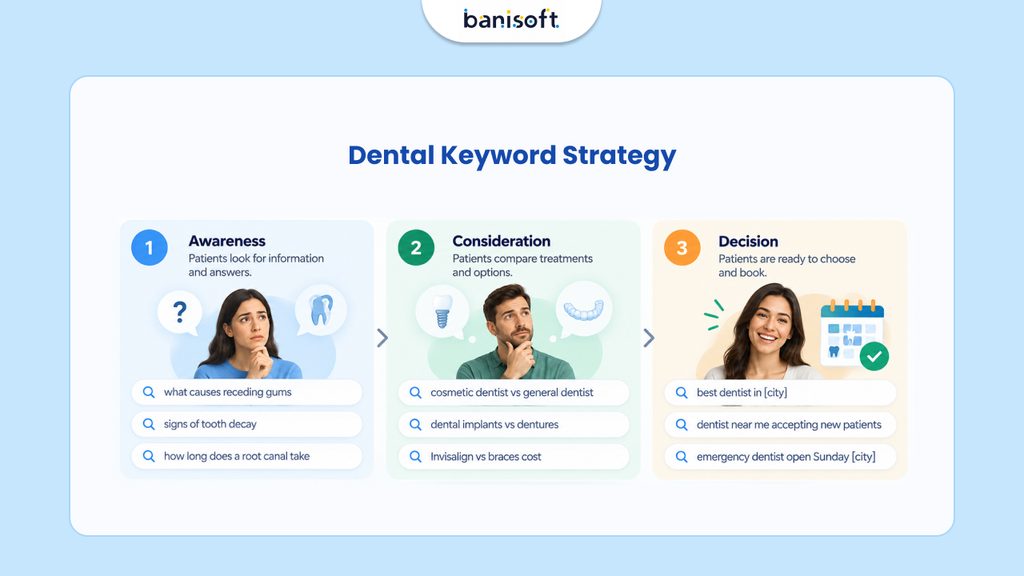
Dental Keyword Strategy – Procedure-Intent Mapping
Dental keywords are not just location-plus-service combinations. They represent distinct patient psychology stages – from general dental anxiety and symptom research to confident local provider comparison to emergency need. Over 92% of dental search queries are long-tail keywords with multiple modifiers. (Click-Vision, April 2026)
A specialized dental SEO agency maps keyword strategy to patient psychology stages:
- Awareness stage: “what causes receding gums,” “signs of tooth decay,” “how long does a root canal take”
- Consideration stage: “cosmetic dentist vs general dentist,” “dental implants vs dentures,” “Invisalign vs braces cost”
- Decision stage: “best dentist in [city],” “dentist near me accepting new patients,” “emergency dentist open Sunday [city]”
Each stage requires different content formats, different page structures, and different conversion goals. A generalist agency typically produces one layer of service pages and a blog – missing the psychological nuance that drives dental patient acquisition.
Local SEO Precision – Multi-Location and Neighborhood Coverage
Dental practices serve geographically precise catchment areas. A patient searching for a dentist is rarely willing to travel more than 5–10 miles. This means dental SEO requires hyper-local coverage: city pages, neighborhood pages, suburb pages, and “near me” optimization across every corner of the service area.
GBP completeness accounts for 32% of Local Pack ranking weight in 2026. (SearchX, March 2026) A specialized dental SEO agency manages GBP optimization as a primary strategy, not an afterthought – including weekly posts, consistent photo uploads (a minimum photo library of 25 images is now a benchmark for competitive practices), service category management, and Q&A maintenance. (Web Tonic citing MedFlowX, July 2026)
Reputation Management – The Compliance-First Approach
Dental practices operate under professional ethics guidelines from dental associations and state licensing boards. Review solicitation, patient testimonials, and before-and-after case documentation are all subject to regulations that a generalist SEO agency is simply not equipped to navigate.
A specialized agency builds review acquisition systems that generate high volume while remaining within Google’s review policies and professional ethics guidelines. They manage negative reviews with responses that protect professional reputation without creating legal liability. They understand which platforms matter for dental patient trust – Google, Healthgrades, WebMD, Zocdoc – and build cross-platform reputation strategies accordingly. (W3era, 2026)
How to Choose the Right Dental SEO Agency in 2026: 9 Critical Evaluation Points
Specialization matters more than agency size – agencies focused on dental and healthcare SEO consistently deliver better results than generalist firms. (Direction, February 2026) Here is exactly what to evaluate:
1. Proven Healthcare and Dental Track Record
Ask for case studies from dental clients specifically – not healthcare generically, not small business, not local SEO in general. Ask for traffic and new patient acquisition data from dental practices in competitive markets. One healthcare practice working with a specialized agency now receives 67% of its leads from organic search, with 39% of those leads becoming paying patients. (Direction, February 2026) That is the benchmark to compare against.
2. YMYL and E-E-A-T Content Methodology
Ask directly: “How do you handle YMYL compliance in dental content?” If the answer is vague or the agency does not know what YMYL stands for, end the conversation. Ask to see examples of dental content they have produced, who authored it, and what credentialing is displayed. Ask how they verify clinical accuracy.
3. Google Business Profile Expertise
Ask how they manage and optimize Google Business Profiles specifically for dental practices. Ask what their benchmarks for GBP completeness look like – number of photos, posting frequency, review velocity targets. Ask whether they track GBP performance separately from website performance in their reporting.
4. Local Pack Ranking Strategy
Ask how they approach coverage across your full service area – not just your city, but your neighborhoods, suburbs, and surrounding areas. Ask whether they build location-specific pages and how they manage keyword cannibalization between those pages.
5. Review Acquisition System
Ask how they generate reviews consistently while staying within Google’s policies and dental professional ethics guidelines. Ask what platforms they target beyond Google. Ask what their client practices’ average review velocity looks like month-over-month.
6. Technical SEO Capability
Dental websites frequently have technical issues that directly suppress rankings: slow page load times from unoptimized image libraries, duplicate content from appointment booking systems generating dynamic URLs, poor mobile performance, and missing schema markup. Ask to see a sample technical SEO audit and how they prioritize fixes.
For dental practices, the highest-priority schema types are LocalBusiness (including dentist-specific attributes), MedicalOrganization, FAQPage (for procedure Q&A sections), and AggregateRating. Ask whether the agency implements and monitors structured data as a standard service.
7. AI Search and GEO Optimisation
Ask whether they optimize content for Google AI Overviews, ChatGPT citations, and Perplexity. This is not yet standard practice at most agencies – but 32% of patients already use AI tools for health information, and that figure is growing rapidly. (Patientfy, June 2026) An agency that is not thinking about this channel is already behind.
8. Transparent Reporting Against Meaningful Metrics
Avoid agencies that report only traffic and rankings. The metrics that matter for a dental practice are: new patient inquiries by source, cost per new patient acquisition from organic, Local Pack visibility across target keywords, review velocity and average rating trajectory, and appointment booking conversion rate from organic traffic. Ask to see a sample monthly report before signing.
9. Contract Flexibility and Budget Alignment
A specialized dental SEO company will charge more than a generalist agency – because they understand the unique challenges of marketing a dental practice and bring genuine compliance expertise. (Digitalis Medical, February 2026) Expect to invest 1,500–5,000+ per month for a comprehensive dental SEO program in a competitive market. Avoid agencies offering dental SEO for 300–500/month – that budget cannot deliver the content depth, technical expertise, and GBP management that competitive ranking requires.
Look for agencies that offer monthly agreements or 3–6 month trial periods before longer commitments. Any agency confident in their results will not require a 12-month lock-in from day one.
Dental Keyword Reference: What Patients Are Actually Searching in 2026
| Keyword | Monthly Volume | Intent | Priority |
| dentist near me | 1,200,000+ | Local/Transactional | Primary |
| emergency dentist near me | 165,000+ | Urgent/Transactional | Primary |
| teeth whitening [city] | 10,000–50,000 | Local/Commercial | High |
| dental implants [city] | 8,000–30,000 | Local/Commercial | High |
| Invisalign [city] | 8,000–25,000 | Local/Commercial | High |
| cosmetic dentist near me | 40,000+ | Local/Commercial | High |
| dentist accepting new patients [city] | 3,000–10,000 | Local/Transactional | High |
| root canal cost [city] | 2,000–8,000 | Local/Commercial | Long-tail |
| dental implants vs dentures | 15,000+ | Informational | Blog/TOFU |
| how long does a root canal take | 22,000+ | Informational | Blog/TOFU |
| is Invisalign worth it | 18,000+ | Informational/Commercial | Blog/MOFU |
| what to expect from dental implant surgery | 5,000+ | Informational | Blog/TOFU |
| dentist for dental anxiety [city] | 2,000–6,000 | Local/Commercial | Long-tail |
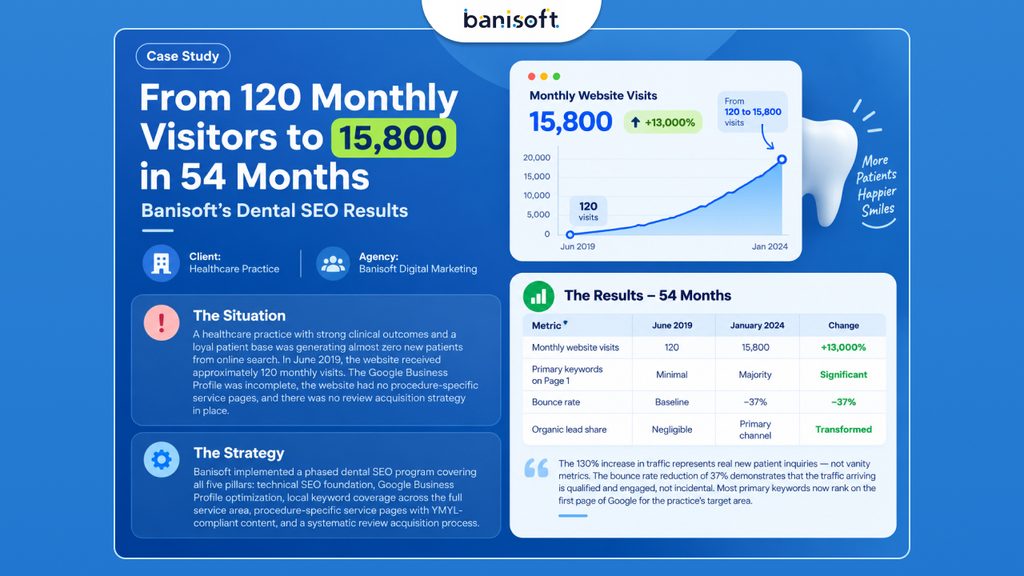
Case Study: From 120 Monthly Visitors to 15,800 in 54 Months – Banisoft’s Dental SEO Results
Client: Healthcare Practice | Agency: Banisoft Digital Marketing
The Situation
A healthcare practice with strong clinical outcomes and a loyal patient base was generating almost zero new patients from online search. In June 2019, the website received approximately 120 monthly visits. The Google Business Profile was incomplete, the website had no procedure-specific service pages, and there was no review acquisition strategy in place.
The Strategy
Banisoft implemented a phased dental SEO program covering all five pillars: technical SEO foundation, Google Business Profile optimization, local keyword coverage across the full service area, procedure-specific service pages with YMYL-compliant content, and a systematic review acquisition process.
The Results – 54 Months
| Metric | June 2019 | January 2024 | Change |
| Monthly website visits | 120 | 15,800 | +13,000% |
| Primary keywords on Page 1 | Minimal | Majority | Significant |
| Bounce rate | Baseline | −37% | −37% |
| Organic lead share | Negligible | Primary channel | Transformed |
The 130% increase in traffic represents real new patient inquiries – not vanity metrics. The bounce rate reduction of 37% demonstrates that the traffic arriving is qualified and engaged, not incidental. Most primary keywords now rank on the first page of Google for the practice’s target area.
Frequently Asked Questions: Dental SEO and Specialized Agencies
- What is dental SEO?
Dental SEO is the specialised practice of optimising a dental practice’s website, Google Business Profile, online reviews, and content to rank prominently in Google search results when patients in the practice’s area search for dental services. It differs from general SEO because dental content is classified as YMYL (Your Money or Your Life) by Google, requiring the highest E-E-A-T standards – and because dental patient search behavior follows a distinct psychology that requires a procedure-specific, locally targeted content strategy. (Adaptify, June 2026) - Why should dentists invest in SEO rather than just running Google Ads?
Google Ads generates immediate new patient leads but stops delivering the moment budget stops. Dental SEO generates leads that compound over time – rankings earned through content quality and authority building continue delivering new patient inquiries indefinitely. Dental SEO-optimized content generates 3x more leads than paid advertising over a 12–24 month horizon, at significantly lower long-term cost per acquired patient. (Click-Vision, April 2026) The optimal strategy for most practices is to run both: paid search for immediate patient flow while organic SEO builds, then gradually reduce paid dependency as organic rankings strengthen. - How long does dental SEO take to show results?
Most dental practices see measurable Local Pack improvements within 60–90 days of Google Business Profile optimisation and local citation cleanup. Organic ranking improvements for competitive procedure keywords like “dental implants [city]” or “cosmetic dentist [city]” typically take 4–9 months. The compounding nature of dental SEO means results accelerate over time – a practice that invests consistently for 24 months will see dramatically stronger performance than the first 6 months suggest. - Why does a dental practice need a specialised SEO agency rather than a generalist?
The dental marketing landscape requires specific technical and content expertise that generalist agencies consistently lack: YMYL compliance, E-E-A-T signals for healthcare content, healthcare patient psychology in keyword and content strategy, review acquisition within professional ethics guidelines, and Local Pack optimization for the geographic precision that dental practices require. (Marketing LTB, July 2026) A generalist agency applying commercial SEO frameworks to a dental website will produce content that Google’s quality systems actively discount. - What is YMYL and why does it matter for dental SEO?
YMYL stands for “Your Money or Your Life” – Google’s classification for content that can directly affect a person’s health, safety, financial stability, or happiness. Dental content falls clearly in this category. Google applies its most rigorous quality evaluation to YMYL content, including the strictest E-E-A-T (Experience, Expertise, Authoritativeness, Trustworthiness) standards. Content on a dental website that does not demonstrate clear clinical expertise and authorship will be systematically downgraded in Google’s quality assessment – regardless of how well-optimized it is technically. (Marketing LTB, July 2026 / Adaptify, June 2026) - How many Google reviews does a dental practice need to rank well?
Practices need 100–200+ Google reviews to stand out in competitive local markets, with top-ranking practices averaging approximately 250 reviews in their profiles. Review recency matters as much as total volume – profiles with no new reviews in 30+ days see declining Local Pack visibility. There is a nearly 3% lift in Google Business Profile conversions for every 10 new reviews a practice earns. (Web Tonic, July 2026) - What is AI search and how does it affect dental patient acquisition?
AI search refers to AI-generated answers appearing in Google AI Overviews, ChatGPT, Perplexity, and Bing Copilot in response to health queries. 32% of patients used an AI tool for health information in 2025 – double the prior year – and patients are increasingly asking AI systems directly for dental provider recommendations. (Rock Health via Patientfy, June 2026) Practices cited in AI-generated answers gain a discovery channel that is entirely separate from traditional SERP rankings. Optimizing for AI citation requires structured content, FAQ sections, direct answer paragraphs, and strong E-E-A-T signals – the same foundations as best-practice dental SEO, executed at a higher standard. - How much does dental SEO cost?
Expect to invest 1,500–5,000+ per month for a comprehensive dental SEO program in a competitive market from a specialized agency. A specialized dental SEO company will charge more than a generalist agency because they bring genuine healthcare compliance expertise, procedure-specific content knowledge, and dental patient psychology understanding. (Digitalis Medical, February 2026) Budget below $1,000/month cannot sustain the content depth, technical maintenance, and GBP management required to compete in most dental markets.
Conclusion: The Competitive Window for Dental SEO Is Open – But Not Forever
The dental practices winning new patients from online search in 2026 did not start their SEO investments this year. They started two to three years ago, built their topical authority, earned their reviews, and now occupy Page 1 positions and Local 3-Pack listings that compound in value every month.
The practices that have not yet invested face an increasingly difficult entry point. 75% of dental patients never click past the first page of results – and the practices occupying those positions are actively building the authority moats that make them harder to displace. (Web Tonic, 2026)
But the window is still open. The practices that invest now – in a specialised dental SEO program with genuine YMYL expertise, systematic review acquisition, and emerging AI search optimisation – will occupy those Page 1 positions for the next decade while competitors are still running expensive paid ads with no lasting asset to show for the spend.
The question is not whether dental SEO works. The 1.2 million monthly searches, the 77% of patients who check reviews before booking, and the 3x lead generation advantage over paid advertising answer that conclusively. The question is whether your practice is capturing that demand or watching competitors capture it instead.
Ready to build a dental SEO strategy that generates consistent new patient inquiries? Get in touch with Banisoft for a free audit of your dental practice’s online visibility →