
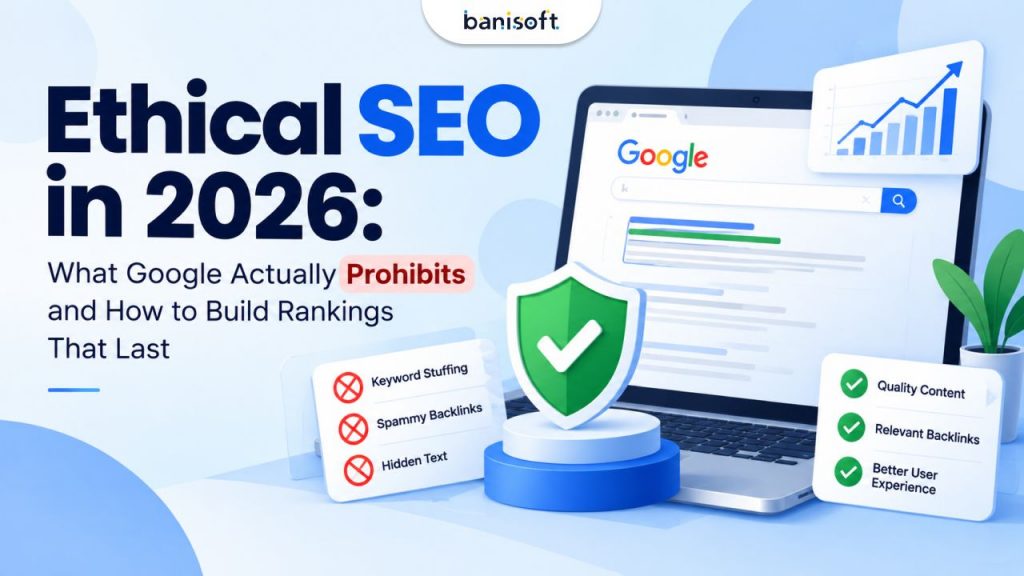
Ethical SEO: A Moral Compass for Digital Marketers
Table of Contents
- Introduction: Ethical SEO Is No Longer Just About Avoiding Keyword Stuffing
- What Is Ethical SEO?
- Ethical SEO and White Hat SEO Are Not Exactly the Same Thing
- The 2026 Rulebook: What Search Engines Actually Prohibit
- The Biggest Ethical SEO Issue in 2026: Scale Without Value
- A Better AI Content Test
- Ethical SEO for AI Overviews, AI Mode and Generative Search
- Microsoft Is Making the Same Shift
- AI Citation Tracking Is Becoming Measurable
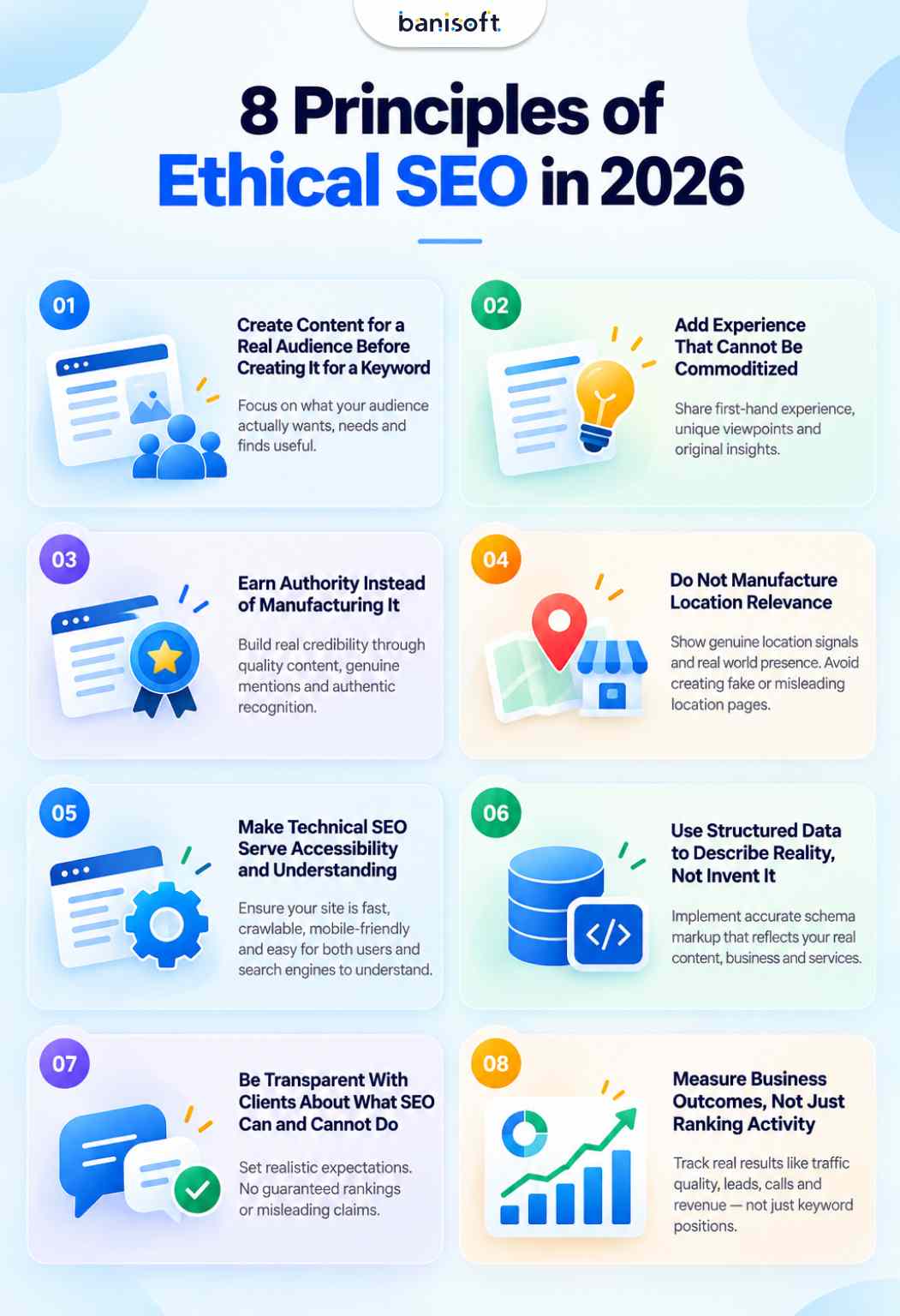
- 8 Principles of Ethical SEO in 2026
- Principle 1: Create Content for a Real Audience Before Creating It for a Keyword
- Principle 2: Add Experience That Cannot Be Commoditised
- Principle 3: Earn Authority Instead of Manufacturing It
- Principle 4: Do Not Manufacture Location Relevance
- Principle 5: Make Technical SEO Serve Accessibility and Understanding
- Principle 6: Use Structured Data to Describe Reality, Not Invent It
- Principle 7: Be Transparent With Clients About What SEO Can and Cannot Do
- Principle 8: Measure Business Outcomes, Not Just Ranking Activity
- Ethical SEO vs. Risky SEO: A Practical Comparison
- Can Black Hat SEO Still Work?
- The Hidden Cost of Cheap SEO
- How to Evaluate an SEO Agency Before Giving It Access to Your Website
- What Happens If Google Detects Manipulative SEO?
- How to Recover From a History of Unethical SEO
- Ethical SEO in the Age of AI Search: What Changes and What Does Not
- An Ethical SEO Checklist for Business Owners
- What Our Original Ethical SEO Article Got Wrong
- Frequently Asked Questions About Ethical SEO
- Where to Start
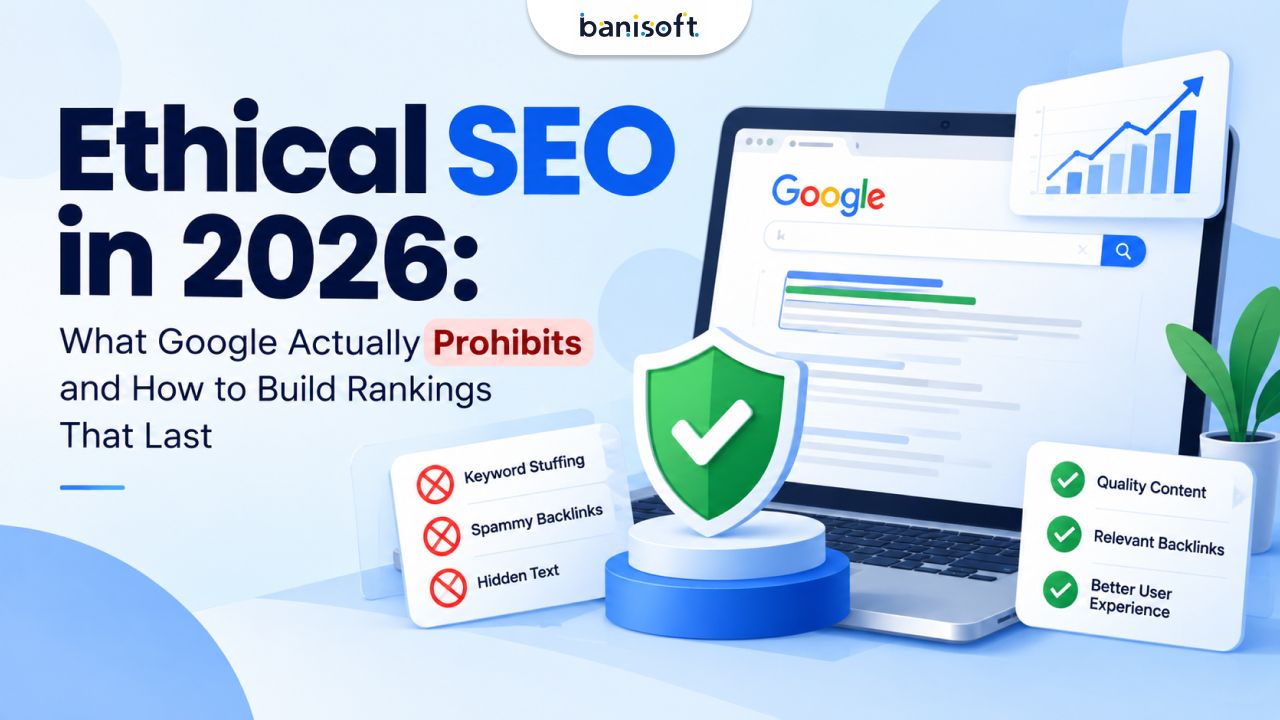
Key Takeaways
- Ethical SEO is broader than simply “white hat SEO.” It means improving visibility without misleading users, manipulating ranking systems, disguising commercial relationships, or producing content primarily to exploit search algorithms.
- Google’s spam policies explicitly cover practices including cloaking, doorway abuse, keyword stuffing, link spam, scraping, scaled content abuse, expired domain abuse, hidden text, and site reputation abuse. Violations can result in lower visibility or removal from Google Search. Google Search Central — Spam Policies for Google Web Search
- AI-generated content itself is not prohibited by Google. The risk comes when generative AI or other automation is used to create large numbers of pages without adding meaningful value, particularly when the primary purpose is manipulating search rankings. Google Search Central — Guidance on Generative AI Content
- Google’s 2026 guidance for generative search specifically recommends valuable, unique, non-commodity content and warns against manufacturing pages around every possible query variation merely to influence rankings or AI responses. Google Search Central — Optimizing for Generative AI Features
- Microsoft applies a similar principle to Bing and Copilot. Its Webmaster Guidelines identify automatically generated content at scale, artificially engineered language, misleading structured data, and prompt injection intended to manipulate AI systems as practices that can reduce search or AI visibility. Microsoft — Bing Webmaster Guidelines
- Buying advertising, sponsorships, or paid placements is not inherently unethical SEO. The problem begins when the commercial relationship is disguised in an attempt to manipulate rankings. Google recommends using rel=”sponsored” for paid placements, with nofollow also accepted in appropriate circumstances. Google Search Central — Qualify Your Outbound Links
- A reputable SEO agency should never guarantee a #1 Google ranking. Google specifically cautions businesses about SEOs that guarantee rankings, use link schemes, or refuse to explain what they are doing. Google Search Central — Do You Need an SEO?
- Ethical SEO does not mean avoiding aggressive competition. It means competing through better content, stronger technical execution, legitimate authority, better user experience, smarter strategy, and measurable business outcomes rather than deception.
Introduction: Ethical SEO Is No Longer Just About Avoiding Keyword Stuffing
The old definition of ethical SEO was easy.
White hat SEO followed the rules.
Black hat SEO broke them.
That distinction worked reasonably well when the biggest arguments in SEO concerned hidden text, doorway pages, keyword stuffing, link farms, and purchased backlinks.
Search in 2026 is more complicated.
A company can now publish thousands of AI-generated articles in a matter of weeks. A respected publisher can allow unrelated third parties to publish content on its high-authority domain. Agencies can manufacture hundreds of city pages that differ by only a few sentences. Paid editorial placements can look indistinguishable from independent recommendations. Content can even be deliberately constructed to influence generative AI systems rather than help the person reading it.
Google’s policies have evolved alongside these practices. Its current spam documentation specifically addresses newer forms of abuse such as scaled content abuse, expired domain abuse, and site reputation abuse, alongside long-standing tactics such as cloaking, doorway pages, hidden text, and link manipulation. Google Search Central — Spam Policies
Some manipulative tactics may work temporarily.
That does not make them sustainable.
The better question for a business owner is no longer:
“Is this white hat or black hat?”
It is:
“Would we still be comfortable with this strategy if Google, our customers, our competitors, and our board could see exactly how it works?”
That is the standard this guide uses.
What Is Ethical SEO?
Ethical SEO is the practice of improving a website’s visibility in search engines while prioritizing users, accurately representing the business and its content, and avoiding tactics intended primarily to deceive people or manipulate search-ranking systems.
It typically includes:
- Creating genuinely useful and original content
- Matching pages to real search intent
- Making websites crawlable and technically accessible
- Improving page experience
- Using keywords naturally
- Building legitimate authority and backlinks
- Clearly identifying sponsorships and paid relationships
- Using structured data accurately
- Publishing truthful authorship and credentials
- Measuring leads, customers, sales, and other meaningful outcomes
- Following search-engine policies
Google describes SEO itself as helping search engines understand content and helping users find a website through search. Its Search Essentials separates legitimate SEO best practices from spam techniques that can lead to reduced rankings or exclusion from search results. Google Search Central — Search Essentials
Google’s people-first content guidance reinforces the same distinction. SEO is useful when applied to content designed to benefit people; problems arise when content is created primarily to attract search-engine visits rather than satisfy the audience. Google Search Central — Creating Helpful, Reliable, People-First Content
Reference image, use the heading of the section in it.
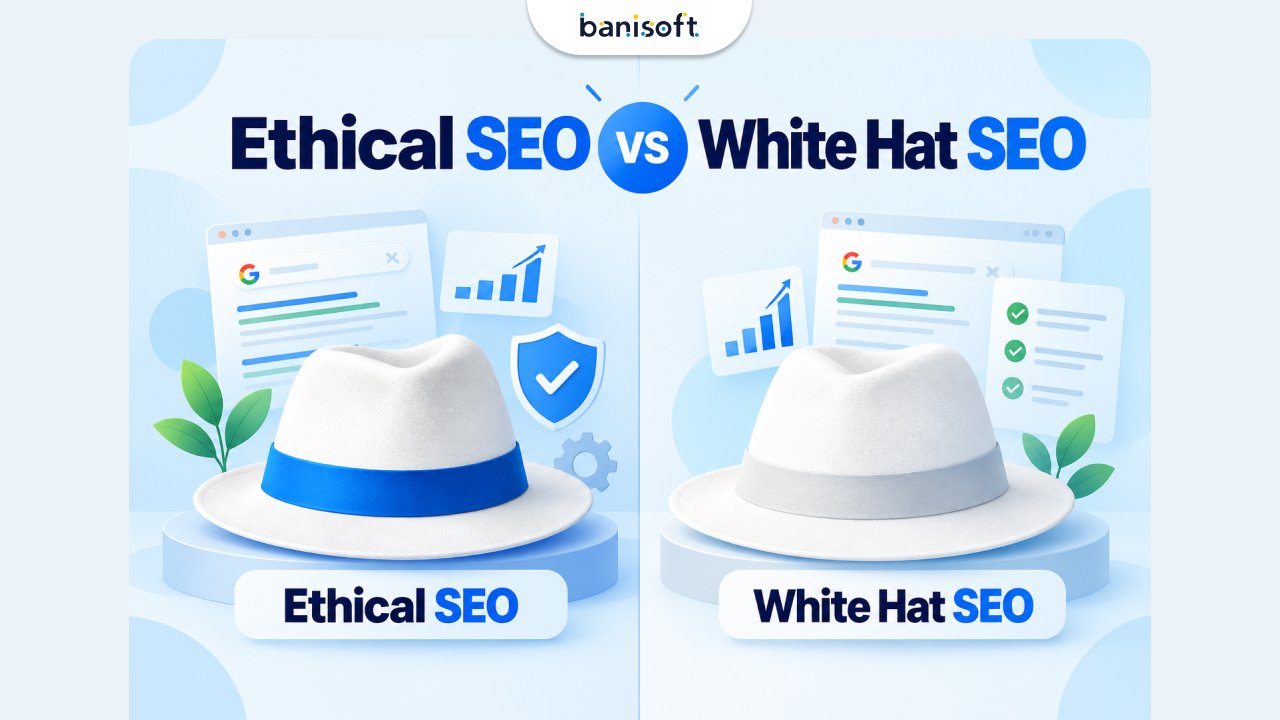
Ethical SEO and White Hat SEO Are Not Exactly the Same Thing
The terms are frequently used interchangeably.
They should not be treated as perfect synonyms.
White hat SEO usually describes techniques that comply with search-engine guidelines.
Ethical SEO asks a wider question about how those techniques affect users, clients, publishers, competitors, and the wider information ecosystem.
Something can therefore sit in a grey area without being explicitly prohibited in a Google policy.
For example:
- Publishing an article because a keyword has traffic potential is perfectly reasonable. Publishing hundreds of shallow articles outside your area of expertise merely because an SEO tool found traffic opportunities is something different.
- Paying a legitimate publication for advertising is normal. Hiding the payment so the resulting link looks like an independent editorial recommendation is not.
- Using AI to organize research or help draft an expert article can increase efficiency. Publishing thousands of untouched AI articles because content has become inexpensive changes the risk.
- Creating separate pages for locations you genuinely serve can improve user experience. Changing only the city name across fifty nearly identical pages can move the same strategy toward doorway abuse.
Google itself recommends asking whether content provides original information, meaningful analysis, substantial coverage, demonstrable experience, and a satisfying experience for the reader. Google Search Central — People-First Content Guidance
This is why the old white-hat-versus-black-hat framework is increasingly inadequate.
The better framework is value, transparency, intent, and risk.
The 2026 Rulebook: What Search Engines Actually Prohibit
Google does not publish a document called “Ethical SEO Guidelines.”
It publishes something more useful: Search Essentials and detailed spam policies.
Google states that websites violating these policies can rank lower or disappear from search results altogether. Google Search Central — Search Essentials
The most relevant practices for businesses in 2026 include:
|
Practice |
What It Looks Like |
Why It Is a Problem |
|
Cloaking |
Showing search engines different content from users |
Misrepresents what the page actually contains |
|
Doorway abuse |
Creating numerous similar pages targeting query variations |
Produces low-value pages designed mainly to capture search demand |
|
Keyword stuffing |
Repeating keywords or locations unnaturally |
Attempts to manipulate relevance rather than improve understanding |
|
Link spam |
Buying, selling or manufacturing links for rankings |
Artificially creates authority |
|
Scaled content abuse |
Producing large quantities of low-value pages primarily for rankings |
Prioritizes manipulation over usefulness |
|
Scraping |
Republishing or lightly modifying other websites without added value |
Creates unoriginal search results |
|
Expired domain abuse |
Repurposing an expired domain primarily to exploit its previous reputation |
Artificially borrows authority |
|
Site reputation abuse |
Using third-party content primarily to exploit a host site’s ranking signals |
Allows unrelated content to benefit from authority it did not earn |
|
Hidden text or links |
Hiding keyword-rich information or links from users |
Gives search engines signals users cannot reasonably see |
|
Misleading structured data |
Using markup that inaccurately represents page content |
Attempts to obtain search treatment under false premises |
|
Hacked content |
Injecting pages, links, code or redirects without authorization |
Harms users and manipulates the host website |
Google’s current spam-policy documentation defines these practices in detail. Google Search Central — Spam Policies for Google Web Search
The pattern worth noticing is that modern policies increasingly focus on why something was created and whether it adds value, rather than whether one particular piece of software or technique was used.
The Biggest Ethical SEO Issue in 2026: Scale Without Value
Generative AI has made content production dramatically cheaper.
It has not made expertise dramatically cheaper.
That distinction explains one of the biggest changes in modern SEO.
Google does not say AI-generated content is automatically against its guidelines.
Google specifically says generative AI can be useful for researching a topic and adding structure to original content. It also warns that using generative AI or similar tools to create many pages without adding value can violate its scaled content abuse policy. Google Search Central — Guidance on Using Generative AI Content
Google defines scaled content abuse around the primary purpose of producing many pages to manipulate rankings rather than help users. Its examples include generative AI pages without added value, scraped or transformed feeds, content stitched together from other pages, multiple sites used to hide the scale of production, and pages containing search keywords but little useful meaning. Google Search Central — Scaled Content Abuse Policy
The important distinction is that the policy is not limited to AI.
Low-value content at scale can be produced by:
- AI systems
- Human writers
- Scraping tools
- Translation tools
- Content spinning systems
- Outsourcing networks
- Combinations of all of them
The issue is the value and intent behind the output.
A Better AI Content Test
Before publishing AI-assisted content, ask:
- Does someone with genuine knowledge of the subject review it?
- Does it contain insights a generic language model would struggle to provide?
- Are important factual claims checked against primary sources?
- Does the article accurately represent our real experience?
- Would we still publish this page if it generated no Google traffic?
- Is it meaningfully better or different from what already exists?
- Can we confidently attach a real person’s name to it?
Google’s 2026 generative-search guidance encourages publishers to create content based on genuine knowledge and experience rather than simply recycling what already exists or what could easily be generated by an AI model. Google Search Central — Generative AI Optimization Guide
If several answers above are no, the problem is not simply that AI was involved.
The problem is that the content may not deserve to exist.
Reference image, use the heading of the section in it.
Ethical SEO for AI Overviews, AI Mode and Generative Search
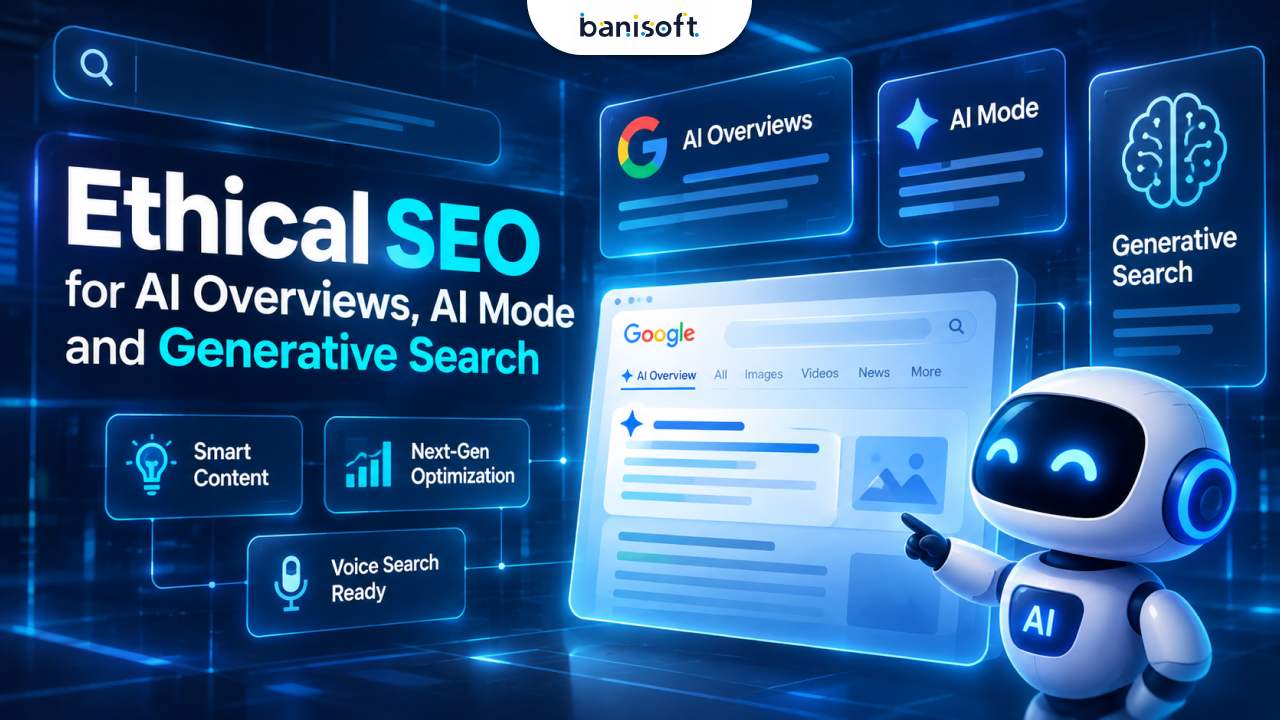
One of the more ironic developments in SEO is that companies are now being sold questionable shortcuts for appearing in AI results while Google itself is advising businesses not to chase shortcuts.
In May 2026, Google published dedicated guidance for optimizing websites for generative AI features including AI Overviews and AI Mode. The guidance emphasizes valuable, unique, non-commodity content and states that established SEO best practices remain foundational to success in generative search. Google Search Central — New Generative AI Search Guidance, May 2026
Google’s detailed guidance says businesses should prioritize:
- Unique viewpoints
- First-hand experience
- Non-commodity information
- Useful images and video where appropriate
- Strong existing SEO fundamentals
- Content created around what visitors actually want
Google also cautions against creating separate pages for every possible variation of a search or “fan-out” query primarily to manipulate rankings or generative AI responses. Google Search Central — Optimizing for Generative AI Features
That is important.
The future of AI visibility is unlikely to be won by creating another layer of thin “GEO pages.”
It will be won by becoming a source worth retrieving.
Microsoft Is Making the Same Shift
Microsoft’s Bing Webmaster Guidelines now explicitly connect traditional SEO with visibility across Bing Search, Copilot, grounding results and AI citations.
Microsoft says the same crawling, indexing and content-quality foundations used in traditional SEO also support eligibility for AI-generated experiences. Microsoft — Bing Webmaster Guidelines
Its guidelines also explicitly identify several AI-era abuses:
- Automatically generated content at scale
- Artificially engineered language
- scraped content without meaningful added value
- misleading structured data
- prompt injection
- content deliberately constructed to manipulate AI systems
That final point is particularly important.
Search manipulation is beginning to expand beyond manipulating rankings.
It can now include attempting to manipulate the AI system constructing the answer itself.
AI Citation Tracking Is Becoming Measurable
In February 2026, Microsoft introduced AI Performance in Bing Webmaster Tools, showing publishers how often their URLs are cited across Microsoft Copilot, AI-generated Bing summaries, and supported partner experiences. Microsoft Bing — AI Performance in Bing Webmaster Tools
The reporting includes:
- Total citations
- Average cited pages
- Grounding queries
- Page-level citation activity
- Citation trends
Microsoft also recommends improving content depth, expertise, structure, clarity, evidence, and freshness when evaluating opportunities to earn more citations.
Clear headings, tables, FAQs, examples, evidence, and cited sources are specifically highlighted as ways to make information easier for AI systems to understand and reference accurately. Microsoft Bing — AI Performance Guidance
This is one reason citations like those used throughout this article matter.
They are useful for readers first, but they also make important factual claims easier to verify.
Reference image, use the heading title & principle heading in each box.
8 Principles of Ethical SEO in 2026
Principle 1: Create Content for a Real Audience Before Creating It for a Keyword
Keyword research is useful.
Keyword worship is not.
A query tells you demand exists. It does not automatically mean your business needs to publish a page about it.
Google recommends asking whether your website has an existing or intended audience that would find the content useful even if they reached it directly rather than through search. It also warns against entering unrelated topics primarily because they appear to offer search traffic. Google Search Central — Helpful, Reliable, People-First Content
Before assigning a topic, ask:
Why is our company qualified to answer this question?
A cybersecurity company writing about ransomware has a reason.
A dental clinic writing about dental implants has a reason.
A digital marketing agency writing about search algorithms has a reason.
A furniture retailer publishing “Best Online Casinos in Canada” because an SEO platform reports high search volume probably does not.
Topical relevance is more than a ranking tactic.
It establishes what your brand actually knows.
Principle 2: Add Experience That Cannot Be Commoditised
Generic information is becoming inexpensive.
Experience is not.
Google’s quality guidance asks whether content provides original information, reporting, research or analysis and whether it demonstrates actual experience or expertise. Google Search Central — People-First Content Self-Assessment
Google makes the same point in its 2026 AI-search guidance: a first-hand review or a genuine point of view provides information that simple summaries of existing material cannot. Google Search Central — Create Valuable, Non-Commodity Content
Instead of writing:
“SEO helps businesses increase organic traffic.”
Explain:
- What changed after redesigning an internal-linking structure
- What happened when cannibalizing URLs were consolidated
- Which technical improvements produced no measurable impact
- Where rankings increased but leads did not
- How lead quality changed after mapping search intent
- What years of working across different markets have taught you
The internet already has definitions.
What becomes harder to commoditize is evidence.
Principle 3: Earn Authority Instead of Manufacturing It
Links remain useful because genuine links can represent recommendations between websites.
That makes them attractive targets for manipulation.
Google’s spam policies classify links created primarily for manipulating search rankings as link spam. Examples include buying ranking links, excessive link exchanges, automated link creation, and large-scale article campaigns intended mainly to generate optimized links. Google Search Central — Link Spam Policy
That does not mean every commercial link is forbidden.
Advertising exists.
Sponsorship exists.
Affiliate partnerships exist.
Paid editorial collaborations exist.
Google recommends marking links that are advertisements or paid placements with rel=”sponsored”. nofollow remains acceptable for paid links, although Google says sponsored is preferred. Google Search Central — Qualifying Paid Links
The ethical question is not:
“Did money change hands?”
It is:
“Are we disguising that commercial relationship in order to manipulate search authority?”
Principle 4: Do Not Manufacture Location Relevance
One of the most common local SEO problems is a legitimate strategy pushed until it becomes spam.
A company serving Toronto, Mississauga, Brampton, Oakville, Burlington and Hamilton may reasonably create useful location pages if its services, availability, examples, FAQs, directions, team information or local experience differ by market.
That is local SEO.
Creating hundreds of pages in which only the location name changes is different.
Google defines doorway abuse as sites or pages created to rank for specific, similar search queries while ultimately funneling users toward essentially the same destination. Google Search Central — Doorway Abuse Policy
Before creating a location page, ask:
What can we include on this URL that makes it genuinely more useful to someone in this location than our generic service page?
If there is no good answer, you may not need the page.
Principle 5: Make Technical SEO Serve Accessibility and Understanding
Technical SEO is sometimes portrayed as manipulating machines.
Good technical SEO does the opposite.
It removes obstacles.
Google describes SEO as helping search engines understand content and helping users discover a website. Google’s developer guidance recommends making sites secure, fast, accessible and usable across devices. Google Search Central — SEO Guide for Web Developers
That includes:
- Crawlable navigation
- Sensible architecture
- Accurate canonical tags
- Correct redirects
- Appropriate HTTP status codes
- XML sitemaps
- Mobile usability
- Page performance
- Indexation controls
- Internal linking
- Descriptive titles
- Accessible images
- Structured data
There is nothing unethical about making your website easier for search engines to understand.
The line is crossed when implementation intentionally gives search engines a misleading version of reality.
Principle 6: Use Structured Data to Describe Reality, Not Invent It
Structured data helps machines understand what a page contains.
Depending on the page, schema can describe:
- The author
- Publication dates
- Organization information
- Products
- Breadcrumbs
- Business details
- Events
- Videos
- Other structured entities
But markup should accurately represent the content users can actually see.
For a blog article, Google supports Article, NewsArticle, and BlogPosting markup and recommends properties including headline, author, author.url, datePublished, dateModified, and representative images. Google Search Central — Article Structured Data
Do not invent:
- Reviews
- Ratings
- Authors
- Credentials
- Prices
- Products
- Availability
simply because a schema property exists.
The markup should describe reality rather than manufacture it.
Principle 7: Be Transparent With Clients About What SEO Can and Cannot Do
Ethical SEO is not only about websites.
It is also about how SEO is sold.
Google’s own hiring guide warns businesses that irresponsible SEO can damage a website and its reputation. It specifically cautions against providers involved in link schemes and other tactics that violate spam policies. Google Search Central — Do You Need an SEO?
Google also makes clear that third-party SEO tools and providers do not have access to Google’s internal ranking data and cannot guarantee search performance. Google Search Central — Third-Party SEO Tools and Advice
A serious SEO provider should be willing to explain:
- What it intends to change
- Why the change is recommended
- What evidence supports it
- What risks are involved
- What is being measured
- What has not worked
- What comes next
SEO should not require secrecy to look impressive.
Principle 8: Measure Business Outcomes, Not Just Ranking Activity
An SEO campaign can comply with every Google policy and still fail commercially.
Traffic is not automatically success.
Rankings are not automatically success.
Backlinks are not automatically success.
At Banisoft, this is where we connect ethical SEO to our broader Profit-Centric Acceleration approach.
Depending on the company, SEO should eventually contribute to:
- Qualified enquiries
- Appointment bookings
- Ecommerce purchases
- Demo requests
- Phone calls
- Store visits
- Sales pipeline
- Customer acquisition
- Revenue
That changes how search strategy is evaluated.
A keyword receiving 100 searches each month but carrying strong purchase intent may matter considerably more than an informational keyword receiving 10,000 searches.
A page ranking third and generating customers can be substantially more valuable than twenty pages ranking first for questions that never generate commercial interest.
Ethical SEO should also be accountable SEO.
Ethical SEO vs. Risky SEO: A Practical Comparison
|
Area |
Ethical Approach |
Risky / Manipulative Approach |
|
Keyword research |
Understand demand and intent |
Create pages for every possible keyword variation |
|
Content |
Expert-led, useful and differentiated |
Mass-produced commodity content |
|
AI |
Research and productivity with expert oversight |
Thousands of unreviewed pages created primarily for rankings |
|
Links |
Earn legitimate editorial references and disclose sponsorships |
Buy disguised ranking links |
|
Local SEO |
Useful differentiated location pages |
Near-identical doorway pages |
|
Schema |
Describe visible content accurately |
Invent ratings, authors, FAQs or reviews |
|
Internal linking |
Clarify relationships and help navigation |
Inject excessive keyword-rich anchors |
|
Reporting |
Connect visibility to leads and revenue |
Report vanity metrics without commercial context |
|
Agency promises |
Explain uncertainty and realistic expectations |
Guarantee rankings |
|
Content updates |
Update when information materially changes |
Change dates simply to manufacture freshness |
|
AI visibility |
Improve authority, evidence and structure |
Chase prompt tricks and artificial GEO hacks |
Google’s guidance specifically warns against changing publication dates simply to make unchanged content appear fresh, producing large quantities of content primarily for search traffic, and creating pages around every possible query variation. Google Search Central — Helpful Content Guidance
Reference image, use the heading title in the image
Can Black Hat SEO Still Work?
Yes.

That is important to acknowledge.
If manipulative SEO techniques never produced results, nobody would use them.
The issue is their risk profile.
Some businesses deliberately operate disposable websites, exploit temporary ranking opportunities, generate revenue, lose the domain, and start again.
That may be an intentional business model.
It is usually a poor risk profile for:
- Healthcare organizations
- Law firms
- SaaS companies
- Ecommerce brands
- Financial companies
- Local businesses
- Established professional services
- Companies investing heavily in brand equity
Google states clearly that meeting Search Essentials does not guarantee indexing or rankings, while violations of spam policies can result in reduced visibility or complete omission from results. Google Search Central — Search Essentials
A disposable affiliate website and a 15-year-old company domain do not have the same risk tolerance.
The useful question therefore is not:
“Can this technique increase rankings?”
It is:
“Would the potential gain justify risking years of accumulated authority and business reputation?”
For established businesses, the answer is usually no.
The Hidden Cost of Cheap SEO
Cheap SEO is not automatically bad SEO.
Expensive SEO is not automatically good SEO.
The problem begins when the economics of an engagement make meaningful quality almost impossible.
Imagine an SEO company charging $300 per month while promising:
- 20 articles
- 200 backlinks
- Technical SEO
- Keyword research
- Reporting
- Competitor analysis
- On-page optimization
The numbers should immediately raise questions.
Something probably needs to be automated, templated, fabricated, heavily outsourced, or performed with minimal review.
Businesses should therefore examine how the work is produced, not just how many deliverables appear in a proposal.
Twenty worthwhile backlinks are very different from twenty backlinks.
Four expert articles are very different from four articles.
One technically meaningful correction can create more value than resolving hundreds of low-priority warnings generated by an automated auditing platform.
Volume is one of the easiest SEO metrics to sell.
It is also one of the easiest to manipulate.
How to Evaluate an SEO Agency Before Giving It Access to Your Website
Google recommends researching the potential advantages and risks of an SEO provider before hiring one. It notes that responsible SEOs can provide valuable services but irresponsible providers can damage both visibility and reputation. Google Search Central — Hiring an SEO
Ask these questions.
1. Can You Explain Exactly How You Build Backlinks?
Weak answer:
“We have proprietary relationships.”
Better answer:
“We use digital PR, relevant editorial outreach, partnerships, resource promotion and legitimate industry placements. Commercial placements are identified appropriately.”
2. Do You Guarantee Rankings?
The correct answer should be no.
An agency can guarantee:
- Agreed deliverables
- Reporting
- Research
- Execution
- Communication
It cannot control Google.
Google explicitly says there are no secrets that automatically rank a website first and warns that third-party SEO predictions do not guarantee performance. Google Search Central — SEO Starter Guide
3. How Do You Use AI to Produce Content?
Look for a workflow involving:
- Research
- Search-intent analysis
- Expert input
- Fact checking
- Human editing
- Source verification
- Brand review
Google permits the productive use of generative AI but warns specifically against generating many pages without adding meaningful value. Google Search Central — Generative AI Content Guidance
4. What Happens If Traffic Increases but Leads Do Not?
This question separates SEO execution from business strategy.
An experienced team should investigate:
- Search intent
- Query quality
- Page relevance
- Conversion paths
- Calls to action
- User experience
- Tracking
- Geographic traffic
- Service alignment
rather than merely reporting that traffic increased.
5. Will I Know Exactly What You Changed?
You should.
Your SEO provider should be able to document:
- Pages created
- Pages modified
- Technical changes
- Redirects
- Links acquired
- Content consolidated
- Schema added
- Issues identified
Your website should never become a black box.
What Happens If Google Detects Manipulative SEO?
Businesses often confuse algorithmic ranking changes with manual actions.
They are not the same thing.
Algorithmic Systems
Google uses automated systems to crawl, index, rank and detect spam.
Google states that even technically eligible pages are not guaranteed to be crawled, indexed or served in results. Quality, relevance and spam policies can all affect whether a page appears. Google Search Central — How Google Search Works
A website can therefore lose rankings without receiving a manual-action notification.
Manual Actions
Google can also apply a manual action after human review.
Website owners can check Google Search Console to determine whether a manual action exists.
This distinction matters because of a common misconception:
You do not submit a reconsideration request every time organic traffic falls.
First determine why visibility changed.
How to Recover From a History of Unethical SEO
If a previous agency used questionable techniques, do not begin by deleting everything.
Begin by establishing evidence.
Step 1: Check Google Search Console
Review:
- Manual Actions
- Security Issues
- Indexing
- Search performance
- Links
Determine whether Google has documented a specific issue.
Step 2: Audit What Was Actually Done
Look for:
- Doorway pages
- Hidden content
- Purchased ranking links
- Large-scale low-quality pages
- Hacked pages
- Suspicious redirects
- Expired-domain strategies
- Scraped or copied content
- Artificial anchor-text patterns
- Misleading structured data
Many of these tactics are specifically covered by Google’s current spam policies. Google Search Central — Spam Policies
Step 3: Separate Low Quality From Actual Spam
A mediocre article is not automatically a spam-policy violation.
Do not destroy potentially useful assets because an automated SEO tool labels them “thin.”
Evaluate each page according to:
- Purpose
- Rankings
- Traffic
- Backlinks
- Conversions
- Originality
- Relevance
- Search intent
Step 4: Correct Genuine Violations
Where appropriate:
- Remove manipulative content
- Improve low-value pages
- Correct misleading implementation
- Fix hacked content
- Remove participation in link schemes
- Consolidate doorway pages
- Remove deceptive structured data
- Correct redirects
Step 5: Submit a Reconsideration Request Only When Relevant
If Google Search Console shows a manual action and you have fixed the underlying issue, document:
- What happened
- What you corrected
- What safeguards you introduced
Do not submit a reconsideration request simply because rankings declined.
Step 6: Rebuild the Value the Manipulation Was Trying to Imitate
Replacing 5,000 bad backlinks with another 5,000 questionable backlinks is not recovery.
Build the signals the previous strategy was attempting to manufacture:
- Genuine expertise
- Helpful content
- Legitimate citations
- Real editorial links
- Recognizable authors
- Strong technical architecture
- Brand demand
- Satisfied customers
Recovery is usually more difficult than prevention.
Reference image: use the heading title in the image.
Ethical SEO in the Age of AI Search: What Changes and What Does Not
AI changes how information is surfaced.
It does not remove the need for trustworthy information.
It may increase it.
An AI system assembling a synthesized answer needs information that can be retrieved, understood and grounded in reliable sources.
Microsoft describes grounding as an increasingly important layer connecting generative models with information from the open web. Microsoft Bing — The Role of Grounding on the AI Web
Microsoft’s February 2026 AI Performance guidance recommends strengthening:
- Content depth
- Expertise
- Page structure
- Evidence
- Freshness
- Clarity
It also specifically notes that clear headings, tables and FAQ sections can make information easier for AI systems to reference accurately. Microsoft Bing — AI Performance in Webmaster Tools
Google reaches essentially the same destination from a different angle: focus on unique, useful, non-commodity content and continue applying proven SEO fundamentals rather than chasing artificial AI hacks. Google Search Central — Generative AI Search Optimization Guide
The lesson is straightforward:
Structure information so machines can understand it, but create it because humans need it.
That is a much more sustainable definition of GEO.
An Ethical SEO Checklist for Business Owners
Before approving an SEO tactic, ask these twelve questions:
|
Question |
Yes = Good Signal |
|
Would this still benefit visitors if search engines did not exist? |
✓ |
|
Can we explain why this page genuinely needs to exist? |
✓ |
|
Is the content materially different from what is already available? |
✓ |
|
Does someone qualified review important claims? |
✓ |
|
Are authoritative sources cited where verification matters? |
✓ |
|
Are sponsored relationships clearly identified? |
✓ |
|
Does structured data accurately represent visible content? |
✓ |
|
Are location pages genuinely differentiated? |
✓ |
|
Could we publicly explain our link-building strategy? |
✓ |
|
Does our SEO provider explain rather than hide its techniques? |
✓ |
|
Are leads, customers or revenue measured alongside rankings? |
✓ |
|
Would we continue the strategy if Google announced a spam update tomorrow? |
✓ |
Google’s own people-first self-assessment uses a similar principle: determine whether your content offers original value, demonstrates expertise, satisfies readers, and exists primarily to serve an audience rather than attract search-engine visits. Google Search Central — People-First Content Self-Assessment
If several answers in the table are no, investigate before moving ahead.
What Our Original Ethical SEO Article Got Wrong
Our original article was directionally correct.
It emphasized:
- Quality content
- Natural links
- User experience
- Technical SEO
- Agency transparency
Those principles still stand.
But search has changed quickly.
The old approach treated ethical SEO largely as a static set of “white hat techniques.”
The modern challenge is broader.
AI makes low-quality content infinitely more scalable.
Publishers can monetize authority in ways that blur editorial independence.
AI answer systems create incentives to manipulate not only rankings but machine-generated recommendations.
Google’s policies are now far more explicit about newer issues such as scaled content abuse, expired domain abuse and site reputation abuse. Google Search Central — Current Spam Policies
And both Google and Microsoft are now publishing specific guidance about content visibility inside generative search experiences. Google Search Central — AI Optimization Guide Microsoft — Bing Webmaster Guidelines
Ethical SEO therefore needs to become an operating principle, not a checklist.
Frequently Asked Questions About Ethical SEO
What is ethical SEO?
Ethical SEO is the practice of improving search visibility without deceiving users or manipulating search engines through spam tactics. It emphasizes useful content, transparent commercial relationships, accurate technical implementation, legitimate authority building, and sustainable business value.
Is ethical SEO the same as white hat SEO?
The terms are commonly used interchangeably, but ethical SEO is broader. White hat SEO normally refers to techniques that comply with search-engine guidelines. Ethical SEO also considers transparency, client interests, user experience, editorial integrity, and long-term business risk.
Is AI-generated content against Google’s guidelines?
No. Google says generative AI can be useful for research and structuring original content. Using AI or other automation to create many pages without adding value, particularly for the purpose of manipulating rankings, can violate Google’s scaled content abuse policy. Google Search Central — AI-Generated Content Guidance
Is buying backlinks unethical SEO?
Buying advertising or legitimate sponsorship is not inherently unethical. Attempting to disguise a paid link as an independent editorial endorsement in order to manipulate ranking signals creates the problem. Google recommends identifying paid placements with rel=”sponsored” and also accepts nofollow where appropriate. Google Search Central — Qualify Outbound Links
What are the most common black hat SEO techniques?
Google’s current spam policies cover tactics including cloaking, doorway abuse, hidden text, keyword stuffing, link spam, scraping, scaled content abuse, expired domain abuse and site reputation abuse. Google Search Central — Spam Policies
Can black hat SEO still improve rankings?
Sometimes, particularly temporarily. The problem is the risk. Manipulative signals can eventually be discounted, and policy violations can reduce search visibility or result in removal from results. Google Search Central — Search Essentials
Can Google permanently ban a website for unethical SEO?
Google states that serious spam-policy violations can cause pages or entire websites to rank lower or be omitted from search results. The consequences and recovery path depend on the violation and whether enforcement is algorithmic or manual. Google Search Central — Spam Policies
How do I know whether my SEO agency is using risky tactics?
Ask the agency to explain how it produces content, builds backlinks, uses AI, creates location pages, implements technical changes and measures results. Google recommends researching SEO providers carefully because irresponsible SEO can damage both website visibility and reputation. Google Search Central — Hiring an SEO
Does ethical SEO take longer?
Not necessarily for every tactic. Technical improvements, search-intent corrections, internal linking and on-page improvements can sometimes produce faster changes. Building genuine authority, editorial links, expertise and brand recognition typically requires sustained effort.
Is keyword optimization unethical?
No. Using language your customers search for helps people and search engines understand a page. Problems begin when keywords are repeated unnaturally or pages are manufactured simply to target variations without adding value. Google specifically classifies keyword stuffing as spam. Google Search Central — Keyword Stuffing Policy
Is GEO different from ethical SEO?
Generative Engine Optimization focuses on how content becomes eligible for discovery, grounding and citation within AI-generated experiences. Microsoft explicitly describes GEO in this context while noting that traditional SEO fundamentals continue to support AI visibility. Microsoft — Bing Webmaster Guidelines
Do I need special schema to appear in Google AI Overviews?
Google’s 2026 guidance emphasizes normal SEO fundamentals, technical accessibility, useful content and existing structured-data practices rather than special AI-only markup. Google Search Central — Generative AI Search Optimization Guide
Can an SEO agency guarantee AI citations or recommendations?
No credible provider can guarantee citations from Google AI Overviews, AI Mode, Bing Copilot or another independent generative system. Microsoft explicitly states that GEO does not guarantee grounding or citations, just as SEO cannot guarantee rankings. Microsoft — Bing Webmaster Guidelines
Where to Start
If you are a business owner, you do not need to memorize every Google spam policy.
Start with one question:
Can your SEO provider explain exactly what it is doing and why it benefits your customers?
Then examine four areas.
- Content: Is it useful enough to carry your company’s name?
- Links: Are they legitimate recommendations or manufactured ranking signals?
- Technical SEO: Is it helping search engines understand the real website, or showing them something artificial?
- Reporting: Is SEO improving meaningful business outcomes, or simply producing more activity?
Google’s own advice to businesses is to research SEO providers carefully and understand what they intend to do before handing over responsibility for a website. Google Search Central — Do You Need an SEO?
Ethical SEO does not mean being passive.
Compete aggressively.
Build better pages.
Answer more useful questions.
Develop stronger tools.
Publish original research.
Earn links competitors cannot simply buy.
Fix technical problems faster.
Improve conversion rates.
Understand customer intent more deeply.
Build the strongest source in your market.
Just do it in a way you would still be willing to defend when the algorithm changes.
That is how sustainable search visibility is built.
If you are unsure whether your current strategy contains risky SEO, duplicate content, low-value AI pages, questionable backlinks, or missed opportunities, Banisoft can review the campaign before you invest further.
Our SEO approach connects traditional search, AI visibility, content, technical SEO and conversion strategy to the metric that eventually matters most: whether search contributes to meaningful business growth.
[Talk to Banisoft about an SEO audit or growth strategy.]
Sources
- Google Search Central — Spam Policies for Google Web Search. Covers cloaking, doorway abuse, keyword stuffing, link spam, scaled content abuse, expired domain abuse, site reputation abuse, hidden text and other spam techniques. Spam Policies for Google Web Search
- Google Search Central — Google Search Essentials. Google’s core technical requirements, spam policies and search best practices. Google Search Essentials
- Google Search Central — Creating Helpful, Reliable, People-First Content. Google’s guidance on originality, expertise, audience focus, search-engine-first content and content quality. People-First Content Guidance
- Google Search Central — Guidance on Using Generative AI Content on Your Website. Explains legitimate AI use and the relationship between mass AI content and scaled content abuse. Generative AI Content Guidance
- Google Search Central — Google’s Guide to Optimizing for Generative AI Features on Search, 2026. Covers non-commodity content, first-hand perspectives and the continuing importance of foundational SEO. Generative AI Search Optimization Guide
- Google Search Central Blog — A New Resource for Optimizing for Generative AI in Google Search, May 15, 2026. Introduces Google’s updated AI-search optimization guidance. Google Generative Search Announcement
- Google Search Central — Qualify Your Outbound Links to Google. Guidance for sponsored, ugc and nofollow link attributes. Qualify Outbound Links
- Google Search Central — Do You Need an SEO? Google’s guidance for businesses evaluating SEO agencies and consultants. Do You Need an SEO?
- Google Search Central — Third-Party SEO Tools and Advice, updated June 2026. Explains that third-party SEO providers do not have access to Google’s internal ranking data and cannot guarantee performance. Third-Party SEO Guidance
- Google Search Central — SEO Starter Guide. Google’s explanation of SEO fundamentals and the absence of any secret technique for guaranteed first-place rankings. Google SEO Starter Guide
- Google Search Central — How Google Search Works. Covers crawling, indexing and serving search results and explains that indexing or ranking is never guaranteed. How Google Search Works
- Google Search Central — Article Structured Data. Guidance for Article, NewsArticle and BlogPosting markup including author, headline, images, datePublished and dateModified. Article Structured Data
- Microsoft — Bing Webmaster Guidelines. Covers traditional SEO, GEO, Copilot grounding, AI citations, automatically generated content, artificial language and prompt injection. Bing Webmaster Guidelines
- Microsoft Bing Webmaster Blog — Introducing AI Performance in Bing Webmaster Tools, February 10, 2026. Covers citation measurement, grounding queries, cited pages, content structure, evidence and freshness. AI Performance in Bing Webmaster Tools
- Microsoft Bing Search Blog — Elevating the Role of Grounding on the AI Web, February 2026. Explains the role of grounding, citations and GEO in AI-driven information discovery. Grounding on the AI Web
Ethical SEO: A Moral Compass for Digital Marketers Read More »